
With the list of errors made by the National Baseball Hall of Fame getting so long as to rival the list of criminal charges fitting (insert politician of your choice here), we here at Dubsism decided there couldn’t be a better time to bring common sense back to Cooperstown.
Let’s be honest. If you’re a baseball fan, you must have at least an inkling that the Hall of Fame is interminably broken. Beside the aforementioned list of blown calls, it’s mired in the fact that the writers who cast the votes are dipshits, the “analytics” geeks are taking over, and the “Pete Rose v. The Steroid Guys” debate is now as stale as month-old ball park popcorn.
Today I’m delving into what I think is one of the biggest non-steroid snubs Cooperstown has committed; the exclusion of two-time Most Valuable Player (MVP) Dale Murphy.
Some Curious Comparisons
My initial efforts to find answers through some relevant player comparisons had the proverbial opposite effect. They just raised one crucial question. The illustration of this becomes most evident when Murphy’s Hall of Fame credentials are stacked up with those of three recently inducted players who had “get out the vote” campaigns launched on their behalf.
As it stands now, the doors to Cooperstown are closed to Dale Murphy. 2024 marked the fifth time Murphy was not elected via the Era/Veterans Committee. During his time on the official Hall of Fame ballot from 1999 to 2013, Murphy never appeared on more than 23.2% of the ballots; he didn’t even crack 15% in 1999, 2000, and 2013.
The following comparisons show that was a massive mistake.
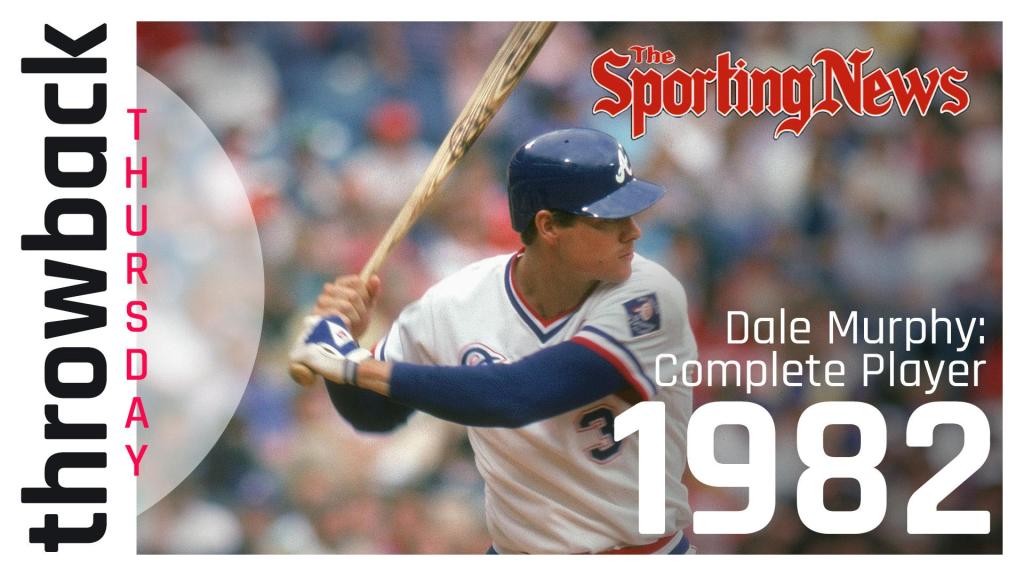
Dale Murphy vs. Edgar Martinez
This really is the “flagship” comparison. One of these guys is in the Hall of Fame, and obviously the other isn’t. One of these guys had a campaign in and around the Baseball Writer’s Association of America (BBWAA) to get him inducted into Cooperstown; the other struggled to stay on the ballot. Why was there such a disparate response by the Hall of Fame’s gatekeepers for two guys with essentially identical numbers?
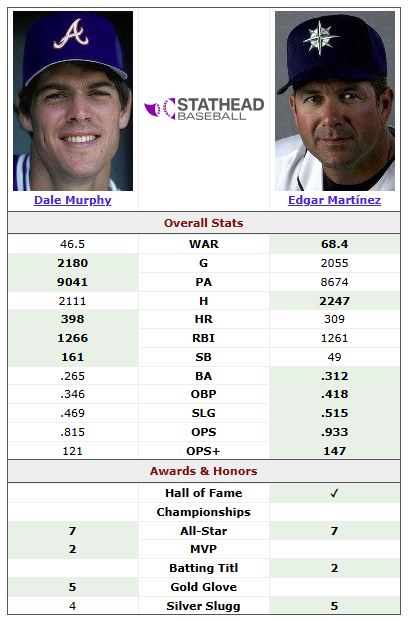
Those numbers suggest two reasons for the difference. Martinez was a darling of the SABRmetricians, it’s a split in the “traditional” numbers, but the totals are almost identical in the two categories that matter the most. Baseball games aren’t won on spreadsheets; they are won by the team that scores the most runs. The logical extension of that dictum means the guy who produces the most runs…either from the times he scored or the times he scored somebody else…would be the most valuable.

Given their identical run production totals, to me the true distinction comes in that “most valuable” phrase. Statistics are just numbers which can be interpreted any way one wants. But when those varying views form a majority opinion as to one player’s value being superior to that of every other player in the league…well, that feels like that should carry some weight towards induction into Cooperstown.
Why didn’t it in the this case?
Dale Murphy vs. Harold Baines
The “Vote Harold Baines” campaign was all about the (insert actual committee title here) “Old Timer’s” Committee understanding that “Designated Hitters” (DH) were baseball’s new “oppressed class” for being under-represented in Cooperstown.
That explains how Frank Thomas was considered a DH for playing 52% of his career games as “bat-only,” as opposed to the 84% for the 500-homer David Ortiz. They knew they really couldn’t put Martinez in ahead of Baines, but that’s exactly what the BBWAA was going to do. So the “Old Timer’s” inducted Baines, but passed over Dale Murphy in the process.
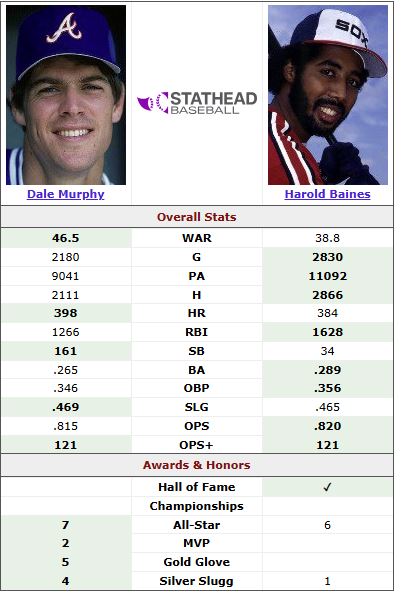
Baines’ numbers are somewhat sexier, but they should be considering he had the advantage of playing nearly 60% of his games not suffering the wear and tear of playing the field. That extended his career by four full seasons over Murphy.

Not only did Dale Murphy have the disadvantage of having played the entirety of his career in the DH-free National League, he broke into the bigs in 1976 as a catcher; easily the most brutal position on the diamond. Baines also didn’t win five Gold Gloves while destroying his knees playing center field in a world containing far too much Astroturf.
Our first comparison suggests MVPs don’t matter that much to Cooperstown’s gatekeepers. This one leads us to suspect Gold Gloves don’t either.
Dale Murphy vs. Tony Oliva
Another committee “darling,” Tony Oliva is the “poster child” for a guy who got into to Cooperstown based on an injury-shortened career including a stretch in which he was a dominant player.
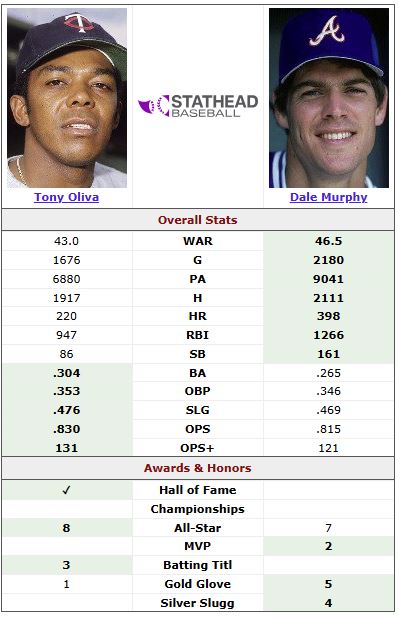
Tony Oliva was one of the best hitters of the 1960s. In the heart of his career from 1964 to 1971, he led the American League in hits five times, won three batting titles, but never finished higher than second in the MVP voting.
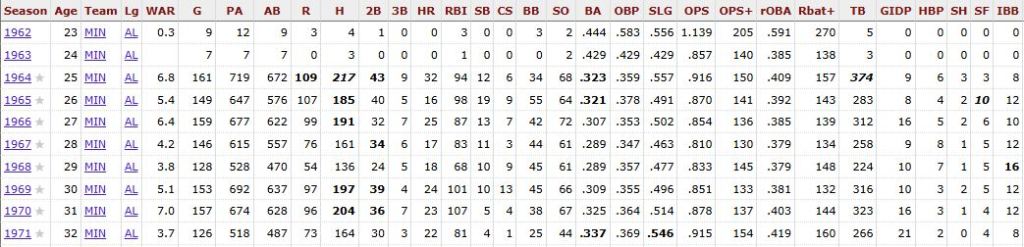
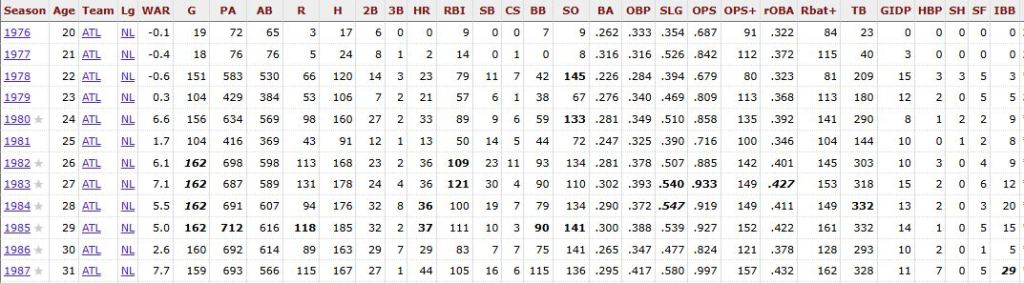
If Oliva’s eight-season span is good enough for Cooperstown, then why isn’t Murphy’s? All he did was lead National League twice in home runs, twice in runs batted in, once in runs scored, all while winning two MVP awards and finishing in the Top Ten for MVP voting four times.
When Oliva and Murphy are compared head-to-head, a similar situation occurs as it does when comparing Harold Baines to Murphy. Baines’ career ends up being ~ 4 seasons (in terms of games played) longer than Murphy’s; the same condition exists between the careers of Murphy and Oliva.

Apparently, batting tittles outweigh MVP awards…just like with Edgar Martinez.
Dale Murphy vs. The “Committees”
This is a list of all the players inducted by the “Old Timer’s” Committee (regardless of the committee’s actual name) in the last ten years. They hadn’t inducted a player with an MVP award until this year.
- 2025: Dick Allen (1), Dave Parker (1)
- 2024: None
- 2023: Fred McGriff
- 2022: Gil Hodges, Jim Kaat, Minnie Minoso, Tony Oliva, Bud Fowler, Buck O’Neil.
- 2021: None
- 2020: Ted Simmons
- 2019: Lee Smith, Harold Baines
- 2018: Jack Morris, Alan Trammell
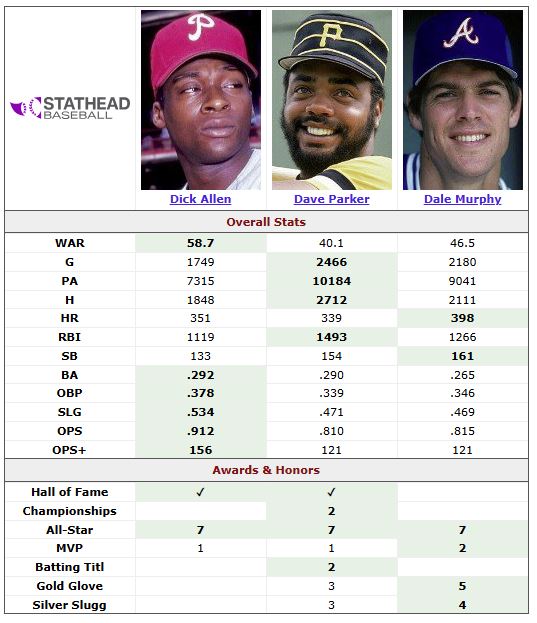
Draw your own conclusions. But it would seem a case can be made at the very least for Dale Murphy over Dick Allen…especially when it comes to our two most valuable numbers.
| Player | Runs Scored | Runs Batted In |
| Dave Parker | 1,232 | 1,493 |
| Dale Murphy | 1,197 | 1,266 |
| Dick Allen | 1,099 | 1,119 |
That’s why those numbers exist…whichever set you prefer.
Dale Murphy: The Essential Questions
1) Was there ever a time Dale Murphy could have been considered the best player in the game?
Abso-fucking-lutely.
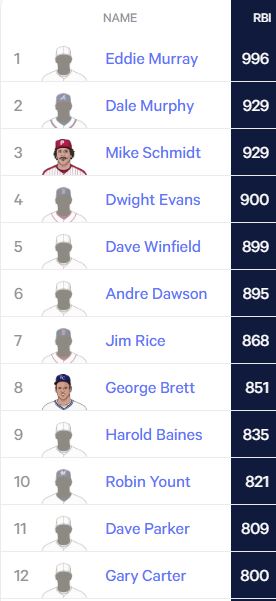
There’s simply no debating Murphy was one of the greatest players of his era. The fact that he won his two MVP awards in consecutive season suggests that in at least 1982 and 1983 he was the best player in the National League. Finishing in the Top Ten in MVP voting in four straight seasons between 1982 and 1985 locks in Murphy’s reservation in baseball’s “1st Class” for the 1980s.
When it comes to driving in runs, it took one of the game’s greatest hitters to outdo Murphy. Eddie Murray is arguably the greatest switch-hitter in baseball history, and the only one among the seven members of the 3,000-hit & 500-home run club. He’s aslo the only player ho drove in more runs in the 1980s than did Dale Murphy.
Let’s say you’d rather crunch the SABRmetrics’ numbers. In the “heart” of Murphys’s career from 1980 and 1987, he racked up a 42.2 bWAR (Baseball-Reference’s calculation for the SABRmetric “Wins Above Replacement”). Only eight players outperformed Murphy in this area (the aforementioned Eddie Murray, along with Wade Boggs, Gary Carter, Alan Trammell Rickey Henderson, Cal Ripken, Mike Schmidt, and Tim Raines), and they are all in Cooperstown.
2) Did Dale Murphy ever win a Most Valuable Player award and/or how many MVP-Caliber seasons did he have?
We’ve already discussed Murhpy’s twin NL MVPs. In addition I would say 1984 and 1985 were also years in which Murphy was clearly amongst the league’s elite. On top of that, Murphy had a total of seven seasons in which the garnered MVP votes.
3) Was there ever a time Dale Murphy could have been considered a “dominant” player?
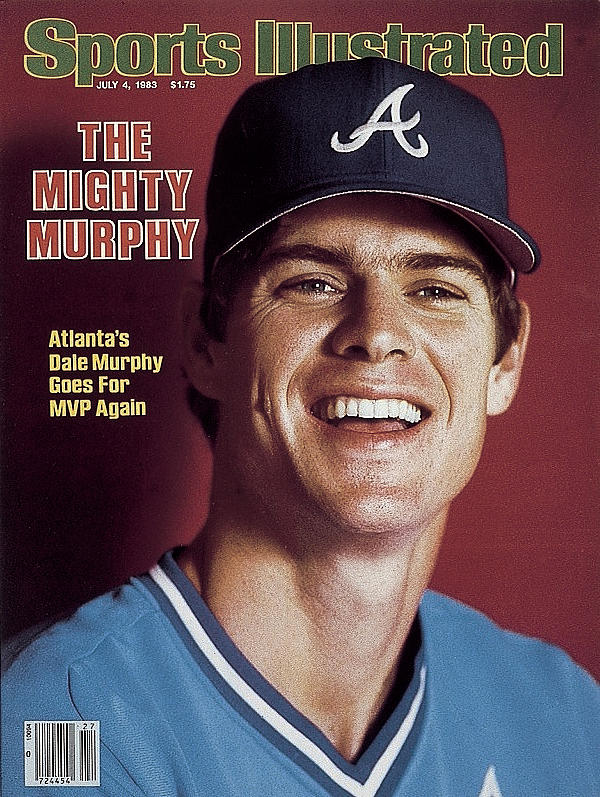
At first, this may seem like a redundancy, but the Hall of Fame is loaded with guys who can’t answer “yes” to the previous two questions. It’s safe to assume assume “dominance” applies to any player who can answer affirmatively to one; it’s set in stone for a guy like Murphy who checks both boxes.
4) What else is in Dale Murphy’s trophy case?
Murphy made seven All-Star teams; the same as Edgar Martinez, Dick Allen, and Dave Parker. He won five outfield Gold Gloves, tying Dave Winfield. Murphy was recognized as the best hitter at his position with 4 Silver Slugger awards, as many as Andre Dawson and one more than future first-ballot Hall-of-Famer Ichiro Suzuki.
5) Is Murphy the best player at his position not in the Hall of Fame?
In a word, no…but arguably because Mike Trout hasn’t retired yet. If you haven’t deduced by now, the case for Dale Murphy’s induction is complex. Because the “heart” of Murphy’s career was essentially over after his age 32 season, he comes up short in the “magic number” categories. Despite that, it’s impossible to deny Murphy was one of the best players in the game for a good chunk of the 1980s.
Since his retirement, an argument can be made as to how Murphy’s career stacks up to other center fielders like Andruw Jones, Kenny Lofton, and Carlos Beltran. For my money, I would have taken Dale Murphy in his prime over any of those guys. That’s essentially the reason this episode exists.
6) How does Dale Murphy compare to other Hall of Famers?
Murphy is so clearly locked into a baseball purgatory thanks to the BBWAA. The Hall of Famers who compare most favorable to Dale Murphy could be their own Hall of Fame for things the writers got wrong. There’s just no freakin’ way it should have taken 11 ballots to get Duke Snider into Cooperstown. Ron Santo was the best third baseman in the game during all that time I was being told Brooks Robinson was the best ever…and the Veteran’s Committee had to induct him posthumously. Gil Hodges was another Committee “Dead Guy” fix. Andruw Jones is still on the ballot, but he’s only got two years left. Frankly, I don’t think he’s getting in, and he has sexier numbers than Dale Murphy.
7) What is the main argument against Dale Murphy’s induction?
Most arguments against the induction of any player usually revolve around three key points…numbers, some sort of “ballpark bias,” and length of career. Murphy gets painted with brushes dipped in all three.
We’ve already addressed Murphy’s shortcomings when it comes to the “Magic Numbers.” We’ve already established the effect of lagging knee injuries on the latter half of Murphy’s career.
The people who want to cling to the “Magic Number” argument will also point out Murphy benefited from playing in Atlanta-Fulton County Stadium, where the ball carried so well the place was called “The Launching Pad.” That ball park was a big contributor to the fact that 70’s “Lumber Company” Atlanta Braves were the first team to feature three 40-homer hitters.
Murphy was blasting 35-ish homers in his MVP-Caliber seasons in the early 1980s when pitching dominated the game. Despite that, his detractors dismiss his power numbers as a “ball park” anomaly.
That’s total crap.
8 ) Why Should We Remember Dale Murphy?
In 1982, two baseball teams snaked their way into living rooms across America through a slim black coaxial cable. Haray Caray and the Chicago Cubs were fun, but Atlanta’s Superstation WTBS made Dale Murphy the face of the game. Thanks to cable TV, this was the first time the best player in baseball was on your TV every day.
In his heyday, Murphy was massively popular, one of the most fun players to watch, and he was the game’s most approachable and friendly superstar. Because of the visibility he had from cable TV, Murphy was seen everywhere every night. As a 13-year-old kid, I knew lots of my “sandlot” baseball buddies who after getting an eyeful of the Braves on Friday night were pretending to be Dale Murphy on Saturday afternoon.
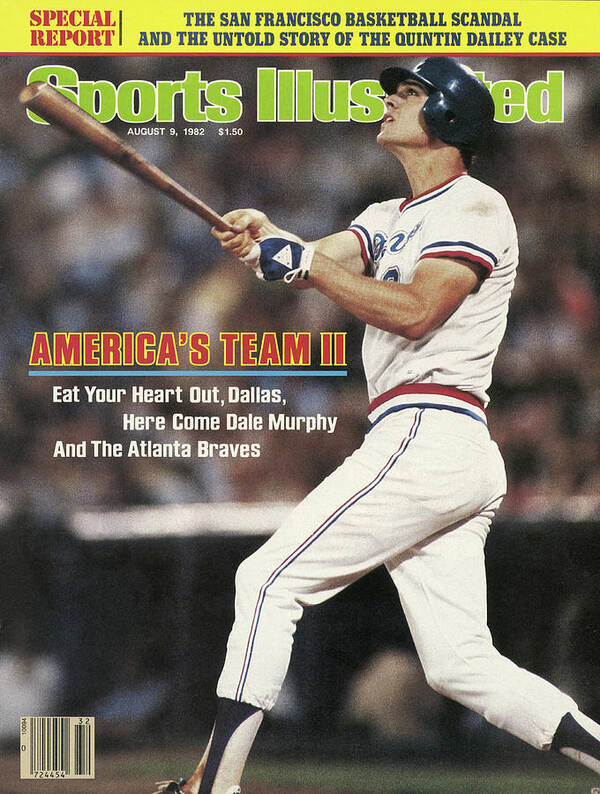
They were easy to spot. On the field, they were imitating his big “all-or-nothing” type swing. On my sandlot, he was so well-known for his opposite field power, any time somebody went yard the “other way,” everybody yelled “MURPH!”
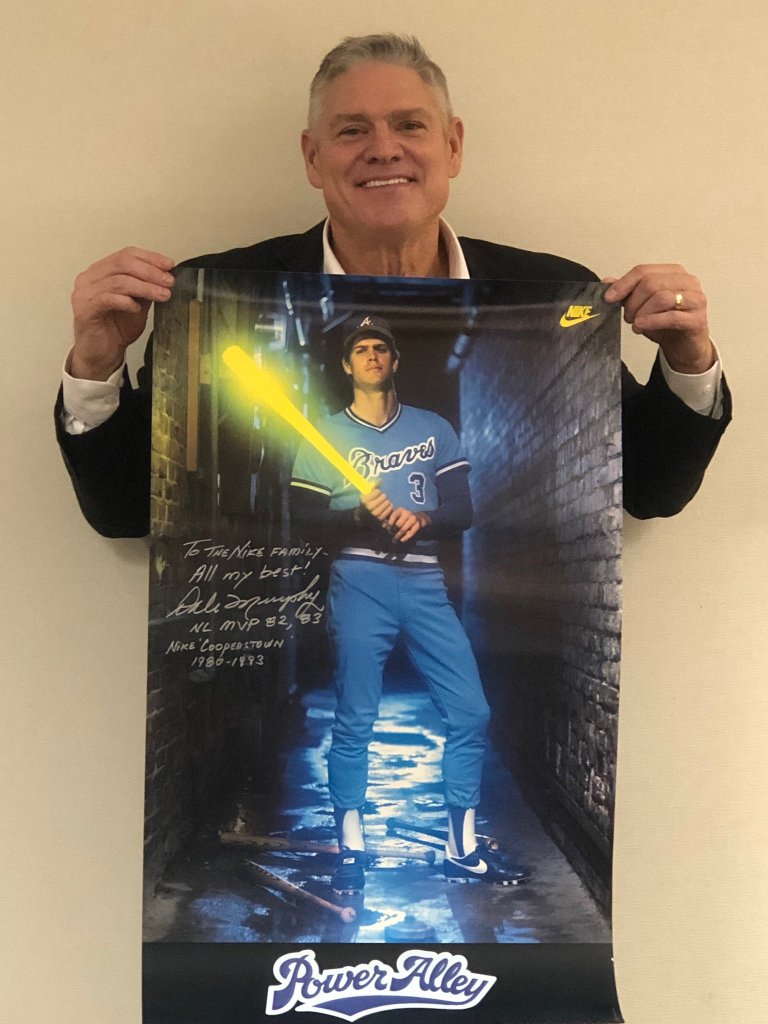
Some of the kids yelling “MURPH!” were clad in Dale Murphy t-shirt “jerseys.” They were the same ones who had his Nike poster on their walls and imitated his long, loping stride tracking down a fly ball in center field…even if they only needed two steps to corral a grounder at second base.
The Bottom Line on Dale Murphy
Dale Murphy is a member of the Oregon Sports Hall of Fame, the Georgia Sports Hall of Fame, and the World Sports Humanitarian Hall of Fame…but he’s not in Cooperstown. That’s just wrong.
In the 1980s, only Hall of Famer Mike Schmidt belted more homers, and only the aforementioned Eddie Murray drove in more runs. As for the other half of my two most valuable stats, nobody in the 1980s scored more runs than Dale Murphy…likely because nobody had more extra-base hits or more total bases than he did.
In his second MVP season, Dale Murphy became only the third player in baseball history to notch a .300 batting average, 30 home runs and 30 stolen bases. The only two to precede him were Willie Mays and Henry Aaron.
Not only are those two of the all-time greats, but that leads us to some very telling quotes about Murphy.
“I’d say he is probably the best all-around player in either league.”
~ Henry Aaron
“He’s the best I’ve ever seen, and I’ve seen Willie Mays.”
~ Chicago Cubs pitching coach Billy Connors
“I can’t imagine Joe DiMaggio was a better all-around player than Dale Murphy.”
~ Nolan Ryan
Even though the memories of Dale Murphy fade with time, the fact he was the best player in the game for at least most of the 1980s needs to be remembered. In 1985, Dale Murphy was voted as the Most Feared Hitter in the National League by opposing pitchers in a survey conducted by the Sporting News.
Just look at these lists of the “all-time” teams by decade. The list for the 1980s features two glaring omissions from Cooperstown, and even the people who made the list think Dale Murphy deserves enshrinement.
Why don’t the Hall of Fame’s gatekeepers agree?
Got a case for or against? Or perhaps you just want to yell at us? Hit us up through our Comments section, the contact form below, or at dubsism@yahoo.com, @Dubsism on Twitter, or on our Pinterest, Tumblr, or Instagram, or Facebook pages, and be sure to bookmark Dubsism.com so you don’t miss anything from the most interesting independent sports blog on the web.


 Dubsism