
- Today’s Movie: Patton
- Year of Release: 1970
- Stars: George C. Scott (#3 on my list of favorite actors), Karl Malden (#12 on my list of favorite actors), Stephen Young
- Director: Franklin J. Schaffner
This movie is on my list of essential films.
NOTE: This installment of Sports Analaogies Hidden in Classic Movies is not being done as part of a blog-a-thon. Instead, this is a monthly event hosted by MovieRob called Genre Grandeur. The way it works is every month MovieRob chooses a film blogger to pick a topic and a movie to write about, then also picks a movie for MovieRob to review. At the end of the month, MovieRob posts the reviews of all the participants.
For July of 2024, the honor of being the “guest picker” went to MovieRob himself, and the topic is “patriotic movies.”
The Story:
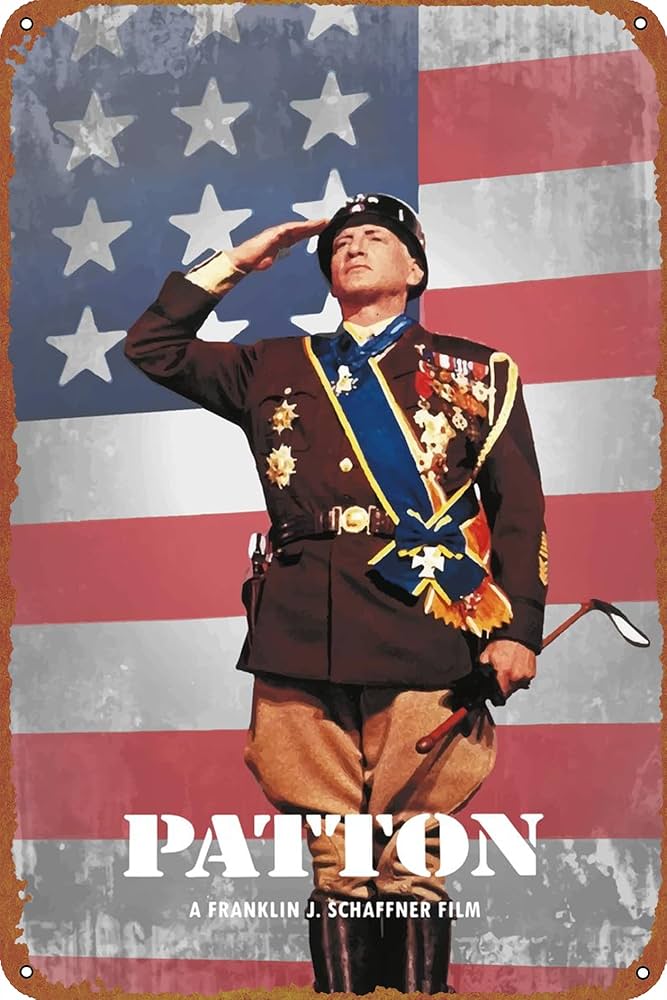
When one makes a film with a larger-than-life protagonist, having an opening befitting such a character is not merely necessary; it’s compulsory. That’s why Patton‘s iconic scene is it’s initial one. You would be hard-pressed to find a classic film fan unfamiliar with the sight of General George S. Patton (played by George C. Scott) standing before an enormous American flag delivering a soliloquy setting the tone for the next 2:52.
Resplendent in impeccable full dress uniform accessorized with a veritable battle-shield of medals and topped with a helmet of as much polish as steel, Patton’s oratory to his men heading to their trial-by-fire runs the range from stern and authoritarian to downright humorous; from reverent and insightful to outright profanity. Not only does this foreshadow the carnival ride of moods this film is, it illustrates how those oscillations are completely driven by the main character.
George C. Scott doesn’t just play Patton; he becomes the movie. While the moods might be akin to a meandering river, the constant current circulating through this film is Patton’s fervent and integral belief that war is the essential expression of the human condition. That flows unimpeded from the opening monologue to Patton’s arrival in North Africa in 1942.
The American army is reeling from a stinging defeat at the Battle Kassarine Pass; it’s aforementioned trial-by-fire against the German Afrika Korps. As a result, General Omar Bradley (played by Karl Malden) declares the Americans need to bring in their best tank commander. As expected, the larger-than-life Patton makes a befitting entrance; complete with a cloud of dust and a wailing siren.

The lackadaisical command post is not ready for the swashbuckling brand of discipline with which Patton bursts through the doors. After this bit of mood-setting, Patton dives straight-away into an assessment of his adversary; the Afrika Korps and it’s legendary kommandant Field Marshal Erwin Rommel (played by Karl-Michael Vogler). Being a student of history and a keen military strategist, Patton has great reverence for the German infantry and the battlefield tactics of Rommel.
Meanwhile, the Germans are also amassing a dossier on Patton. Like Rommel, Patton carries a considerable reputation; so much so the Germans’ respect for him is clearly tinged with fear. This is reflected in their in-depth study of Patton the man; his idiosyncrasies confusing them as to his true character. Patton the man simply doesn’t make sense to the Germans, all while they cannot discount his skill as a commander. The fact that Patton reads the Bible daily, yet “curses like a stable boy,” writes poetry, and believes in reincarnation completely befuddles the Germans. Rommel eloquently voices the German misunderstanding and trepidation of Patton by declaring “I will attack and annihilate him…..before he does the same to me.”
This proves to easier said than done. Rommel leads a Germans assault on the American positions in Tunisia while Patton watches from his command post in the hills nearby. Exclaiming that he read Rommel’s book, Patton has anticipated Rommel’s plan. As a result, Patton is able to lie in wait to ambush and annihilate Rommel’s troops. Not only does this give the American army it’s first victory, but it adds to Patton’s already sizable ego.

This sets the stage for a burgeoning rivalry between two prima donnas; Patton and his equally egotistical British counterpart, Field Marshal Sir Bernard Law Montgomery (played by Michael Bates). Because there’s only room in any stable for one “show pony,” Patton and Montgomery waste no time in coming to an intense mutual dislike.
The rivalry between Patton and Montgomery manifests in the next phase of the war; the Allied invasion of Sicily. Naturally, each has his own plan for that operation and the ostensible following invasion of the Italian mainland. In the first example of Patton’s fundamental misunderstanding of politics’ inherent theatrical dynamic and its’ concomitant paucity of reality, despite his efforts wining and dining the powers-that-be, Montgomery’s plan is the one selected. Outraged by this decision, Patton schemes to show up Montgomery.
As the invasion of Sicily plays out, Montgomery’s troops find themselves bogged down by strong German resistance. Despite the fact Patton was ordered to support Montgomery by protecting his left flank, he soon adopts a plan of his own designed to beat Montgomery to the key objective; the port city of Messina.
When General Bradley notices how far across the island Patton has moved his forces, he questions Patton’s motive. By taking the city of Palermo, then racing his troops back across Sicily to beat Montgomery to Messina, Patton pushes his men to their breaking point by testing their endurance while racking up significant casualties. Not only does this foster dissension among Patton’s commanders, it marks a beginning for Bradley to mistrust him.
As Montgomery leads the British forces triumphantly into Messina’s main square, he believes he’s driven the Germans from Sicily…and more importantly has beaten Patton to the main objective. That’s until the musician’s in Montgomery’s parade abruptly fall silent. Upon investigating, Montgomery is greeted by Patton complete with tanks and troops in formation behind him.
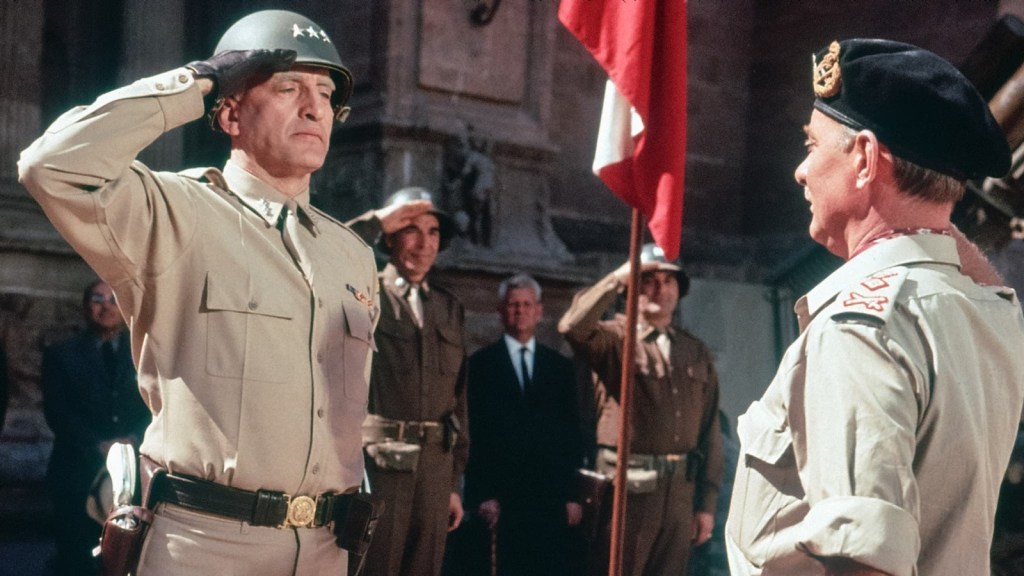
Patton: “I shaved extra-close in preparation for one of your slaps!”
As the war marches into the Italian mainland, Patton commits his first major political blunder when he inspects a field hospital. When the general encounters a crying soldier suffering from what we now call post-traumatic stress disorder (PTSD), Patton becomes enraged at what he considers to be little more than cowardice. Patton’s rage spills over as he slaps and derides the soldier; ultimately ordering him to be sent back to the front.
This also marks Patton’s first time facing consequences for his actions. He is reprimanded in writing and ordered by Supreme Allied Commander General Eisenhower to apologize the soldier, all who were present in the field hospital, and the entirety of the U.S. 8th Army. Patton does his duty, even though it’s clear it takes every fiber of his being not to choke at being forced to swallow his pride.
Although he does not know it, Patton has been placed on probation. He grumbles at having been sent on public relations duty, but another fact of which he is oblivious is that moving him around keeps the Germans guessing as to the Allies’ next move. Simply put, the Germans think the reports that Patton may be court-martialed for slapping the soldier are just so much misinformation.
As the lead up to the Normandy invasion builds, Patton is summoned to England. He believes he will be given command of the D-Day invasion of France. Instead, he is told by General Walter Beadle Smith (played by Edward Binns) that he will be a decoy for the main operation. Smith also makes Patton’s probationary status known to him.
Smith goes on to spell out Patton’s problem. He tells the probationary general “point blank” that Patton’s biggest problem is “his own big mouth.” Knowing Patton doesn’t understand politics, Smith explains to him in detail that his antics make him a thorn in Eisenhower’s efforts maintaining an already-fragile alliance.
Several days after the invasion, Patton is sent to France to meet with General Bradley. The two have a bit of a contentious conversation; at one point Bradley tells him that if he had been Patton’s senior in Sicily, he would have relieved him of his command. But this discussion ends with Patton being given command of the U.S. 3rd Army.
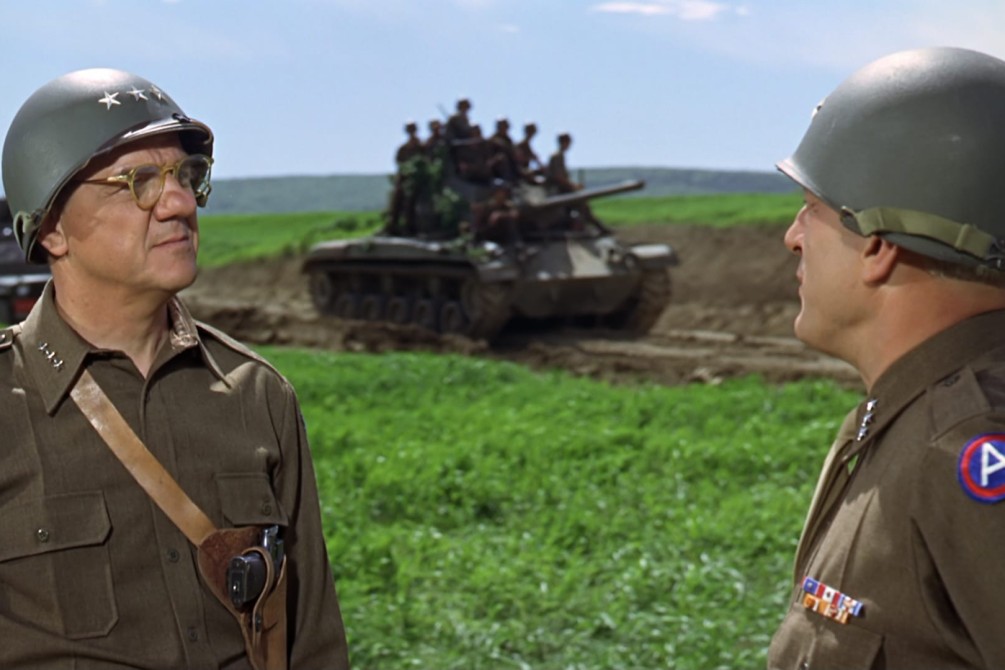
Having been given a chance for redemption, Patton leads 3rd Army on a sweep across France; taking them right up to the German border. But as Christmas 1944 approaches, the Germans launch a counter-offensive designed to divide the Allied forces and forestall the end of the war. As a result, the U.S. 101st Airborne Division gets cut-off and surrounded in the Belgian city of Bastogne. Patton provides the miracle needed to rescue the 101st, which only ups the general’s stock again.
As the Third Reich crumbles under the weight of the Allied advances, Patton ponders his future after the war. But once again, Patton says the wrong thing to the wrong people, creates more political problems, and is once again relieved of his command by Eisenhower.
The film ends with Patton having proved himself as one of the greatest military commanders of the Second World War, but now the general faces a world which no longer needs him. Calling on his love of history, Patton closes with another soliloquy with the general lamenting “that all glory is fleeting.”
The Hidden Sports Analogy:
With this installment, it might be safe to say the Ryan family of American Football coaches gets a disproportion amount of mention on this electronic screed. The tags for both Buddy Ryan and his son Rex get frequent addition; today’s tale goes in the “Rex” camp.
As we Americans slog toward the “dog days of summer,” there’s really no debating two of the biggest spectacles we offer nationally right now (especially in 2024) are politics and sports. It would be an exercise in pointlessness denying there’s a strong intersection between the two, even before today’s hyper-politicized and polarized nature.
But it is that very nature that made me choose this movie for this event; the key here is Patton’s polarizing persona. People either loved or hated him; the general didn’t have many “undecided voters.” Football coaches can also have the same bombastic, larger-than-life personality, but nobody personified the combination of personality and polarization more than Rex Ryan during his time with the New York Jets.

Likening football to war is so easy it’s become shopworn. But the connections between football and politics are less often discussed…despite the fact war is the ultimate extension of politics. The life a a “high-profile” football coach navigates the very same political waters as does that of a state governor.
Think about it. Both are tasked with tasked with making decisions having potentially monstrous repercussions, every one of those decision forges alliances and fuels enemies, and following every one there’s a press conference offering little more than second-guessing my a media with questionable motives and general lack of intellect.
Ultimately, Patton did not understand politics…and neither did Rex Ryan. But whether it was leading the U.S. 3rd Army into Germany or getting the New York Jets within sniffing distance of the Super Bowl twice, despite what their detractors would say, both were skilled generals of their respective fields.
In this case, the bond between the two is really all about emotion in it’s rawest state. Passion can power a lot of positives, but the same fire that heats your home occasionally burns it down. Patton had his moment slapping that soldier in Sicily. The cauldron that was Rex Ryan erupted on the sidelines of Heinz Field in Pittsburgh after his New York Jets lost their 2nd straight AFC Championship game,

Even thought every football fan in America was a first-hand witness tp that boil-over, none of us knew we were witnessing the apogee of Rex Ryan’s career trajectory. The fact Rex Ryan was at the top of his game and the New York Jets were comfortably at cruising altitude as one of the best teams in the National Football League disguised their own “soldier in Sicily” problem. No, Ryan didn’t slap his quarterback, but he was clearly frustrated giving the ball to a man whose ineptitude would ultimately earn him one of the most ignominious nick-names in the history of the game.
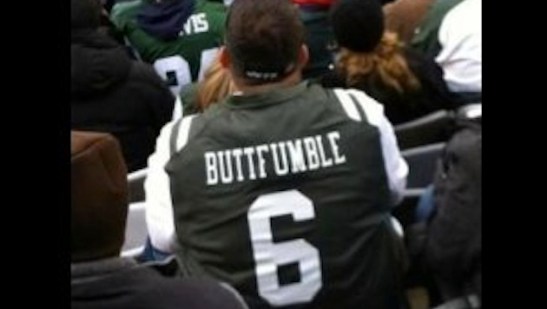
Legend has it Ryan figuratively re-enacted his headset-spike in the office of Jets’ general manager Mike Tanenbaum. Apparently, Ryan forcefully announced the impossibility of getting that team into the Super Bowl with Mark “Butt Fumble” Sanchez as the quarterback.
We could debate the fairness of that moniker; the resultant discussion would still bring a litany as to why nobody was surprised if something like this had to happen. it would involve Mark Sanchez. But it didn’t take long to see the arc heading downward from the “Head-set Spike” in January 2011 to that infamous 2012 Thanksgiving Night in New York.
The optics would have been obvious had the “Head-set Spike” happened in immediate response to the “Butt Fumble” or even as the flash at the end of the fuse lit by that fiasco. But the exact reverse is the reality. In fact, Rex Ryan was grousing to the front office about needing a quarterback in New York literally from the moment he hit town.
Tannebaum’s first attempt to placate Ryan centered on the 2010 free-agent signing of 40-year old Mark Brunell and the hope that maybe someday Kellen Clemens would resemble an National Football League (NFL) quarterback.
The second failure came the next year with Tannebaum’s drafting of Greg “Howdy Doody” McElroy in the 2011 NFL Draft, a 7th-round pick who now as an NFL commentator has filmed discussion segments longer than the effective portion of his on-field career.
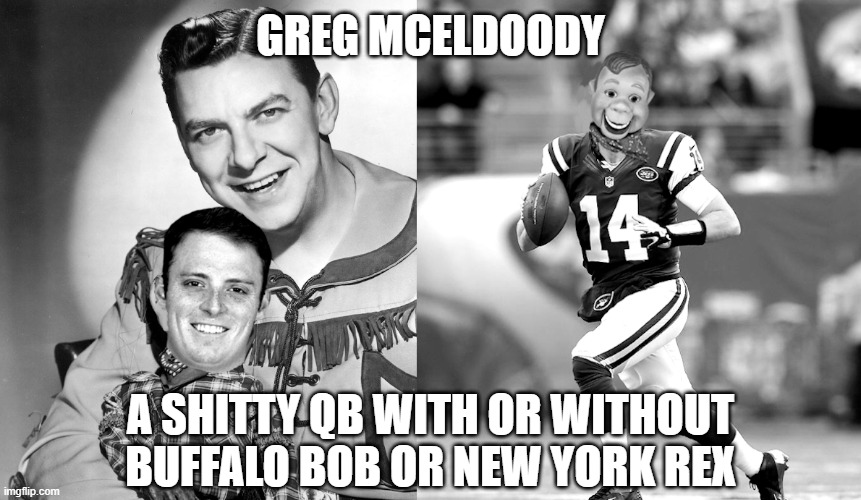
Keep in mind going into that off-season, we’ve just seen the “Head-set Spike” and as the temperature goes up on Ryan’s demands for a quarterback, so does the volatile nature of the relationship between the head coach and Tannebaum.
The stage was now set for “Strike Three” between Ryan and Tannebaum…the acquisition of Tim Tebow.
For those of you who may not remember, “Timmy Jesus” was the two-time National Champion and Heisman Trophy winning quarterback back from the University of Florida. His fellow Gator and my blog brother from another mother SportsChump probably still has a crucifix bearing Timmy J’s likeness and fasts every year on the anniversary of “The Promise”… Tebow’s “resurrection” after the infamous loss at Mississippi State in 2008.
That notwithstanding, the exploits of “Timmy Jesus” in college football which saw him walk across a lake to heal an injured swan simply did not transubstantiate to the professional ranks. In other words, for Tim Tebow, the initials for the National Football League actually stood for “Not For Long.”
Feel free to debate Tebow’s exploits all you want; it’s not like we didn’t. The bottom line is Tebow was not what Ryan had in mind.
To be fair to Mike Tannebaum, in both 2011 and 2012 the New York Jets didn’t have a realistic draft option. I suppose they could have traded away their future to take the Cam Newton gamble, but there was precious little in the 1st round after that. Frankly, Tannebaum should get some credit for not making a typical Jets-like move by trading up to get Jake Locker, Blaine Gabbert, or Christian Ponder.
The Jets didn’t have a pick until the 30th overall in 2011. Granted they got a pretty damn good player at that spot in defensive lineman Muhammad Wilkerson. However, just five picks later, the Cincinnati Bengals grabbed a quarterback who took them to the playoffs in four straight season from 2011 through 2014. Andy Dalton would be the face of the Bengals for the better part of a decade, and the Jets’ missing on him and the start of their protracted playoff absence…well, that’s not a coincidence.
Come 2012, the draft prospects weren’t much better. The Jets picked at #16 in the 1st round, but there was a sure-fire, can’t miss quarterback in Andrew Luck who would be at the top of the order. But there was no way the Indianapolis colts were trading away the first pick in the draft.
The current Heisman Trophy winner would be available with the 2nd pick…if the Jets could trade up to get it. But Robert Griffin III looked, smelled, and proved to be what a “best-case scenario” Tebow would be…as short-lived as it was.
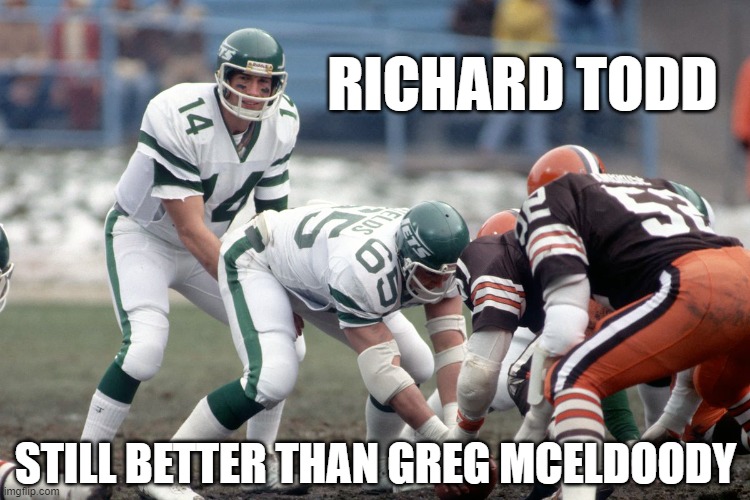
After that, the only realistic option was Ryan Tannehill. Be warned, old-school Jets’ fans…get ready for the mention of another polarizing name from your franchise history. The fact of the matter is statistically-speaking over the course of his career, Tannehill compares very favorably to (gasp!) Richard Todd. Being a Jet meant Todd took the controls of a lot of bad Jet squads, but in 1981 he led them to their first playoff appearance since “Broadway Joe” and the 1969 win in Super Bowl III.
Like it or not, that makes Richard Todd 1 of only 4 Jet quarterbacks to play in an AFL/AFC Championship game: the aforementioned “Broadway” Joe Namath, Todd, Vinny Testaverde, and Mark Sanchez. Regardless of on which side of the “Todd sucked/didn’t suck” divide you reside as a Jet fan, don’t even try to tell me you wouldn’t rather have Todd or any of those other three rather than who that team has trotted out as a quarterback since…
- Greg McElroy
- Geno Smith
- Michael Vick
- Ryan Fitzpatrick
- Bryce Petty
- Josh McCown
- Sam Darnold
- Luke Falk
- Trevor Siemian
- Joe Flacco
- Zach Wilson
- Mike White
- Tim Boyle
- Aaron Rodgers
Not only does that begin the erosion of the “At least he didn’t do something ‘Jets-y'” defense of Mike Tannebaum’s’ draft strategy, but the “could have had” factor completely washes it away. After the 2nd round, there were still solid “better than Mark Sanchez” quarterbacks still on the board. Kirk Cousins lasted until the 4th round; say what you will…he’s been a top-level if not under-rated performer long enough to get seriously paid by 3 different NFL franchises.
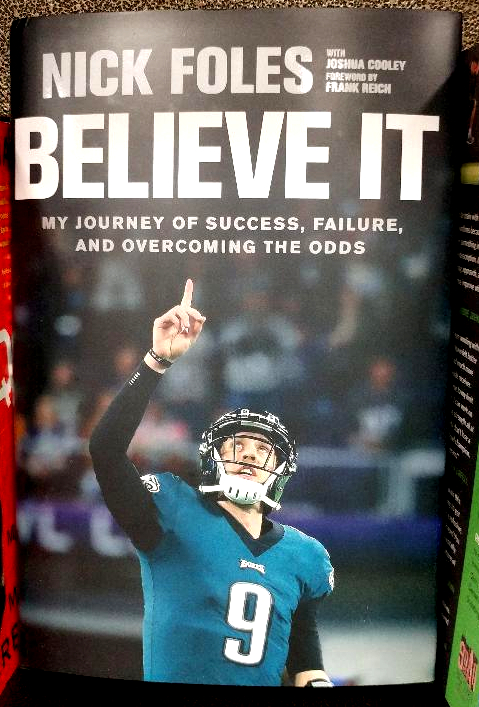
Even if he wanted to stay “on the cheap,” Tannebaum could have had Nick Foles in the 3rd round. Granted Foles was a “journeyman,” but that’s a function being both a victim of salary-cap realpolitik and having the talent to stay in demand. That’s how he blew past all of Drew Brees’ Texas state high-school passing records and became a Super Bowl Most Valuable Player (MVP) by out-dueling Tom Brady. Let’s face it; if you get to write a book about your football exploits, you did something right…something Mike Tannebaum could no longer claim.
Speaking of failed defenses, with the death of “At least he didn’t do something ‘Jets-y,'” Tannebaum could only rely on “I was just following orders” for his creation of the “Odd Couple” of Rex Ryan and Tim Tebow.
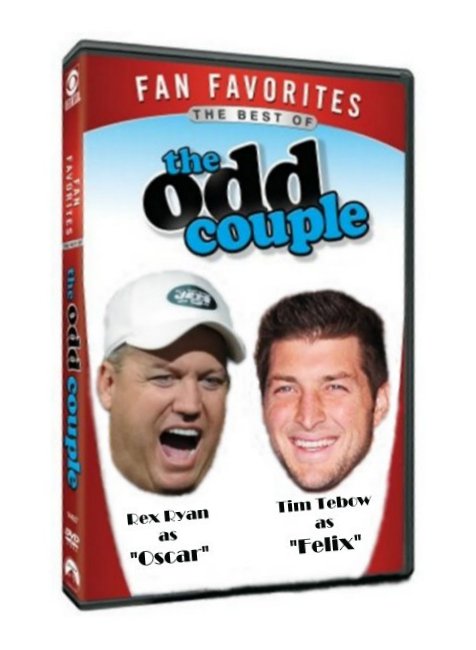
In his own words, the Jets’ general manager tried to sell the idea he was “under orders” from owner Woody Johnson “to be mindful of the payroll.” Of course…as is the purpose of any purely political statement, it was meant to create a narrative with deliberately vague legitimacy delivered with equally obtuse supporting “logic.”
That recipe for quasi-rhetoric not only cooks nicely for politics, it brings us full-circle to the connection between them and football. To his credit, Tannebaum had a full grasp of both this concept and it’s application. To his detriment, like far too many others in prominence today, he didn’t comprehend the direct correlation between the level of emptiness in a false narrative and it’s degree of structural vulnerability. Because it couldn’t stand up to the test of truth, “I was just following orders” failed as badly for Tannebaum as it did for various Nazis at the Nuremburg war crimes trials after the Second World War.
Don’t be the soft-brain who wants to think I just compared an NFL general manager to Herman Goehring et al. Doing so misses the real comparison; in both cases “following orders” doesn’t excuse questionable decision-making. Goehring could have let the Luftwaffe strafe the British Army into non-existence on the beaches of Dunkirk, but he didn’t. He followed orders to allow the Wehrmacht to claim final victory with a good, old-fashioned infantry charge.
In Tannebaum’s case, he failed to get the quarterback Rex Ryan needed because he was directed to shave the dime. But rookie quarterbacks are cheap when you don’t draft them before the 2nd round. I’ve already mentioned Tannebaum’s complete misses; they’re what ultimately cost him his job.
Conversely, Rex Ryan’s Achilles Heel came from his own fundamental misunderstanding of politics’ inherent theatrical dynamic and its’ concomitant paucity of reality. The “long story short” is Ryan never got his quarterback in New York, which ultimately landed him the fate inevitable to most football coaches…he got fired.
Remember the old saying “fool me once, shame on you; fool me twice, shame on me?” Or one could say ending up in the same predicament twice says more about the maker than the decision. Either way, upon getting the gate in New York, it didn’t take long for Ryan to get a head coaching job on the other end of the Thruway in Buffalo. Despite the fact he was with a different team in a different city, he still had a familiar problem; an owner who had yet to understand the value of a quarterback.
At least in Buffalo, he never had Greg McElroy.
The Moral of the Story:
Decisions have consequences. The only person responsible for your decisions is you.
Got a question, comment, or just want to yell at us? Hit us up at dubsism@yahoo.com, @Dubsism on Twitter, or on our Pinterest, Tumblr, Instagram, or Facebook pages, and be sure to bookmark Dubsism.com so you don’t miss anything from the most interesting independent sports blog on the web.

 Dubsism