
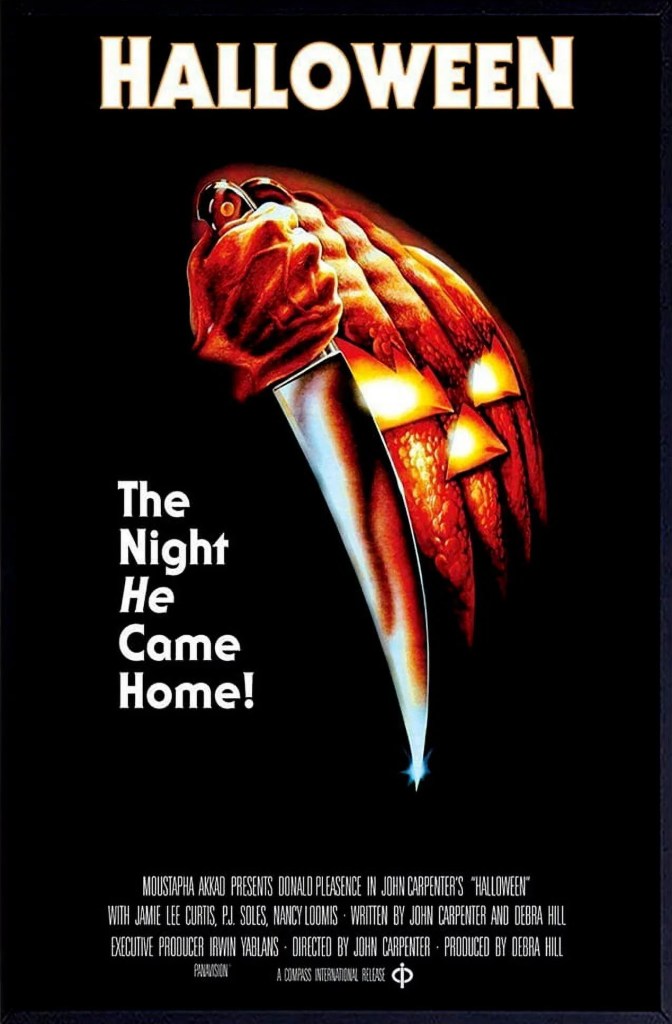
- Today’s Movie: Halloween
- Year of Release: 1978
- Stars: Donald Pleasance, Jamie Lee Curtis, Tony Moran
- Director: John Carpenter
This movie is not on my list of essential films.

NOTE: This installment of Sports Analogies Hidden In Classic Movies is being done as part of something called the 3rd Annual Spooky Classic Movie Blog-A-Thon being hosted by Hoofers & Honeys. Given the time of year and the straight-forward nature of the theme, nobody should be afraid to discover what all will be in here…
You can see all the contributors to this blog-a-thon here:
The Story:
Once the viewer gets past John Carpenter’s iconic theme music, the film opens on October 31, 1963 in Haddonfield, Illinois. A shadowy figure is shown approaching a white, two-story Victorian house. The unknown figure looks inside seeing a 17-year-old Judith Margaret Myers (played Sandy Johnson) passionately kissing her boyfriend (played by David Kyle).
After their encounter, she is sitting alone brushing her hair as the figure comes up behind here. As she spins around to confront the stranger, she sees it is 6-year old Michael Myers (played by Will Sandin). Without warning, Michael repeatedly stabs her. As he walks away, their parents’ car pulls into the driveway. Micheal is still holding the knife.
Fifteen years on the night before Halloween 1978, Dr. Sam Loomis (played by Donald Pleasance) and his nurse Marion Chambers (played by Nancy Stephens) have been tasked with transporting the now-21 year-old Michael Myers (played by Nick Castle) to a hearing to determine whether he will continue to be institutionalized. Through a series of events, Michael escapes.
The next day in Haddonfield, Laurie Strode (played by Jamie Lee Curtis) is one her way to her high school. While’s she’s leaving, her real estate agent father Morgan (played by Peter Griffith), reminds he she needs to drop off a key at the now-abandoned Myers house as there’s a prospective buyer. When she drops the key under the mat, a figure appears inside…one which will follow throughout the rest of the film.
Back at the asylum, Dr. Loomis is in disagreement with Dr. Wynn (played by Robert Phalen) as to whether Michael has returned to Haddonfield. Wynn doesn’t think Michael could drive that far Haddonfield and blames Loomis for not adequately warning the staff about Michael.
Michael is in fact in Haddonfield; he’s first shown there outside the high school standing next to the Smith’s Grove Sanitarium he stole watching Laurie. Then he moves to the elementary school where he confronts some boys bullying Laurie’s little brother Tommy.
Along the road between Smith’s Grove and Haddonfield, Dr. Loomis calls the Haddonfield Police Department. Like Wynn, the police are skeptical of Loomis’ claim. Loomis then notices a tow truck parked nearby where he discovers Michael’s white hospital gown. Loomis is now convinced Michael is in Haddonfield, and as he hurriedly heads that way, he doesn’t noticed the unclothed body of the tow truck driver lying in the grass.
Walking home from school, Laurie and her friends Lynda (played by P. J. Soles) and Annie (played by Nancy Loomis) are talking about their babysitting assignments for that night as the Smith’s Grove Sanitarium car goes speeding by them. They continue walking when Laurie believes she sees Michael hiding behind a bush. Nobody else see him, thus cementing the premise Laurie and Loomis are the only ones with a concern over what is to come.
Here’s where Halloween becomes the “blueprint” for the genre. All “horror” movie teenagers smoke pot, fornicate, and make mind-bogglingly bad decisions while being stalked by a homicidal maniac. Michael Myers becomes the essential “slasher” villain; he appears suddenly from the shadows and disappears just as quickly; then he begins systematically slaughtering the town’s teenagers.
As the blood starts flowing in Haddonfield, Dr. Loomis forms an alliance with Haddonfield’s Sheriff Brackett (played by Charles Cyphers). As they arrive at the abandoned Myers house to begin searching for Michael, Loomis sums his 15-year experience with Michael as “seeing nothing but pure evil inside him.” Brackett goes to warn the rest of the police, Loomis decides to stay at the house believing Michael will return.
Dr. Loomis still stands waiting, when suddenly, he sees the Smith’s Grove Sanitarium car! Dr. Loomis begins running down the street, sure of where Michael is. Naturally, he’s heading to the scene of the slaughter-in-progress, ostensibly to come to the rescue of our heroine Laurie.
When she goes to the house where her friends were babysitting, she finds no signs of Annie or Lynda. When she goes upstairs, she find Annie’s body with the headstone of Judith Myers above her. Then, the body of Annie’s boyfriend drops from the ceiling in the doorway As Laurie screams in terror, the closet door swings open to reveal Lynda’s body.
Another trope truly engrained into the genre is the idea of the monster that can’t be killed. There’s more than once in Halloween when it seems Michael Myers is dead, but it is later discovered he is very much alive. In fact, that’s used in the ending in order to leave open the possibility for sequels.
As Laurie is exhaustedly slumping against the doorway of the room where she was hiding, she doesn’t notice the supposedly-dead Michael is slowly rising behind her. As she tries to leave the room, Michael grabs Laurie her by the neck and begins strangling her. In a fight for her life, Laurie pulls off Michael’s mask, revealing his true identity. At that moment, Loomis appears at the top of the staircase, produces his pistol and shoots Michael. He falls backward from the gunshot, but still manages to escape. Loomis chases him into another room and empties his pistol into Michael. The impact of the bullets knock Michael through the balcony doors and over the railing, after which he slams into the ground and appears to be dead.
But the end of the film makes it very clear he isn’t…
The Hidden Sports Analogy:
What’s more frightening: a movie monster you can’t kill, or an aging quarterback who won’t retire? How about a quarterback who while his career is clearly in decline, keeps threatening to retire…but never does, only to continue slaughtering a team’s salary cap?
Welcome to the story of Brett Favre. The very genesis of this blog cam over fifteen years ago when “King Brett I” ascended to throne of the Minnesota Vikings. That was 2009, and by then, Favre was already in earnest doing his “Lucy pulling the football” routine, having already done it to the Green Bay Packers and the New York Jets.
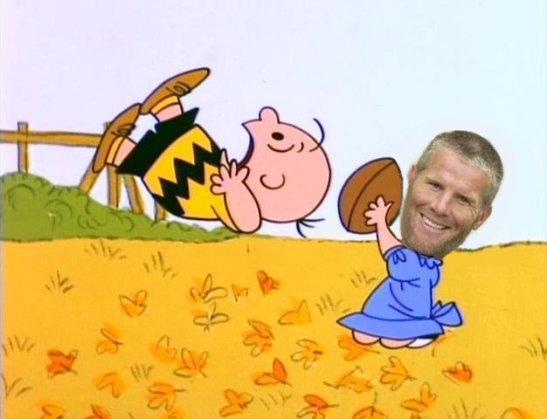
But those in the know are all too aware of the fact Favre start singing the retirement song well before that. Just like I had to do a timeline for Viking fans outlining the decline of “King Brett I” as a “big-game” quarterback, here’s a similar chronology detailing Favre’s flirtation with hanging up his cleats…right up until the moment time took care of that for him.
2003: To be fair, the first aria in the opera which became Favre’s retirement wasn’t his fault. After the Packers lost at home in the Wild Card round to the Atlanta Falcons, the 32-year old future
Hall of Famer said “I have every intention of coming back” after being asked if he was planning to retire. But, given the omni-directional sludge pump that is American journalism, that answer lacked sufficient clarity.
2004: In what will become a pattern, Favre throws a crippling interception in overtime against the Philadelphia Eagles in the Divisional round of the play-offs. The Packers lose, but Favre’s “no comment” on the retirement question only fuels the speculation, despite the fact his teammates all insist he will be back. Again, really not his fault…but by now, he should know better as to answering such questions.
2005: After dishing up four interceptions.in a Wild Card round loss to divisional rival Minnesota, Favre tells the Packers he “needs to think about his future.” Despite this, he still somewhat vaguely “commits” to return. This marks the end of being able to blame sloppy journalism for this on-going problem.
But later that year, the Green Bay Packers take quarterback Aaron Rodgers in the first round of the NFL Draft. Having a new quarter-horse in the stable, combined with Favre’s age and the fact he chucked 29 interceptions the following season leading the Packers to a 4-12 campaign only meant one thing. The retirement rumors were in full roar and Favre draws out his decision for almost the entire 2006 off-season.
2006: In a season where the Packers go 8-8, Favre does nothing to assuage the feeling this year is the “farewell tour.” The feeling this is his final season is so prevalent, fans of the rival Chicago Bears give the 36-year old Favre a standing ovation in tribute in the belief it would be his last appearance in Soldier Field. However, in what won’t be his last tear-filled press conference, Favre announces in February he will return for the following season.
Don’t forget the Packers now have another quarterback waiting on the bench for his day…
2007: Here’s the real “Michael Myers comes back to life” moment. Favre has a time-defying, completely off-the-chain season at 37 years old. He throws for over 4,000 yards, earns a first-team Pro Bowl selection, all while breaking Dan Marino’s record for career touchdown passes and John Elway’s mark for career wins. All this leads the Green Bay Packers to a 13-3 record and playing host to the first NFC Championship game at Lambeau Field since the Super Bowl season of 1995.
But…Favre throws a game-costing interception in overtime, providing a crushing end to what many Packer fans thought was a championship season. The retirement rumors started at the post-game press conference game, where Favre promised to decide “sooner rather than later.”
However, by this time, the Packers have had enough of this shit. As such, they tell Favre to make a decision my March, or they will make the decision for him.
March 4, 2007: Brett Favre “officially” retires.

April 23, 2007: Brett Favre “unretires.” Green Bay Packers’ general manager Ted Thompson and head coach Mike McCarthy meet to iron out the details on his return. Not only does this mean the Packers have to tell Rodgers he’s going back to the bench, but Favre ups the ante on the “pulling the football” trick by announcing he’s staying retired.
This effective destroys the relationship between Favre and the Packers, and a petty “Snipe War” breaks out between them, with all the shots being fired via the media.
July 29, 2007: Brett Favre officially requests reinstatement from NFL Commissioner Roger Goodell. The “turd in the punchbowl” is Favre is still under contract to the Packers for three more years. That means upon reinstatement, the team would have 24 hours to decide either cut him, add him to the roster, or trade him. To avoid putting the team on the spot, Goodell waits for Favre and the Packers to reach an agreement before granting reinstatement.
July 30, 2007: Welcome to a week Packer fans are likely never to forget. In what provres to be a complete disaster, Packers CEO Mark Murphy offers Favre a $20,000,000 “marketing agreement” to stay retired. In no time, news of this skeezy “deal” leaks to the press. This effectively split the team’s fanbase between those angry at the team treating their future Hall of Fame quarterback in such a manner, and those who want to move on believing Aaron Rodgers is the future.
August 2, 2007: In a scene that will repeated in two years and will prove to be the very genesis of this blog, news cameras broadcast live footage of Favre landing in Green Bay for Family Night at Lambeau Field. Even though over 50,000 adoring fans are in attendance, Packer management does not allow Favre to be in the locker room or on the field. He’s shown watching from a luxury box in the stadium.
August 3, 2007: Goodell reinstates Favre and is added to the Packers’ roster. The prevailing thought i Favre will compete with Aaron Rodgers to be the starting quarterback. However, in a press conference later that day, Favre declares he’s not past the “personal differences” between himself and Packers’ general manager Ted Thompson. This leaves the team literally no choice but to trade Favre.
August 5, 2007: From the minute it looked like Favre could be available, the Minnesota Vikings were contacting him; so much so the Packer’s filed a tampering complaint with the league. Commissioner Goodell dismisses this complaint, all while Favre keeps saying Minnesota is his preferred destination. Tampa Bay starts inquiring about a deal, but Ted Thompson makes it clear Favre will not be traded to an NFC team.
August 7, 2007: One of the only teams who loves a dumpster fire retread quarterback more than Minnesota steps up with the winning offer. In exchange for sending a conditional 4th-round draft pick and agreeing to a provision they will give up three 1st-round picks if they trade him to the Vikings, the New York Jets acquire the rights to Brett Favre.
February 2009: After an 8-3 start that has Jets fans seeing Super Bowl stars in their eyes, the wheels come off the wagon. The Jets win only one of their final five games to finish the season at 9-7 and miss the play-offs. As one would expect, Favre retires.
August 18, 2009: As previously mentioned, this also happens to be the same day the very first post on this blog was posted. Ending weeks of speculation, the 39-year-old Brett Favre signs a 2 year, $28 million deal with…you guessed it…the Minnesota Vikings, thus beginning the two-season-long Favre-gasm for the purple fanbase.
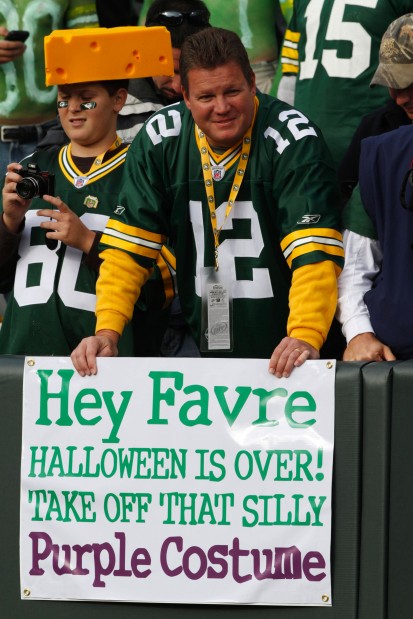
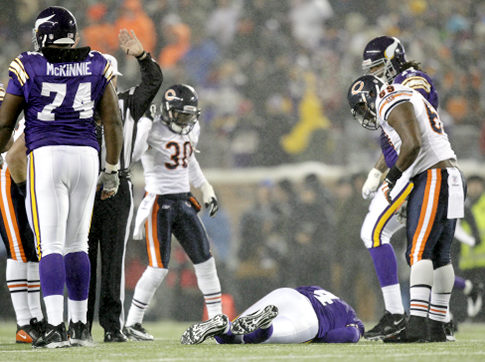
Of course, it all turned out to be one big dry-hump as the Super Bowl dreams never materialized in Minnesota. To be fair, Favre did have an incredible season in 2009, and he did lead the Vikings to within one game of the Super Bowl, but that was when that pesky “interception late in the game” monster reared it’s ugly head yet again.
The last vision of Favre on an NFL field finally separated him from Michael Myers; as far as the NFL was concerned, King Brett I was dead.
The Moral of the Story:
It doesn’t matter if you’re a blade-wielding maniac or a legendary NFL quarterback…Father Time is undefeated.
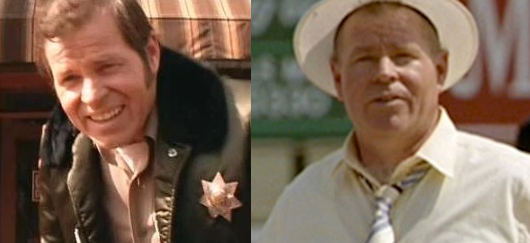
P.S. There’s a link between this classic “horror” film and one from the world of baseball. It comes in the form of actor Charles Cyphers, who not only plays “Sheriff Brackett” in Halloween, but also fills the role of “Charlie Donovan,” the general manager of the Cleveland Indians in the 1989 classic Major League.
Got a question, comment, or just want to yell at us? Hit us up at dubsism@yahoo.com, @Dubsism on Twitter, or on our Pinterest, Tumblr, Instagram, or Facebook pages, and be sure to bookmark Dubsism.com so you don’t miss anything from the most interesting independent sports blog on the web.

 Dubsism
Enjoyed this atmospheric post.
LikeLike
[…] Dubsism takes us to Halloween […]
LikeLike
Very apt analogy – Favre killed fans’ hope and dreams as effectively as Michael Myers killed unwary teenagers. Love that fan’s sign, “Hey Favre, Halloween is over!”
LikeLike