


Some things have universal appeal. It’s rare for the beautiful girl to be rejected; not many pass on the keys to a hot sports car. For bassists, the Rickenbacker is just such a thing. Whether they admit it or not, at some point every serious thick-stringer has coveted one.

The trick to beauty is that whole bit about it’s residence in the eye of the beholder. After all, the buxom blond girl isn’t for everybody. But there’s a reason why I have a framed Marilyn Monroe movie poster in my house, and there’s a reason why I have a Rick.
At points along my way, I’ve been both a bassist and a drummer. In one band where I manned the cans, we had a bass player who sported a Rickenbacker MapleGlo 4001. That big, blond beauty caught my eye; so much so I asked for a test drive.
Moments later, the soundtrack to one of the great “love/hate” relationships of my life sprung from an old Ampeg tuber.

It was the awkward first dance with the girl who held the deed on your desires. The shaky anticipation gave way to something so uncomfortable it grew it’s own mystery around my inability to put it down.
The neck felt wrongly wonderful like having sweaty palms on the first chance at holding your dream girl’s hand. The sound did nothing to ease my anxiousness, but steeled my resolve to ignore it. That was 40 years ago; I’ve owned my own 1977 Jetglo 4001 for 30.
Some say familiarity breeds contempt, but in this case, three decades replaced those original qualms with six specific love/hate features which in my beholden eyes are inherent to the Rick’s beauty.
1) The Bridge
Love:
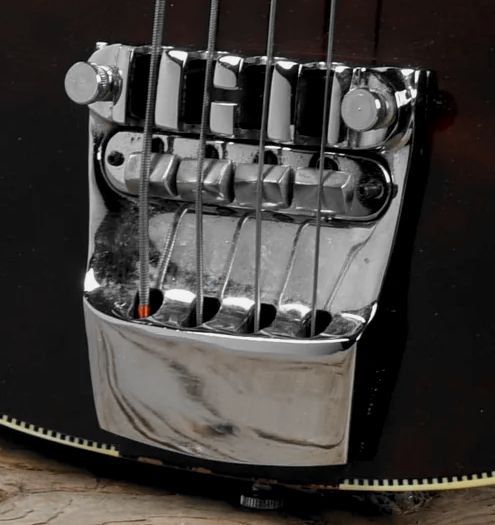
I’ll discuss this more when I get to the “sound” issue, but if you’re in the “Chris Squire” camp as mentioned in the video below, you completely understand this. That bridge and it’s location in relation to the treble pick-up means you can do that “precision pick” style like Squire by playing between the bridge and the treble pick-up, or you can play around the bass pick-up for something nearing the “Lemmy Growl.”
This configuration lends so much the Rick’s signature sound, which even the most-ardent Rick-haters still try to emulate. Tina Weymouth (my favorite female bassist) never played a Rick (to my knowledge), but here’s a guy who just diagnosed her chronic Rick Envy.
Hate:
There’s no other way to say it…the bridge design literally sucks out loud. If you leave the treble pick-up cover in place, you can forget about palm muting. Not only are these two features so close even the hands of a toddler would find the technique impossible, but the fact the strings are recessed into the structure makes palm muting pretty much a pipe dream anyway.
2) The Treble Pickup Cover
Love:
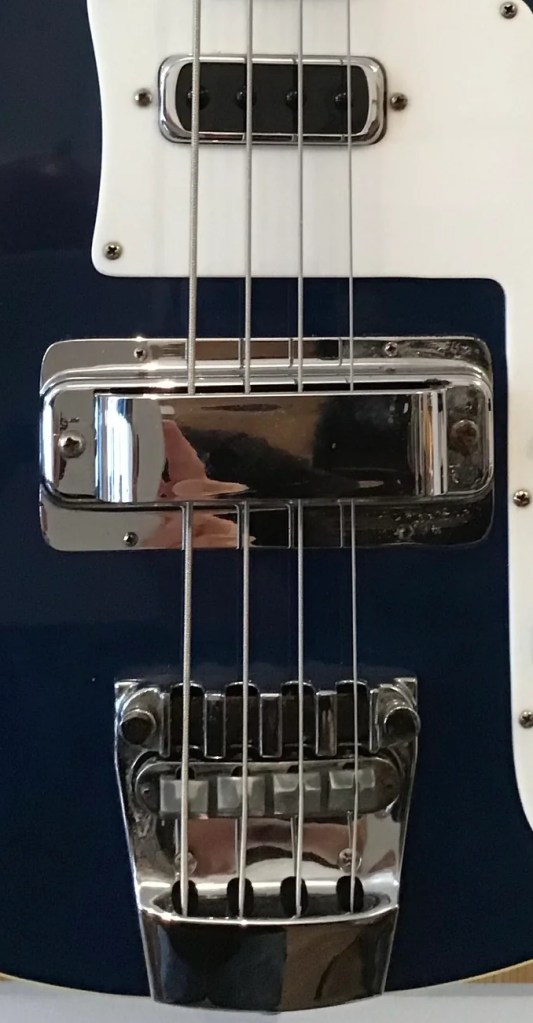
I’ve racked my brain to find a functional reason why this feature exists. There simply isn’t one. That flattened chrome arch is purely cosmetic, but short of the Rick’s curvy body (more on that in Point #3), there isn’t a feature that is as defining for the Rick’s signature appearance. It just fuckin’ looks cool.
Hate:
The closest thing to a functional reason I have is perhaps it was meant to serve as a thumb-rest. If that’s true, it’s in the worst possible place. “Pick” players don’t need such a feature, and this location nearly forces mother-pluckers like me to play right in front of the bridge where the strings are the stiffest.
That kills all the nuance of the “finger” technique, but if you’re going to remove that thing. you’d better be a goddamn legend like Cliff Burton.
3) The Body and Under Fore-Arm Ridge

Love:
Since the first Rick 4001 was released in 1957, it’s curves had to be a tribute to the voluptuous female body in vogue at the time. That curvaceous nature puts the Rick’s “waist?” further back than most other bodies, which makes it easier for my broad-shouldered self to rest my arm comfortably on it when seated.
Hate:
There a reason why you never see anybody on stage playing a Rick in short sleeves. Thanks to Sir Paul and his long sleeves, a bassist with a properly-configured Rick can do unheard of things like (gasp!) play the melody. Short sleeves can only mean a date with some rather uncomfortable chafing.
4) The Neck and the Twin Truss Rods

Love:
If you like your weapons solidly built, the Rick 4001 is for you. The body could stop an artillery shell, and the neck follows suit…complete with it’s matching thickness and twin truss rods. I know those who don’t appreciate the Rick’s thickness, but for me it’s just right.
I will admit it is a bit over-engineered and certainly over-built, but I believe that is a big part of what gives the Rick it’s ton. I’m also convinced that’s how it holds tune. Yeah, yeah, yeah…I know there are those who think the Rick can have string-slip issues, but I’ve always found those concerns to be a bit over-blown. Not to mention, it gives the Rick a sense of stability.
As far as tone/sound issues The unique fret construction lets you pull off slides like this.
Hate:
Since I was just talking about the frets…
Maybe it’s just me, but something feels fundamentally wrong with an electric bass neck only having 20 frets. Number aside, I know one thing which garners much agreement. While the frets’ soft, shallow construct allows for those amazing slides, the fact they are made from some seriously cheap material means you can wear them down to the nubs in no time.
The frets coming to an end means neck replacement and the inherent “joy” brought by the Rick’s twin truss rods. Getting the torque right in those bad boys is the definition of a “balancing act;” you’ve got to get the tension just right for the sound you want without shortening the neck’s life by warping the shit out of it.
But even before you get the that point, you’re going to discover adjusting the truss rods can feel more like a wrestling match; it literally can be an exercise in brute force. There’s an amount of pressure you must apply to be able to make even the slightest adjustment, but too much can snap the rod, crack the neck, or just generally ruin your day.
Here’s what a guy with badly-adjusted truss rods sounds like. I’m not jerking you around; there’s a reason.
It’s not hard to get your hands on the idea that the best example of this comes in a song about masturbation. That’s because most of the guys who deliberately misadjust their truss rods are “pick” players who are also converted guitarists. That means by definition they love distortion/effects, so when normal guitar mischief like Fuzz, Wah, or whatever isn’t available, they screw around with whatever they can find…like the twin truss rods. That’s why a large number of guys fitting that description are jerk-offs.
Either way, the big thing those truss rods do is combine with the body to bring in the Rick at just under a scale-crunching 10 pounds. There’s simply no debating the only thing heavier than the sound of a Rick in Lemmy Kilmisters’s hands is the Rick itself.
5) Four Knobs, Two Jacks, and a Switch

Love:
There’s so much more to the beauty of the Rick than just it’s body. From those knobs, jacks, and switches springs the soul of the Rickenbacker which gives it the lift needed to fly above the traditional role of bass, letting it spread to other roles; in this case to those held for rhythm guitar.
How else do you get this diamond from the non-grunge musical desert known as the 90s?
Hate:
Nothing. Not a goddamn thing. I suppose if one really needed something here, I could be schooled on the gauge and resistance of the wiring, the quality of the connections, or some other technical twaddle. No bassist worth a pluck is ever going to scoff at what the Rick can do.
6) The Sound
Love:
Take everything from Point #5, funnel through it through two outputs, and we are officially “full-circle” from what I alluded to in the first point. Say what you will…love them or hate them…finger pluck or pick (nobody slaps a Rick, do they?) the universal point of agreement is nothing sounds like a Rick.
That flexibility makes the Rick the ultimate weapon for me when it comes to writing and composing. It’s one thing to be struck with an idea; it’s completely another to be able to bend sounds around that concept with knob-twists and flicks of switches.
In a future installment of another series, you will learn all about John Wetton, the man I consider to be my “spirit animal” in terms of being a bassist/writer/composer.
That’s why when I saw that Rick in his hand, I knew exactly how that song came to be. It likely started with a chunk of a lyric, a couple of Rick plucks to figure out key and where to start with the underpinnings, slide some rhymes around, bend a few sounds around them and voilà! In this case, not only do you have the skeleton of a song, it holds up a powerfully beautiful melody…from all things, the thick strings of a bassist.
Hate:
The easy and common criticism here: the pickups have a tendency to hum. We could spend days arguing that point and postulating solutions, but that’s completely pointless. They may hum more than average, but that’s the price you pay for that sound.
Live with it.
The Bottom Line:
This guy is an “executive summary” of everything I just said.
But the one thing we’ve learned: regardless of your opinion, there is somebody (at 6:45 above) who slaps a Rick.
And the world just became a better place.
P.S. Here’s a great rundown of exceptional Rick-meisters which also runs the gambit of sounds and styles. It’s not an accident many of the names I’ve already mentioned are repeated here.
Got a question, comment, or just want to yell at us? Hit us up at dubsism@yahoo.com, @Dubsism on X, or on our Pinterest, Tumblr, BlueSky, Truth Social, or Instagram, or Facebook pages, and be sure to bookmark Dubsism.com so you don’t miss anything from the most interesting independent sports blog on the web.


[…] of Dubsism (A favorite sports […]
LikeLike
As tagged…
https://dubsism.com/2025/06/08/sports-analogies-hidden-in-classic-movies-volume-163-brewsters-millions/
LikeLike