
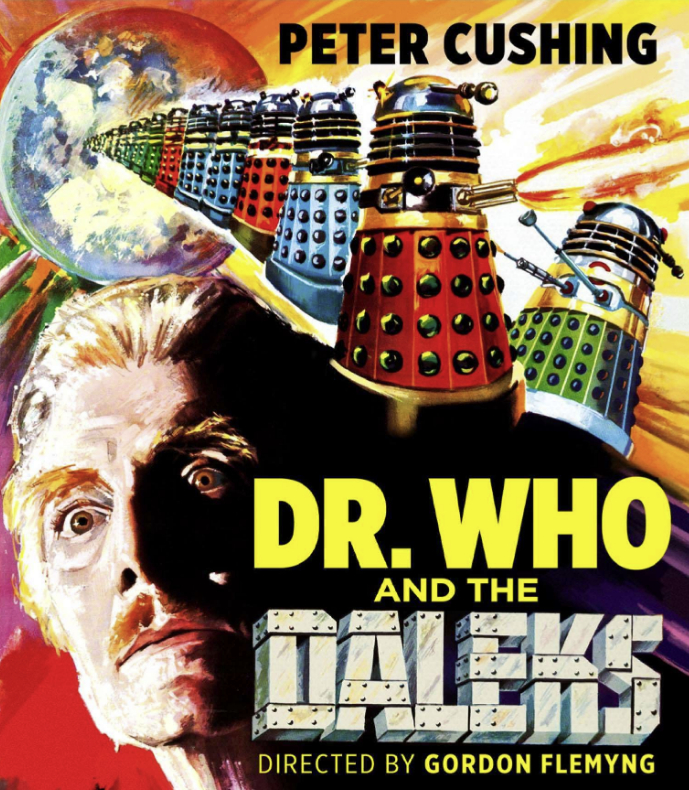
- Today’s Movie: Doctor Who and the Daleks
- Year of Release: 1965
- Stars: Peter Cushing, Roy Castle, Jennie Linden
- Director: Gordon Flemyng
This movie is not on my list of essential films.
NOTE: This installment of Sports Analaogies Hidden in Classic Movies is not being done as just part of a blog-a-thon. Instead, this is a monthly event hosted by MovieRob called Genre Grandeur. The way it works is every month MovieRob chooses a film blogger to pick a topic and a movie to write about, then also picks a movie for MovieRob to review. At the end of the month, MovieRob posts the reviews of all the participants.
For October 2025, the honor of being the “guest picker” went to James of Blogging By Cinemalight! and the topic is “movies featuring robots.”
But like the old late-night commercials would say “BUT WAIT!!! THERE’S MORE!!!”

In the “two birds with one stone” department, this piece is also just one of many contributions to a event called the Hammer-Amicus Blog-a-Thon V being hosted by Realweegiemidget Reviews and Cinematic Catharsis. They keep hosting quality events like this, and they keep inviting a slew of supremely talented and interesting contributors.
Then…they invited me.

Reasons for that notwithstanding, it presents a choice. It’s up to you as a reader which you’d rather do first…continue with my nonsense here, or take a stroll through the people who actually know how to write about movies. Since I understand the obvious nature of the decision, here’s the links to aid acting on it.
I realize I may be committing blog bigamy here, but I thought it was big of me to admit it…
The Story:
The old saying goes “Accidents will happen,” but none could be be quite like this. Dr. Who (played by Peter Cushing) along with his granddaughters Susan (played by Roberta Tovey), Barbara (played by Jennie Linden), and Barbara’s boyfriend Ian (played by Roy Castle) all find themselves having been transported unintentionally to another planet by the doctor’s latest invention, a “time machine” called TARDIS.
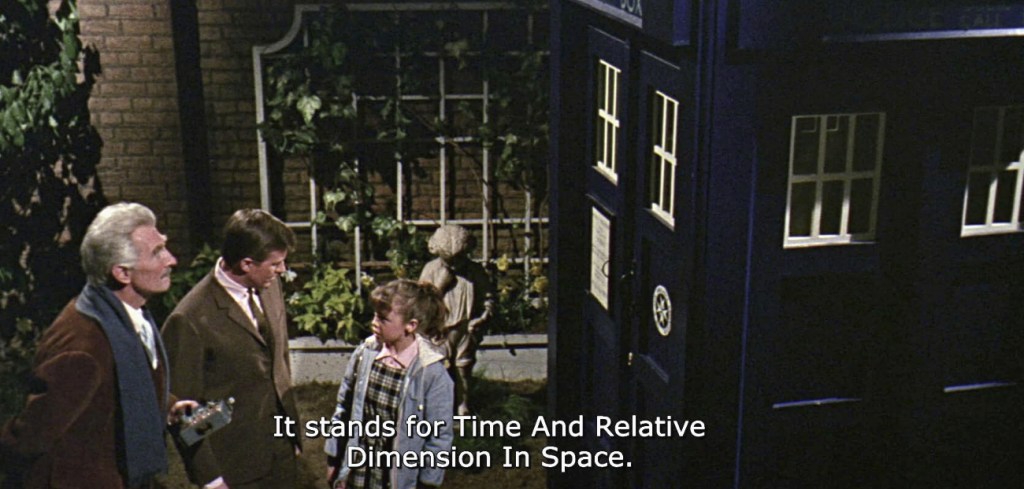
While getting their bearings, the group sees a city in the distance. They also find a small container of drugs which they take aboard TARDIS. But Dr. Who doesn’t want to leave; he feels this merits investigation. He makes the others believe a vital component called a fluid link has a leak. This ruse also ensures the group will go with him into the city to search for the mercury which is “needed” to refill the fluid link.
Almost immediately upon their arrival in the city, the Doctor et al. are captured by a group of robot-hybrids known as “Daleks.” They commandeer the fluid link, and while the Daleks are examining it, Dr. Who realizes the group has been exposed to radiation. The drugs they discovered may be their only hope of survival…but they remain in the TARDIS.
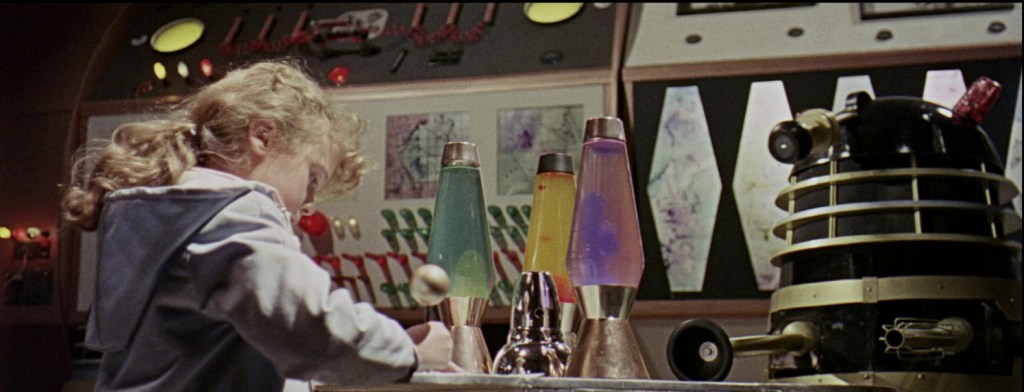
But the Daleks have problems of their own. While they are decidedly more evil…they intend to escape the city and destroy all life on the planet…but they area also trapped by the radiation. Upon hearing the Doctor and his group discussing the drugs, the Daleks make a proposal. In return for surrendering the drugs to the Daleks, the humans will be given enough to treat themselves.
As she is the only one still possessing the needed strength, Susan is sent to retrieve the drugs from the TARDIS. When she arrives, she encounters Alydon, the leader of the Thals, a species that fought the Daleks previously in a nuclear war. He gives Susan a second container of anti-radiation drugs in case the Daleks double-cross them.
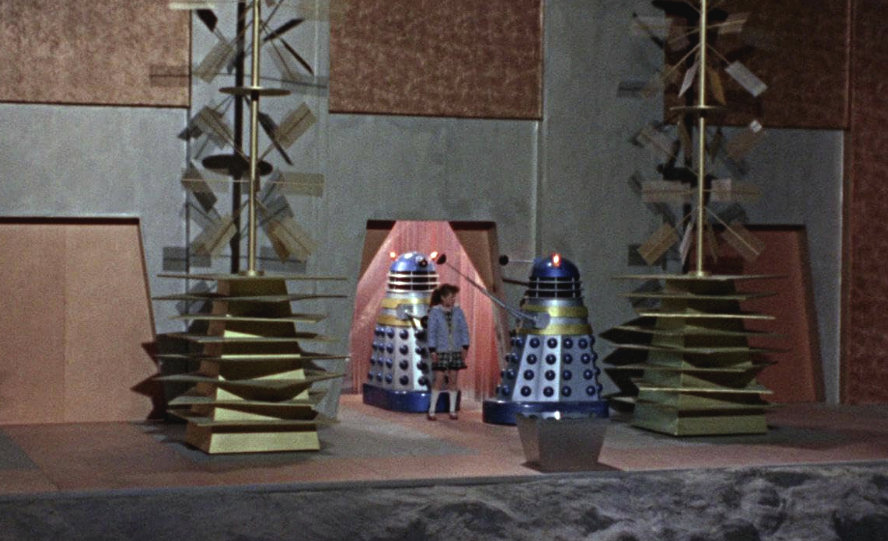
Upon returning to the city, the Daleks discover the second drug supply, but they keep their word allowing the humans to treat themselves with it. Susan explains to the others the Thal crops have failed and they have come to the city hoping to trade the anti-radiation drug formula to the Daleks for food. But since the Daleks have the humans under surveillance, they know the plight of the Thals. As a result, they decide the Thals are now expendable as they have a sample of the drug.
As part of a “peace offering,” the Daleks convince Susan to write a letter promising they will provide food the Thals can collect throughout the city. However after Susan completes the letter, the Daleks reveal their plan to kill the Thals.
When a Dalek enters their cell, the Doctor and his group disable it. They manage to escape and warn the Thals entering the city. Together they evade the Daleks by fleeing into a jungle. Meanwhile, the Daleks have discovered the anti-radiation drug has side effects so disastrous as to render it virtually unusable. For revenge, the Daleks decide to detonate a neutron bomb which will increase the planet’s radiation level above that which even the Thals could survive.
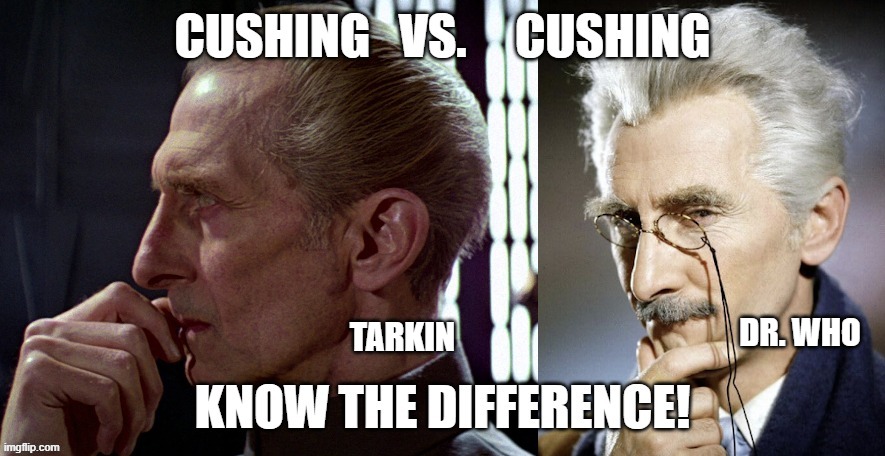
This is when Dr. Who realizes they are stranded as long as the Daleks still have the fluid link, and he cannot get it back without the Thals’ help. Alydon declines to fight the Daleks insisting the Thals are now peaceful. However, Dr. Who orders Ian to take a Thal woman to the Daleks in exchange for the fluid link. Alydon stops Ian from carrying out the order, but the Doctor has proven the Thals will fight given the proper provocation. Alydon and the Doctor lead the Thals in an attack on the city, but the Daleks hold their ground. During the battle, Dr. Who and Susan are re-captured.
At the same time, Ian, Barbara, and a small group of Thals execute a raid on the Dalkes from the rear. Once inside the city, they join the remaining the Thals who have mounted a successful mission rescuing the Doctor and Susan. Now they are able to access the Daleks main control center, where they have begun the detonation process for the neutron bomb. A battle ensues, during which the Daleks inadvertently destroy their main control console, which cuts their power and stops the bomb detonation.
The Hidden Sports Analogy:
In it’s very own trailer, this film mentions the accidental journey. My own first paragraph is forced to discuss it; it’s pretty central to the plot here. But the true irony lies in the fact the entire Doctor Who franchise is itself an accidental journey.
In December 1962, Doctor Who was conceived by the British Broadcasting Corporation (BBC); it was originally intended to be a science-fiction series, but more educational than entertainment. The premise concerned the adventures of an old man traveling through space and time in his TARDIS (disguised as a police call box) discussing various events through out history. Many TV executives thought it would never be made; others believed if it went to production it would be short-lived.
One BBC executive named Sydney Newman decided such a low-risk project might be the perfect “proving ground” for a young production assistant named Verity Lambert. In all honesty, she was far from Newman’s first choice. But after several others declined the opportunity, he was at the point where he faced the classic “low-risk, high-reward” risk.
While Lambert was seen as bright and capable, Britain was like many other places in the world in the 1960s. There simply weren’t very many women in the professional work force, let alone in such a niché role as television producer.
In other words, if she succeeded, Newman could add more talent to his stable. If not, he wasn’t really risking anything. The reason such gambles are low-risk because they nearly never pay-off. But when Doctor Who debuted on November 23, 1963, it literally became an overnight sensation.
Newman put a young unknown on their game’s biggest stage, and she threw a knock-out punch which changed the world. Only a few months later, a young boxer named Cassius Clay would do the same thing.

Lambert’s first indicator of success came as she rode the bus to work the following morning. She couldn’t help but notice children on the bus were chasing each other around yelling, “EXTERMINATE THE HUMANS!” in their best Dalek-robot voices.
Ironically, it was the Daleks driving the show’s success, but during production BBC’s Head of Serials Donald Wilson (who was Lambert’s boss at the time) had strongly advised against using the script in which the Daleks first appeared. Wilson’s calculus was still rooted in the show’s educational concept, which he could not jibe with man-killer robots. He also had sample audience testing that reflected the show’s concept wasn’t a winner. But Wilson’s attempt at quantifying what people liked failed catastrophically. As a result, he admitted Lambert had a better feel for the direction of Doctor Who and gave her leave to create the show’s content as she saw fit.
Newman won his gamble, and the pay-off was one of the classic science-fiction series of all-time.
You simply never know what’s going to work. The business world loves to find new ways attempting to quantify the chances of outcomes. The sports world is full of similar perversions of probability and statistics. When such a gumbo is spiced with enough pseudo-math, wishful thinking, and outright voodoo, the result is “analytics.”
This isn’t the first time the sports world love of numbers has been examined in this series. The first time may serve as the perfect example for the theme here. Professor Groeteschele from Sidney Lumet’s 1964 Cold War classic Fail-Safe is the literal embodiment of the so-called expert who is “never wrong.”
For purposes of this discussion, the difference between boxing coaches and British television executives is irrelevant; they both used the analytic pursuit of perfection to be completely wrong.
In the lead-up to the Rome 1960 Summer Olympic Games, the Americans were rounding out their boxing team, but they had one major quandary. They had an 18-year light heavyweight named Cassius Clay that polarized the powers-that-be in the Team USA boxing world.
There were those who felt Clay’s agility combined with his ability to counter-punch made him a formidable threat in the 81-kilogram divsion. Those views were opposed by the forerunners of today’s “Groetescheles” who swore the “numbers” on Clay simply didn’t add up to his being a successful boxer.
The “Tale of the Tape” is specific to boxing, but it really proved to be the “preview of coming attractions” for the analytics crowd. Frankly, it’s little more than a spurious a concept based on the belief that a major part of determining those with the proper construct for being a boxing champion can be done through a series of measurements.
This a pure example as to why I don’t trust analytics. When it comes to sports, there’s only two types of people who rely on statistics to drive a discussion. There’s the guy who didn’t even watch the event, and he’s opposed by the guy who didn’t understand what he saw. Just watch the American sports media for 30 minutes and the fact there is no other option will become abundantly clear.
Here’s another case of a distinction without a difference; it matters little which sort of “Groeteschele” missed the boat on Cassius Clay. They were both wrong and refused to admit it…even as the data points rolled in suggesting their error.
The “Groetescheles” lost the argument about putting Clay on Team USA. They didn’t even consider being in error even after Clay dominated in Rome on his way to a gold medal as a light heavyweight. Even as Clay worked his way through a slate of contenders, his detractors kept pointing out he struggled to win fights with top contenders.
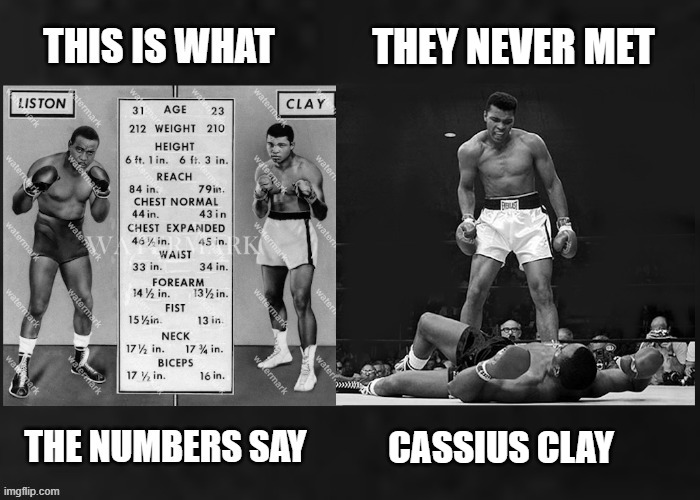
It wasn’t until Cassius Clay captured the heavyweight title in 1964 that his detractors finally stood silent. Many of them never admitted their error; their silence was far more indicative than anything they ever actually said.
Their drought of words continued as the hurricane that was Cassius Clay became Muhammad Ali. It’s only the sheer magnitude of how far off the mark the “Groetescheles” were that overshadowed their silence. Ali became universally regarded as the greatest boxer of all time and one of the most revered and transcendent athletes in all of sport (that might have something to do with why he’s been featured before in this series).
The Moral of the Story:
You can do all the “math” you want…you just never know.
Got a question, comment, or just want to yell at us? Hit us up at dubsism@yahoo.com, @Dubsism on Twitter, or on our Pinterest, Tumblr, Instagram, or Facebook pages, and be sure to bookmark Dubsism.com so you don’t miss anything from the most interesting independent sports blog on the web.

 Dubsism
Thanks for adding this non-horror film to our blogathon, and great to see this one again. Really loved that you added the unsung Doctor Who of the movies and great pics. The Daleks don’t seem too scary next to the wee girl – thanks for joining and added you to day 1 of the blogathon, out around this time tomorrow.
LikeLiked by 1 person
[…] at Dubsism shares his thoughts on Amicus’ Doctor Who and the Daleks (1965) and adds his own particular twist with his hidden sports […]
LikeLike
Clever post, Jonathan!
I would have never guessed the connection between Doctor Who and Cassius Clay, but the moral adds up.
LikeLike
Thanks! One man’s moral is another’s chemical imbalance 🙂
LikeLike
Fascinating review. I never anticipated that you would draw a parallel between Muhammad Ali and Dr. Who, but there you have it. Thanks for joining the blogathon!
LikeLiked by 1 person
That was an interesting and very informative article! This film sounds like quite an adventure!
LikeLike