Life as viewed through sports, old movies, and too many concussions
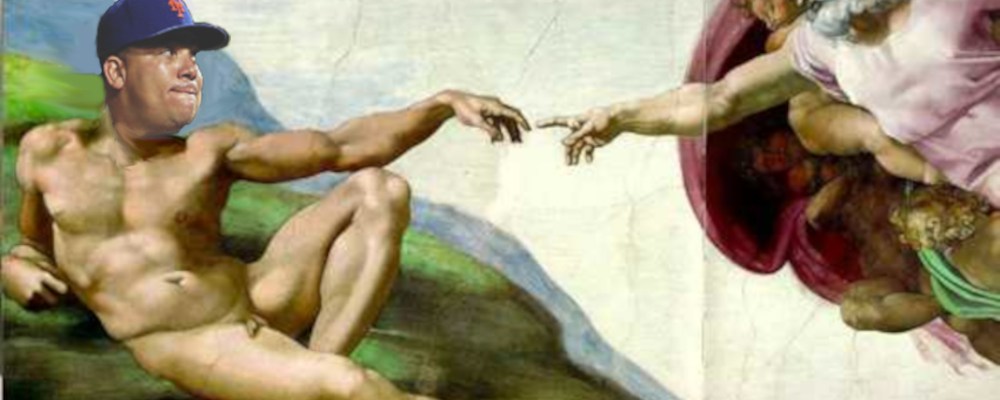
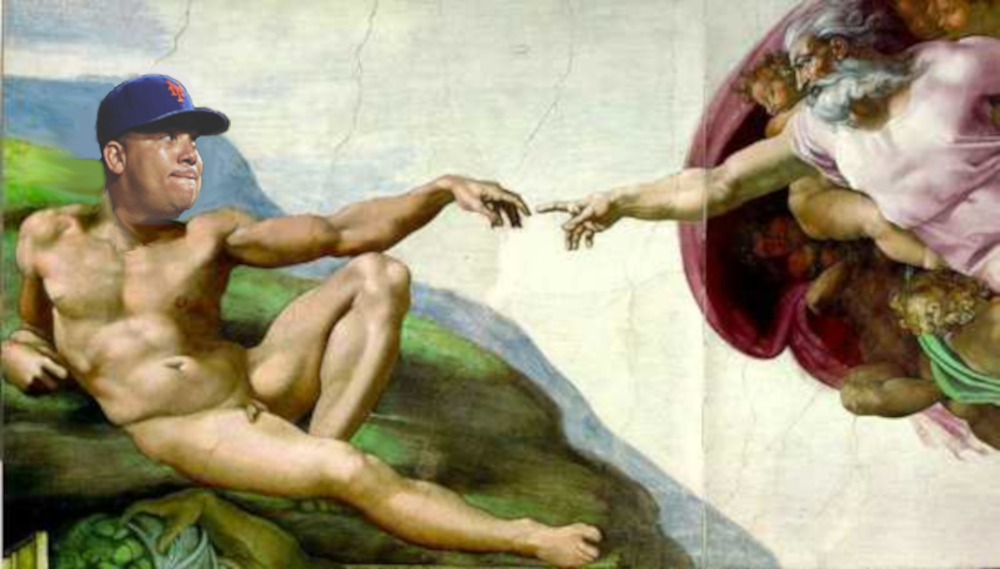
Cooperstown Complaints: Episode 4 – Arguments On the Existence of God and Their Equivalents Concerning Bartolo Colon as a Hall of Famer
At one time I used this approach for Dubsism’s Jamie Moyer for the Hall of Fame campaign. The case of Bartolo Colon’s enshrinement offers the same “perfect storm;” it feels like time for a resurrection. After falling off the ballot in his first season (2024), there’s clearly a need for “divine intervention” concerning Colon’s candidacy for Cooperstown. Let’s be honest…the argument can be had (hence this piece) about whether Colon is worthy of enshrinement, but the fact the man only received five votes is blasphemy.
Scoff at the religious overtones all you want, but in the movie Bull Durham, Susan Sarandon called it the “Church of Baseball.” Sticking to that analogy like pine tar, if baseball is a church then the Hall of Fame is it’s sacred reliquary. Whether you want to talk about his shine on the diamond or dig into the theology of the “Church of Baseball,” I’m here offering the much-needed broader discussion about Colon’s worthiness for enshrinement.
Bartolo Colon’s Cooperstown Candidacy: On The Diamond
247 Wins: Better than Hall-of Famers Joe McGinnity (246), Juan Marichal (243), Herb Pennock (241), Mordecai “Three Finger” Brown (239), Clark Griffith and Waite Hoyt (237), Whitey Ford (236), Jim Bunning and Jim “Catfish” Hunter (224), Pedro Martinez (219); as well as more than Cooperstown locks (as of this writing) Clayton Kershaw (223) and Max Scherzer (221)
Two 20-win season (2002, 2005)
Had 9 seasons with at least 15 wins
2,535 Strikeouts: Better than Hall-of-Famers Christy Mathewson (2,507), Don Drysdale (2,486), Jack Morris, (2,478), Jim Kaat (2,461), the aforementioned Jamie “Not in Cooperstown” Moyer (2,441), Dennis Eckersley (2,401), Sandy Koufax (2,369), Robin Roberts (2,357), Early Wynn (2,334), Juan Marichal (2,303), and more…
Had 2 200-strikeout seasons (2000, 2001)
Plate appearances were not counted in the strikeout totals
1.3118 Career Walks/Hits Per Innings Pitched (WHIP): Better than Hall-of Famers Clark Griffith (1.3126), Tom Glavine (1.3137), and Bob Feller (1.3157)
4-time All-Star: (1998, 2005, 2013, 2016)
1 Cy Young Award: (2005, 21-8, 3.48 ERA) There’s a long list of great pitcher s who never won a Cy Young, including Hall-of-Famers Juan Marichal, Mike Mussina, Nolan Ryan, and Don Sutton
Finished in the Top 10 in Cy Young Award voting three additional times: 1999 (4th), 2002 (6th) and 2013 (6th)
Speaking of things needing to be mentioned, it’s not possible to over-value the importance of guys who show up for “big games.” Colon was a member of two pennant-winning clubs (Cleveland Indians, 1997; New York Mets, 2015). In 10 post-season starts, Colon notched a 3.49 Earned Run Average (ERA), which compares him favorably to other noted “big-game” pitchers of his era like Tom Glavine and Roger Clemens.
Bartolo Colon’s Cooperstown Candidacy: The Epistemology
One of the blogosphere’s greatest charms is it’s serving as the express train from the sublime to the ridiculous. I’m proud to be the chief engineer on that train, especially when I can illustrate absurdity when it’s rooted in it’s own pomposity, like that of Baseball Writer’s Association of America (BBWAA).
The very genesis of this series is the growing list of errors being committed by the BBWAA in their role as the gatekeepers to the Hall of Fame. Like Jamie Moyer, Bartolo Colon didn’t get nearly the consideration he deserved. Now he’s is just another entry on the scroll of evidence suggesting BBWAA is loaded with people who really don’t understand baseball beyond analytics.
This is where two terms have become so muddled as to have become erroneously interchangeable; despite their overlap, “statistics” and “analytics” are not identical.
“Analytics: a process in which a computer examines information using mathematical methods in order to find useful patterns.”
“Statistics: the science of collecting, organizing, analyzing, interpreting, and presenting data to understand patterns, make decisions, and draw conclusions about populations from samples.”
Literally by definition, “analytics” is a process, whereas “statistics” is a science. That’s a major distinction because a process is a series of actions taken in order to achieve a particular end; whereas science is discovering, interpreting, and communicating significant patterns in data to drive justified beliefs. Science also allows for the changing of those beliefs based on data collected; processes are by their very nature designed to limit external inputs once it is in place.
Combined withe the sheer arrogance of the writers who have appointed themselves as some sort of moral arbiter, the false idolatry of “analytics” have landed both Moyer and Colon (among many others) in the same Hall of Fame “purgatory.” It’s also the force driving any argument based on numbers into a discussion of that original difference.
As such, I’m drawn back to the theological arguments supporting Moyer’s case I used from a Listverse post because they also eerily apply to Bartolo Colon while illustrating the errors of the BBWAA.
1) Ontological Argument
“First formulated by St. Anselm, Archbishop of Canterbury, then taken up by Alvin Plantinga. “God exists, provided that it is logically possible for him to exist.” This argument is quite brazen in its simplicity, requiring not only a belief in God, but a belief in the necessity of God. If you believe he is necessary, then you must believe he exists.
The Counter Argument
Criticism typically deals with the Ontological Argument committing a “bare assertion fallacy,” which means it asserts qualities inherent solely to an unproven statement, without any support for those qualities. It is also criticized as a circular argument, revolving from a premise to a conclusion which relies on the premise, which relies on the conclusion.”
How This Applies To Colon
Ontology focuses on the study of being, existence, and reality, where epistemology is about the study of knowledge, belief, and justification. In other words, ontology asks “What is there (what exists)?”while epistemology asks “How do we know what exists?”
Does that sound familiar? It should, because the difference in play here is the same as those being confused by the BBWAA. “Analytics vs. Statistics” is a perfect example of the difference between ontology and epistemology.
Not only does this argument strike at the heart of that difference, it establishes it as a recurring theme. That thread weaves it’s way throughout this piece because Colon clearly lacks analytical appeal based on his paltry vote total from the writers. Conversely, as shown above, a credible argument can be made statistically for Bartolo Colon to be inducted into the Hall of Fame.
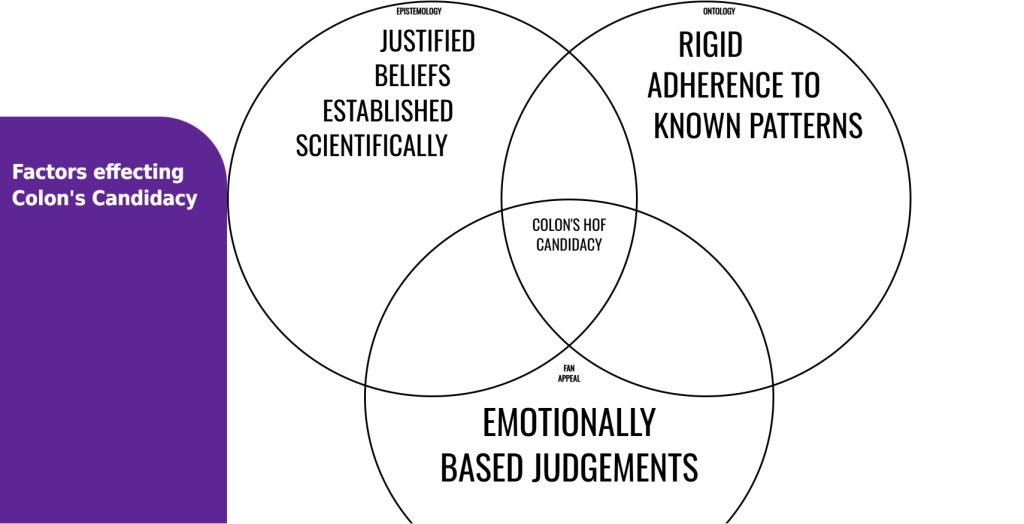
As the counter argument above states, the Ontological Argument can be seen as circular. To me, it’s biggest flaw stems from it’s ignoring Colon’s fan appeal, which is something which seems to be shared by the BBWAA. This also causes the writers to dismiss any career numbers amassed his prime, believing them to be simply compiling the career numbers shown above which (like it or not) put him in the same neighborhood as several Hall-of-Famers.
Given those three subsets of data, the Ontological Argument inherently denies Bartolo Colon’s late-career value an an experienced major-league pitcher. Instead, it discounts it because he was an overweight pitcher in his 40’s because he was compiling career numbers placing him in proximity to such “sacred cows” as Juan Marichal and Sandy Koufax. Not only does that completely ignore Colon’s popularity at the end of his career, it dismisses a central tenet in life in general…not just sports. Guys who can do the job are the guys who get the job. That means experienced major-league pitchers – even fat, middle-aged guys – who can get guys out will always land on a roster…and compile numbers.
I find it difficult to accept an argument which ignores merit for any reason…no matter how it gets there.
2) Moral Argument
“This argument is very old, and states that God must exist for the following reason:
An aspect of morality is observed.
Belief in God is a better explanation for this morality than any alternative.
Belief in God is thus preferable to disbelief in God.
The Counter Argument
This argument is technically valid, provided that the three constituents are accepted, and most critics refuse to accept the first. Morality, they argue, is not universal. Murder was perfectly fine for the soldiers of the First Crusade, who slaughtered every man, woman, and child in Jerusalem in 1099. Thomas Hobbes argued that morality is based on the society around it, and is thus not objective.”
How This Applies To Colon
The Moral Argument brings us to another flaw in the Ontological Argument, because it adheres to the “four pillars” of epistemology…belief, truth, evidence, and reason.
The lack of belief…particularly that of justifiedbelief…makes it easy to get lost in the “Alanis Morrisette” level irony in applying what may be the oldest argument on this list to what may be the oldest pitcher to notch a Major League home run. Like Moyer, Colon’s candidacy created an impassioned schism. Without any analytical thought, the mention of Colon potentially being enshrined in Cooperstown led to an immediate “yes” or “no” among those asked.
That also happens to be the inherent flaw in the current induction protocol and it’s reliance on the BBWAA; the confusion of personal bias with justified belief.
3) Argument From Degree
“This is one of St. Thomas Aquinas’s “Five Proofs of God,” and still causes debate among the two sides. Here is Aquinas’s statement of it, which I have translated from Latin, for a sense of thoroughness:
The fourth proof originates from the degrees discovered in things. For there is discovered greater and lesser degrees of goodness, truth, nobility, and others. But “more” or “less” are terms spoken concerning various things that approach in diverse manners toward something that is the “greatest,” just as in the case of “hotter” approaching nearer the “greatest” heat. There exists, therefore, something “truest,” and “best,” and “noblest,” which, in consequence, is the “greatest” being. For those things which are the greatest truths are the greatest beings, as is stated in Metaphysics Bk. II. Furthermore, that which is the greatest in its way, is, in another way, the cause of all things belonging to it; thus fire, which is the greatest heat, is the cause of all heat, as is said in the same book (cf. Plato and Aristotle). Therefore, there exists something that is the cause of the existence of all things, and of goodness, and of every perfection whatever. We call this “God.”
The Counter Argument
The most prevalent criticism of this argument considers that we do not have to believe in an object of a greater degree in order to believe in an object of a lesser degree. Richard Dawkins, the most famous, or infamous, Atheist around these days, argues that just because we come across a “smelly” object, does not require that we believe that we believe in a “preeminently peerless stinker,” in his words.”
How This Applies To Colon
The most compelling argument here comes from St. Thomas Aquinas. It centers on the justified belief that within the spectrum of any belief system, there is a point at which we all draw a line in terms of acceptance without truth, evidence, and reason. This drives the third subset in the Venn diagram above; this is the essence of Fan Appeal, especially in the case of Colon.
Aquinas argument also embraces the universal nature of emotional appeal; even relying on it to a degree as this entire construct touch on the fundamental tenets of faith. But it also serves as the purest example of the errors of the Ontological Argument and it’s selective reliance on the “analytics” based approach of the BBWAA.
First, there is the sheer nature of the “analytics” argument. Hall of Fame voting has always been cast in the light of “magic numbers;” we all know such standards as 300 wins and 3,000 strikeouts. But there’s three facts which change the calculus:
Those standards are not absolute, which is why it took so long for guys Don Sutton and Bert Blyleven to be inducted.
Those standards were set in a different era; Greg Maddux may very well be the last 300-game winner (let alone 350) we see as long as baseball continues it’s love affair with the five/six-man rotation.
Because of their transitory status and the era in which they were in common acceptance, the writers have largely abandoned the statistically-base “numbers” approach for their “analytics.”
More importantly, this is more significant than simply swapping which set of numbers you prefer. The traditional “numbers” argument is a “top-down” construct, in much the same way as Thomas Aquinas’ “Greatest Heat” argument serves as the backbone for the Argument From Degree.
“…proof arises from the degrees that are found in things. For there is found a greater and a less degree of goodness, truth, nobility, and the like. But more or less are terms spoken of various things as they approach in diverse ways toward something that is the greatest, just as in the case of hotter (more hot) which approaches nearer the greatest heat. There exists therefore something that is the truest, and best, and most noble, and in consequence, the greatest being. For what are the greatest truths are the greatest beings, as is said in the Metaphysics Bk. II. 2. What moreover is the greatest in its way, in another way is the cause of all things of its own kind (or genus); thus fire, which is the greatest heat, is the cause of all heat, as is said in the same book (cf. Plato and Aristotle). Therefore there exists something that is the cause of the existence of all things and of the goodness and of every perfection whatsoever—and this we call God.”
~ Paul Halsall, Fordham University
In other words, this argument explains our collective preference for using the “greatest” to set standards; the “greatest” heat establishes the measure for determining lesser heat. That’s why a century after the heart of his career, Babe Ruth is the standard we use for sluggers. The same applies to pitchers and such immortals as Cy Young and Walter Johnson.
Don’t worry, next up there’s more on “numbers” and hitters…
4) Argument From Reason
“One of my favorites, with very intricate abstraction. C. S. Lewis (who wrote “The Lion, the Witch, and the Wardrobe”) came up with this. It begins as an argument from design, and then continues into something new. Very basically, it argues that God must exist, because, in Lewis’s words:
“Supposing there was no intelligence behind the universe, no creative mind. In that case, nobody designed my brain for the purpose of thinking. It is merely that when the atoms inside my skull happen, for physical or chemical reasons, to arrange themselves in a certain way, this gives me, as a by-product, the sensation I call thought. But, if so, how can I trust my own thinking to be true? It’s like upsetting a milk jug and hoping that the way it splashes itself will give you a map of London. But if I can’t trust my own thinking, of course I can’t trust the arguments leading to Atheism, and therefore have no reason to be an Atheist, or anything else. Unless I believe in God, I cannot believe in thought: so I can never use thought to disbelieve in God.”
The Counter Argument
It sounds powerful, and the final judgment on it is still out there. But its primary weak point is that, in the strictest sense, it is not a proof of God’s existence because it requires the assumption that human minds can assess the truth or falsehood of a claim, and it requires that human minds can be convinced by argumentation.”
But in order to reject the assumption that human minds can assess the truth or falsehood of a claim, a human mind must assume that this claim is true or false, which immediately proves that human minds can assess the truth or falsehood of a claim.
But none of this has anything to do with God’s existence. Thus, the argument is better treated as a disproof of naturalistic materialism. However, given that most Atheists use naturalistic materialism as the foundation of Atheism, is is a very viable argument.”
How This Applies To Colon
In more irony, the Argument From Reason may be the most unreasonable argument discussed here because it shares the inherent weakness in an argument made by C.S. Lewis. This is what links excluded pitchers like Bartolo Colon and the cavalcade of hitters who are not yet enshrined in Cooperstown. Trust me, there’s much more on that coming in this series, but I can’t think of a better example than Bill Buckner…which is why he hit lead-off for Cooperstown Complaints.
Too many members of the BBWAA believe in “the unforgiveable sin.” The problem is they also believe defining the sin and punishing the sinner are both within their parlance. The Bible identifies only one unforgivable sin: blasphemy against the Holy Spirit. Specifically as mentioned in Matthew 12:31-32, Mark 3:28-30, and Luke 12:10, it’s defined as attributing the work of the Holy Spirit (convicting people of sin and drawing them to Christ) to Satan, a deliberate and rejection rejection of God’s saving grace, which ultimately leads to unrepentance and eternal separation from God.
In other words, the “unforgiveable sin” is not a single bad act like murder or adultery, rather a continued and persistent refusal to accept God’s forgiveness, leaving no path to salvation. That’s why the forgiving is found only through Jesus Christ as delineated in John 14:6.
However, the BBWAA is a collection of egos who believe their own judgment supersedes the forgiveness of the Holy Spirit, which in this case is represented by the Hall of Fame itself and/or Major League Baseball. Instead, because of one bad act – arguably the most famous error in the history of baseball – Bill Buckner had a career worthy of far greater consideration than 10 lousy votes. I’m pretty sure I know what Colon’s “unforgivable sin” was… his 2012 PED suspension. That’s why his consideration got the same “bum’s rush” as did Buckner.
Worse yet, the entire construct gets wrapped around it own axle because of its own intrinsic contradiction as laid out in the counter argument. When it comes to the writers and the Hall of Fame, the entire “numbers” argument is predicated on human judgement. The entire construct is dependent on the assumption that human minds can distinguish true from false and can be convinced by arguments. But rejecting the assumption upon which the entire construct relies can only be done by admitting the human mind can understand the false nature of the original claim…which proves the original claim.
Boil it all down and what you’re left with is this: if we as humans cannot trust our own judgement, then what the hell does any of this matter?
5) Cosmological Argument
“Thomas Aquinas’s most famous proof of God refuses to go away. You’ve probably already heard of it in some form. It was around before Aquinas, at least as early as Plato and Aristotle, and in basic terms, it goes like this:
1. Every finite and contingent being has a cause. 2. Nothing finite and contingent can cause itself. 3. A causal chain cannot be of infinite length. 4. Therefore, a First Cause (or something that is not an effect) must exist.
This is especially impressive in that it was theorized by the Ancient Greeks, at a time when the Universe was not known to have had an origin. Today, we call this “the Big Bang,” and the argument has changed to this form:
1. Whatever begins to exist has a cause. 2. The Universe began to exist. 3. Therefore, the Universe had a cause.
The Counter Argument:
Sequentially speaking, these three points are true. But the second point requires the Universe to have had a cause, and we still aren’t sure it did. “The Big Bang” is the most prevalent astrophysical theory today, but it has its detractors, most arguing that because the mathematics that leads back to a big bang do not function at the point immediately prior to the big bang, those mathematics were invalid to begin with.
Better than this, however, is the argument that this proof of God commits the logical fallacy called “infinite regression.” If the Universe had a first cause, what caused that first cause? Criticism declares that it is unfair to argue for every thing’s cause, and then argue for the sole exception of a “First Cause,” which did not have a cause.”
How This Applies To Colon
Obviously, the cause here is the re-ignition of Bartolo Colon’s campaign. The reason covers the soul of the Colon’s fan appeal. The progression works like this:
The driving force behind this blog is an old, fat guy.
Bartolo Colon was competing in Major League Baseball as old, fat guy.
Generally, being an old, fat guy means an end to your competitive athletic days.
Old, fat guys everywhere were living vicariously through Bartolo Colon, and they loved him for it.
If that isn’t a cause, what is?
The Bottom Line On Bartolo Colon
It’s quite plausible that Bartolo Colon wouldn’t have been elected by the writers even without their “Chemical McCarthyism.” The fact is all tolled, his career lands squarely in “could go either way” territory
The SABRmetricians could point to Colon’s career Wins Above Replacement (WAR) of 49.2 being higher than many pitchers inducted into Cooperstown, including Dizzy Dean, Catfish Hunter, and Jack Morris. Morris matters here because his induction has become a de facto baseline for other pitchers for comparison for any of the various “numbers” arguments; stuff like “his WAR was higher than Morris’” or “his ERA was lower than Morris.” I’m not sure why that is, but I do know Colon falls right in the middle here.
Now, it’s time for you to decide…
Got a question, comment, or just want to yell at us? Hit us up at dubsism@yahoo.com, @Dubsism on Twitter, or on our Pinterest, Tumblr, Instagram, or Facebook pages, and be sure to bookmark Dubsism.com so you don’t miss anything from the most interesting independent sports blog on the web.
Know somebody who might like this? Share it here!:









 Dubsism