
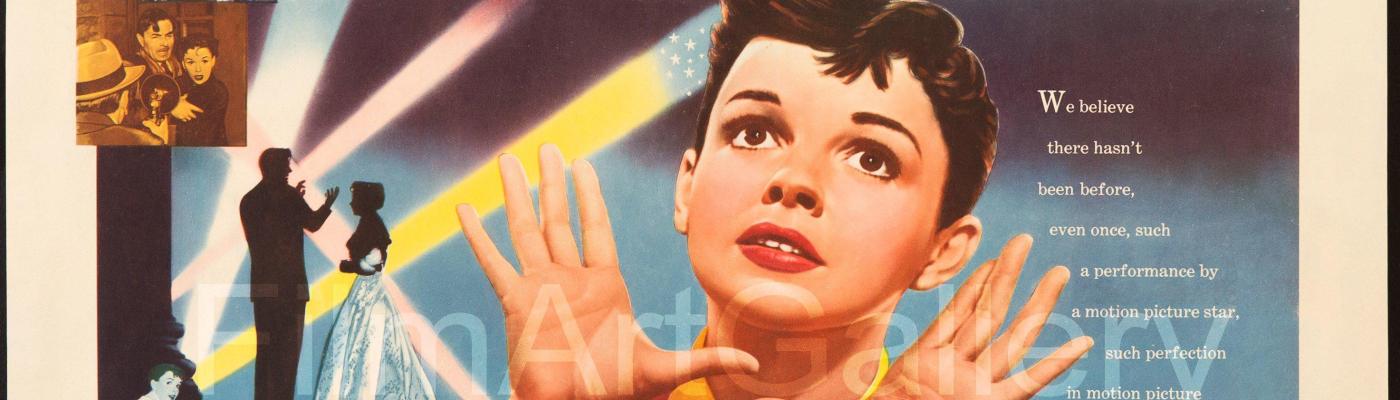

- Today’s Movie: A Star Is Born
- Year of Release: 1954
- Stars: Judy Garland, James Mason, Jack Carson
- Director: George Cukor
This movie is on my list of essential films.
NOTE: This installment of Sports Analaogies Hidden in Classic Movies is not being done as part of a blog-a-thon. Instead, this is a monthly event hosted by MovieRob called Genre Grandeur. The way it works is every month MovieRob chooses a film blogger to pick a topic and a movie to write about, then also picks a movie for MovieRob to review. At the end of the month, MovieRob posts the reviews of all the participants.
For July of 2023, the honor of being the “guest picker” went to MovieRob himself, and the topic is “movies about making movies.”
The Story:
This film opens showing a gala event at Hollywood’s Shrine Auditorium. One of the chorus girls is a talented singer named Esther Blodgett (played by Judy Garland). Backstage, her path crosses with former matinée idol Norman Maine (played by James Mason). Maine is clearly drunk, and studio publicist Matt Libby (played by Jack Carson) attempts to keep him off the stage. Despite this, Maine bursts into the action. In an attempt to save the number, Blodgett takes Maine by the hand pretending his drunken antics are all part of the show. As a result, the audience erupts in applause.
Having a moment of clarity, Norman sees that Esther’s improvisation saved him from serious public humiliation…which he can ill afford as his career in on the decline and the studio is beginning to tire of his escapades. Maine gives her a gushing “Thank You” and takes her lipstick to draw a heart on the wall.
Later, Norman sees her sing in an after-hours club frequented by musicians. He is immediately taken by her immense talent, and beseeches her to follow her dream. He also insists that she can break into movies. Esther is initially taken aback by Norman’s interest in her; she doesn’t believe that a star of his magnitude would show an interest in her.
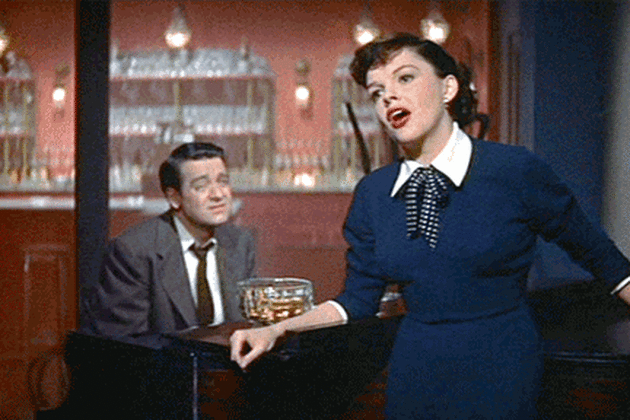
Putting his money where his mouth is, Norman tells Esther her can get her a screen test, asks her to “sleep on it,” and promises to call her the next day. Next thing you know, she tells her bandleader Danny McGuire (played by Tom Noonan) that she is quitting. As much as he tries to dissuade her, Esther is resolved to follow her dream.
However, Norman is called away early in the morning to a filming location. He tries to send a messenger to Esther, but this fails as he cannot recall her address. Since she doesn’t hear from Norman, she writes him off and goes on with her life. Now that she’s quit the band, she takes jobs as carhop and a television commercial singer as she is determined to succeed on her own.
Norman keeps trying to contact Esther, but he finds her apartment only to discover she has moved. Norman catches a break when he hears her voice in a commercial and uses that to track her down. After finding her, Norman pulls some shenanigans to get studio head Oliver Niles (played by Charles Bickford) to cast Esther in a small film role.
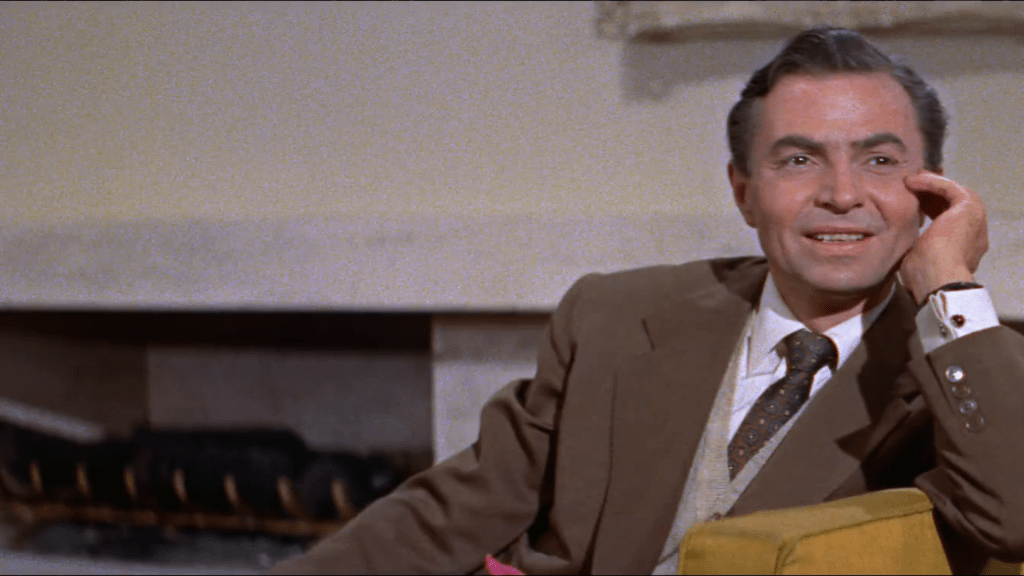
At first, Niles is skeptical believing that Esther is simply one of Norman’s passing fancies, but when Norman finally gets Niles to hear Esther (whose name has now been changed to “Vicki Lester” by the studio) sing, he too is taken with her talent and puts her in a “big-time” musical. This launches her career, and as the tile says…a star is born. In the middle of all this, Norman and Esther/Vicki elope…infuriating Libby as they have deprived him of a huge Hollywood publicity opportunity.
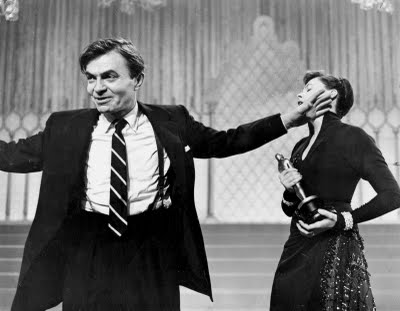
Esther/Vicki’s career now takes a meteoric rise, but as she is on the ascent, Norman is heading in the opposite direction. Once the king of Hollywood, Norman is now an aging alcoholic in a world which just doesn’t have much tolerance for his drunken antics. The essential example of this is when Esther/Vicki wins an Academy Award and during her acceptance speech, a completely wasted Norman blusters into her acceptance speech and accidently hits her in the face.
Niles now has two problems. Not only is his cratering matinée idol becoming a public relations problem, but he fears years of enabling Normans’ drinking will have an adverse effect on the continued rise of his new star. Esther/Vicki tells Niles that Norman has checked himself into a sanitarium. Acknowledging Norman is addressing his addiction issues, and as a favor to Esther/Vicki, Niles agrees to offer Norman some work.
Later, Norman is at a racetrack where he encounters Libby. Norman attempts to be polite with Libby who wants no part of him. Instead, Libby taunts and insults Norman, making it known they are not friends, and that Libby only bailed Norman out of his troubles on so many occasions because it was his job. When Libby jabs Norman with the comment that he can always live off his wife, Norman throws a punch at him. However, Libby is a much larger man and in better shape; he proceeds knock Norman flat on his ass. As a result, Norman saddles up to the racetrack bar, starting a binge which will ultimately land him in front of a judge. Norman finds himself on the wrong end of a 90-day sentence for being drunk and disorderly. Esther/Vicki pleads with the judge to release Norman into her custody, to which he reluctantly agrees.
Back at home, Esther/Vicki puts Norman to bed. Niles comes to the house, and during their conversation about what to do with Norman, Esther/Vicki tells Niles she will give up her career to nurse Norman back to health. Little do they know Norman is not asleep and has overheard their entire discussion. Realizing that not only has he destroyed himself, he is now on the verge of doing the same to Esther/Vicki. Norman rises from bed, tells Esther/Vicki that he is going to refresh himself with a swim in the ocean, and that he wants her to prepare sandwiches for a meal afterward. Esther/Vicki is overjoyed to see a cheerful Norman again, but she has no idea Norman has no intention of returning from the ocean…and he doesn’t.
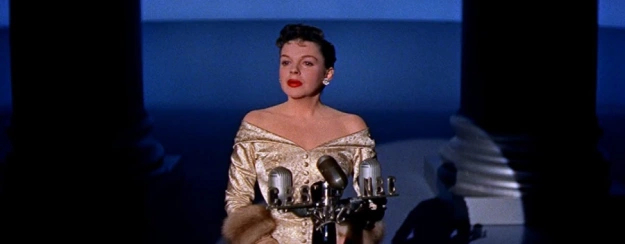
At Norman’s funeral, Vicki is mobbed by reporters and fans. Horrified by that mob scene, afterward she cloisters herself in her home. She remains a recluse refusing to see anyone until her old bandleader Danny convinces her to attend a charity function. She agrees, and upon arriving backstage at the Shrine Auditorium, she spots the heart Norman drew on the wall the night they met. Esther/Vicki momentarily loses her composure, but recovers in time to introduce herself to the crowd and a worldwide television audience as “Mrs. Norman Maine.”
The Hidden Sports Analogy:
This coverage of A Star Is Born marks the first time a movie has been featured three times on Dubsism. The first was a complete parody; the second was a comparison of all the versions of A Star Is Born and the various incarnations of the Oakland Los Angeles Oakland again Las Vegas Raiders. But now it’s time to talk about the Hall-of-Fame sports analogy hidden in this movie.
Those who know me and/or have been regular readers of this blog should be aware of my life-long hatred of the Los Angeles Dodgers. Following that, you might just know that I consider storied Dodger skipper Tommy Lasorda to be just this side of the Anti-Christ.
Those who know this version of A Star Is Born already know that Norman Maine is drunken reprobate. But no matter the depths to which they sink, no one is 100% pure evil. After all, everybody knows that at least Hitler made the trains run on time. As for Norman Maine and Tommy Lasorda go…well, they were instrumental in launching legendary careers.
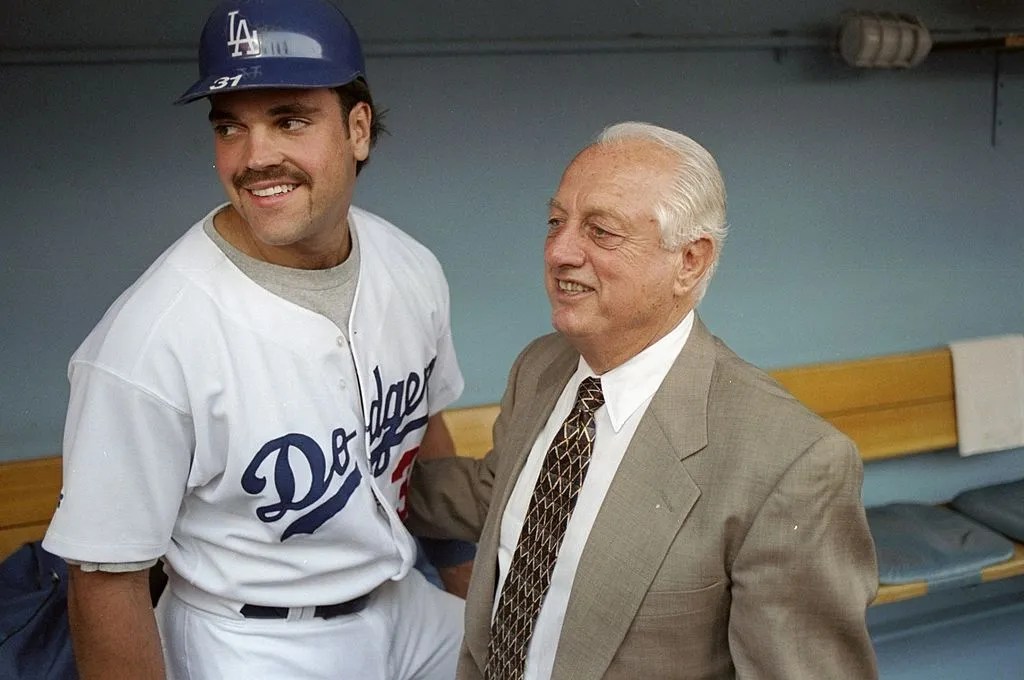
You just read about Maine’s role in the rise of Esther Blodgett/Vicki Lester. But if it weren’t for Tommy Lasorda, the Hall-of-Fame career of Mike Piazza may have never been.
Back in 1988, Piazza was plying his wares as a baseballer at Miami-Dade North Community College. Outside of south Florida, this institution may not be on your radar, but that’s not the case if you happened to be a major league scout. This is a school which produced big leaguers like Raúl Ibáñez, Plácido Polanco, Andrés Torres, Alex Fernández, Bucky Dent, Warren Cromartie, Mickey Rivers…amongst many others. But nobody thought a young first baseman named Mike Piazza would ever be in those ranks.
However, young Piazza had an ace in the hole. His father Vince just so happened to have a life-long friend he grew up with in Norristown, Pennsylvania who just so happened to be Tommy Lasorda. Vince Piazza was in his youth an aspiring “boy of summer,” but like 99.99999% percent of us who had the same dream of getting to “The Show,” he fell short. But he was determined that one of his sons would be a major league baseball player.
To that end, Vince Piazza called his childhood friend to request a favor. Piazza asked Lasorda if the Dodgers might use a late-round draft pick to take his son Mike. Not wanting to say no to his childhood friend, Lasorda pulled some strings with the Dodgers and lo and behold, the Dodgers used their last pick…in the 62nd round; the 1,390th overall selection…to draft Mike Piazza.
Let’s be honest. Anybody who survives the draft all the way down to the 62nd round has a pretty slim chance to be a “boy of summer.” Hell, I was a college-age ballplayer in 1988, and I survived the entirety of the draft; I made it all the way to “undrafted.”
However, Mike Piazza had two advantages. First, he had Tommy Lasorda singing his praises. Then, Piazza tore the cover off the ball in his first tryout with the Dodgers. After that, Lasorda told the Dodgers that Piazza would be willing to move to catcher, which was the team’s particular need at the time. Next thing you know, Mike Piazza gets a contract from by the Dodgers, and with a $15,000 signing bonus.
From the start, nobody was worried about Piazza’s bat; but it did take him some time to master the “tools of ignorance.” Piazza made it to the major leagues with the Dodgers in 1992. He only played 21 games with Los Angeles as a September call-up, but that (and his performance in spring training the following season) was all it took for the Dodger brass to anoint Piazza as the team’s starting catcher for 1993.
As the title says, a star was born. In his first full season in the bigs, Piazza hit .318 with 35 home runs and 112 runs batted in. That was good enough for him to make the first of his 12 All-Star Game appearances, 10 Silver Sluggers (given every year to the best hitter at each position), and landed him the National League Rookie of the Year award.
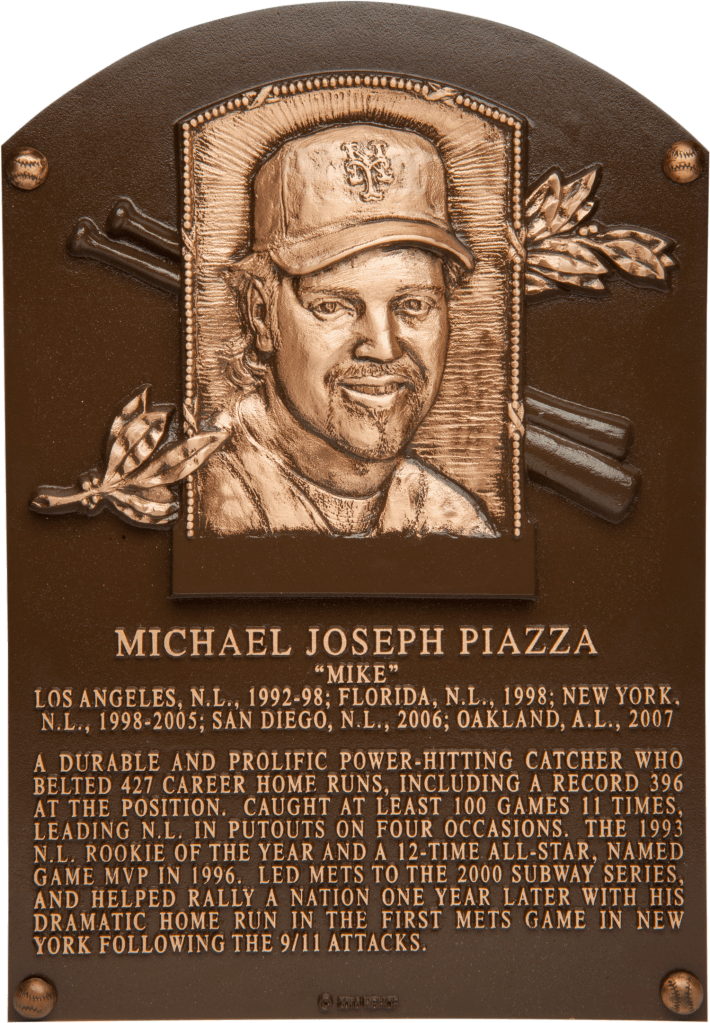
After 16 major-league seasons, Piazza racked up a .308 career batting average (better than Hall of Famers Paul Molitor, George Brett, and Hank Aaron), 427 career home runs (more than fellow catchers and Hall of Famersw Johnny Bench, Carlton Fisk, and Yogi Berra), and 1,335 runs batted in (more than straight up Hall of Famers Duke Snider, Derek Jeter, and Roberto Clemente). Given that, Piazza joined all those Hall of Famers in Cooperstown in 2016.
The Moral of the Story:
In a throwback to the very first installment in this series…greatness often exists in places you wouldn’t think to look for it.
Got a question, comment, or just want to yell at us? Hit us up at dubsism@yahoo.com, @Dubsism on Twitter, or on our Pinterest, Tumblr, BlueSky, Truth Social, Instagram, or Facebook pages, and be sure to bookmark Dubsism.com so you don’t miss anything from the most interesting independent sports blog on the web.

 Dubsism
Solid review of ‘A Star is Born’! I also liked reading about Mike Piazza’s story! I participated in July’s Genre Grandeur, where I reviewed ‘RKO 281’. I have written about ‘A Star is Born’ as well, but it was the version from 1937. I’ll post the links to both reviews if you’re interested in reading them.
LikeLike