
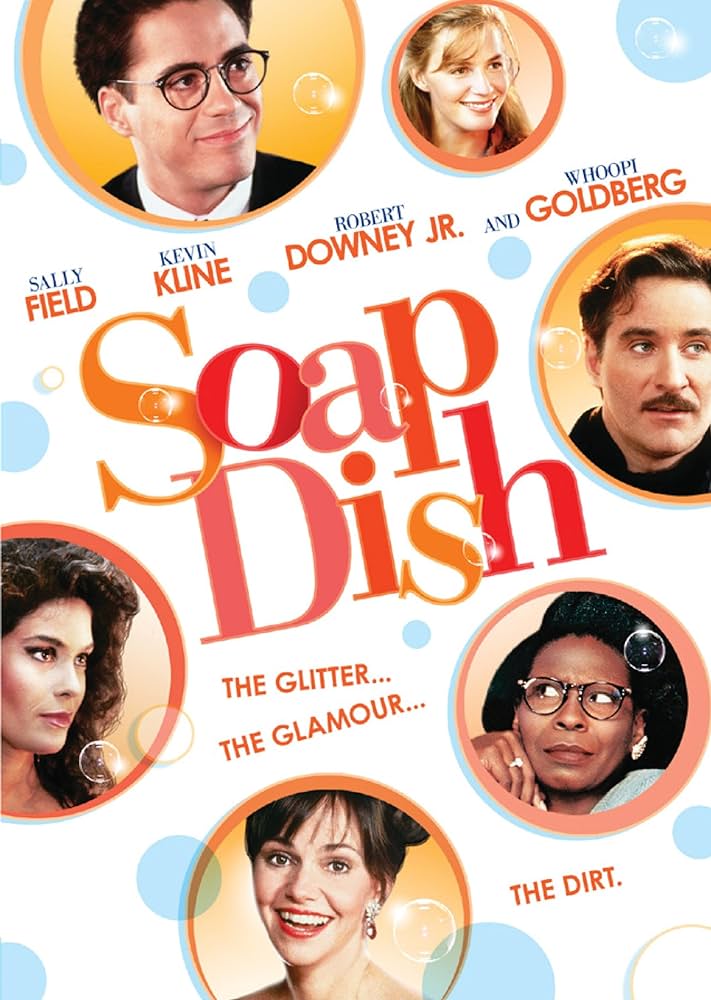
- Today’s Movie: Soapdish
- Year of Release: 1991
- Stars: Sally Field, Kevin Kline, Cathy Moriarty
- Director: Michael Hoffman
This movie is on not my list of essential films.

NOTE: This installment of Sports Analogies Hidden In Classic Movies is being done as part of something called the Aaron Spellingverse Blog-A-Thon being hosted by RealWeegieMidget Reviews.
You can see all the contributors to this blog-a-thon here:
The Story:
A comedic “sausage being made” view of the making of a soap opera, Soapdish opens at the Daytime Television Awards in New York City. As the producer of the soap opera The Sun Also Sets, David Seton Barnes (played by Robert Downey Jr.) is walking the red carpet with stars Montana Moorehead (played by Cathy Moriarty) and Ariel Maloney (played by Teri Hatcher). While they are working the rope-line reporters, the attention of the fans turns to their favorite; twelve-time Best Actress nominee Celeste Talbert (played by Sally Field). While they are all entering the arena, a young woman (played by Elisabeth Shue) is shown struggling to get a glimpse of Celeste.
Once in the building, Celeste wins an award. While she is offering the standard fare “thank you” speech, her co-stars not so subtly turn green with envy. Later upon returning to her luxurious Manhattan apartment, Celeste discovers her night has been a pyrrhic victory as her lover has left her to return to his family.
The next day, Montana makes David an offer to sleep with him if if he writes Celeste out of the show; naturally replacing her screen time with Montana. At the same time, the woman seen earlier admiring Celeste sneaks into the office of casting director Betsy Faye Sharon (played by Carrie Fisher). She introduces herself to Sharon as aspiring actress Lori Craven. Sharon casts her as an “extra.”
Meanwhile, Celeste is growing self-conscious about her age; as a result she has an on-set tirade about her “mature” costumes that make her look like “Gloria Fucking Swanson.” In an attempt to lift Celeste’s spirits her head writer and confidante Rose Schwartz (played by Whoopi Goldberg), takes her to a mall for some shopping. Once there, Rose alerts the mall patrons as to Celeste’s presence by acting as a regulars fan. Celeste is rejuvenated as she basks in the admiration.
But back at the studio, David and Montana are hatching a plot to turn Celeste’s fans against her. The scheme is to have Celeste murder a homeless person; the idea being the shocking twist will both alienate her fans and boost the show’s sagging ratings. David makes the decision to use Lori in the role of Celeste’s victim, but because they think she may not be able to act, the make her character a deaf-mute. When Celeste objects to the story line, David fakes an anxiety attack and blames network executives for forcing him into it.
A real-life plot twist comes about as Celeste recognizes Lori as her niece from Iowa. She is disappointed that Lori dropped out of college to pursue an acting career. As their plot is bogging down, David and Montana conspire to find Celeste’s former lover and co-star Jeffrey Anderson (played by Kevin Kline), Celeste had Jeffrey fired from The Sun Also Sets two decades prior and his career never recovered. David finds him performing in a schlocky dinner theater production of Death of a Salesman. David plies Jeffrey with liquor to convince to rejoin the show. Jeffrey jumps at the chance to serve up some revenge.
Celeste’s improving mood sours once again as she learns of Jeffrey’s return. Matters only complicate as the newest script reveals that Celeste is Montana’s on-screen mother and Celeste and Jeffrey clash as she is failing to mask her re-surfacing attraction to him. Better yet, to break up their fight, Lori makes a flirty invitation to Jeffrey for dinner that evening. However, the capper to this series of events is Celeste makes a suicide attempt by stepping front of a bus, but the driver stopped just in time.
As Lori announces her departure for her date with Jeffrey, Celeste twirls into the predictable rage and shadows her niece’s path to his apartment. Once the they enter the building, Celeste obtains Jeffrey’s apartment number from the asks the doorman. However, as Lori prepares to leave, Jeffrey admits his original intent was to inspire jealousy in Celeste, but has actually come to like her. Celeste watches all this from the fire escape.
However, Celeste does not see Lori leave and precariously navigates a narrow ledge. The cement crumbles under her feet, leaving her screaming and dangling from a drainpipe before Jeffrey rescues her. Once inside Jeffrey’s apartment, Celeste searches frantically for Lori while Jeffrey teases her about having a lingering affection for him. They exchange kisses while she warns him to stay away her niece.
The next day, Montana and David ratchet up their plot by writing a scene including a romantic embrace between Lori and Jeffrey. As expected, this inflames Celeste into attacking Jeffrey. Celeste does not know the cameras never stopped rolling; as her emotions completely boil over she reveals Lori is her illegitimate daughter…and Jeffrey is her father. Because her contract forbade her from making her pregnancy public, Celeste gave infant Lori to her mother in Iowa and had Jeffrey fired.
By now, Lori’s role on the show is expanding (complete with regained voice)…much to Montana’s chagrin. Meanwhile, Celeste is hurtling toward a nervous breakdown, prodded by Montana’s assertion she’s had an affair with Jeffrey. Later, Celeste discovers a tabloid newspaper published a story claiming Montana is carrying Jeffrey’s child. Everything comes to a head when Celeste, Jeffrey, and Lori all threaten to quit the show, spurring the producers to shoot a live episode where even the actors won’t know what is happening as they will recite their lines from a teleprompter.
During the climactic scene, in a fit of vanity Jeffrey refuses to wear his glasses rendering him unable to read his lines. As the script falls into chaos, Lori breaks character pleading with Celeste not to leave. This leads to Lori promising to accept Jeffrey and Celeste as her parents so long as they don’t lie to her. Everybody is overcome with the raw emotion until the final twist is revealed: Montana’s pregnancy is fake as she is revealed to be a man. Montana hysterically flees the set as David skulks away from his boss.
The Hidden Sports Analogy:
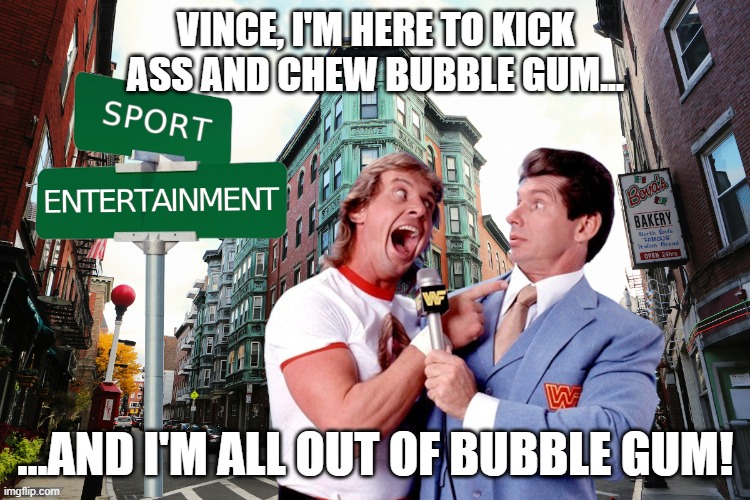
Some say professional wrestling isn’t a “sport.” Honestly, it doesn’t meet our own definition of the term. In this case, that’s a distinction without a difference because the common theme for this series is the intersection of sport and entertainment. Feel free to bog yourself down in that stale “Is wrestling real?” debate; doing so completely misses the point here because wrestling lives in the heart of that intersection. The key here is entertainment, and there is almost nothing which enrapts it’s audience more than wrestling. Arguing over the “true sporting” nature of it is little more than quibbling over the costume cladding the entertainment.
Having said that, wrestling has more than it’s “over the top rope” entertainment value driving why it makes for such great stories. Drama is the essential component, and at the core of drama lies conflict.
“Good vs. Evil” gives us the purest essence of it, and the universally-understood vector for that essence is sport. There’s really no better recipe for this series…which is why several wrestling-related tales have graced this electronic screed.
- Sports Analogies Hidden In Classic Movies – Volume 102: “Abbott and Costello Meet Frankenstein“ Most popular depictions of Frankenstein’s monster show him as a shade of green. But how close were we to Andre the Giant as “Redskin-stein?”
- Sports Analogies Hidden In Classic Movies – Volume 108: “National Lampoon’s Vacation” Just imagine the owner of an NFL team as a drunken “Clark Griswold” in a tale with so many twists it somehow links Hollywood legend Don Ameche, the Baltimore/Indianapolis Colts, and Pro Wrestling Hall of Famer Fritz von Erich.
- Sports Analogies Hidden In Classic Movies – Volume 133: “A Bucket of Blood” Professional wrestling in the 1980s is the perfect example of what sports would look like if it were directed by Roger Corman…if only Jimmy “Superfly” Snuka was a sculptor.
- Sports Analogies Hidden In Classic Movies – Volume 152: “The Rockford Files – The Queen of Peru” Which is crazier: having a world-famous diamond in a charcoal grill or two wrestlers hiding a donkey in an apartment?
Once you grasp that essence, the only way to “level up” is to reveal the drama behind the making of a drama. Soapdish took the comedic route examining this phenomena as it manifested itself “behind the scenes” of a soap opera. Regardless of which way you wish to traverse that whole “life imitates art” trope, the connection comes from the real-life soap opera which burgeoned around the making of WrestleMania III.
Any of it’s aficionados will tell you the 1980s were a transformative decade for professional wrestling. Without going into the entire history, this is when Vince McMahon, Jr. essentially conglomerated it from a loose collection of regional fiefdoms into the leviathan know known as World Wrestling Entertainment. Once McMahon effectively brought the wrestling world under his control, he took the steps to take professional wrestling from mid-size municipal arenas to filling football stadiums.
One of the pillars of that progression was the creation of WrestleMania. McMahon knew that to be on the “big” stage in “sport-o-tainment,” his venture needed a “signature” event. There’s no arguing with success as Forbes routinely ranks WrestleMania as one of America’s most valuable sporting event brands, most recently valued somewhere between $250 and $300 million. That places it right along side event brands such as Super Bowl, NCAA Final Four, and FIFA World Cup.
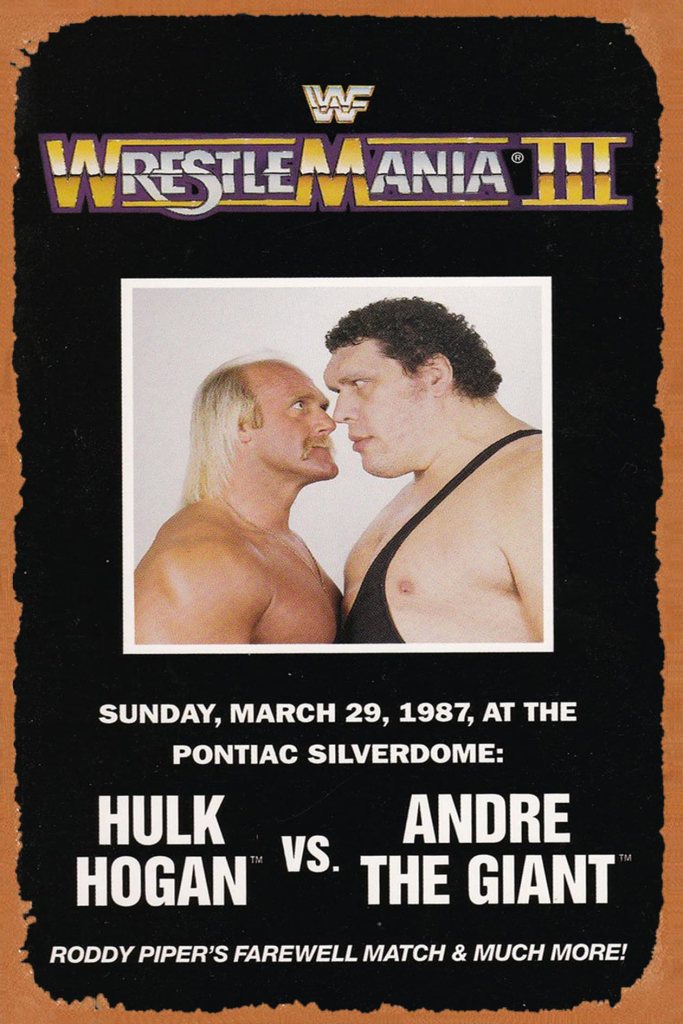
But in 1987, WrestleMania was still little more than a fledgling in the world of “sport-o-tainment.” . As one would expect, WrestleMania III was heavily promoted, complete with a range of drama-dripping conflicts…all of which led to this event filling the Pontiac Silverdome with a reported attendance of 93,173. At the time, this set the world record for the largest indoor event.
As far as the drama factor goes, WrestleMania III did not abandon this staple of it’s predecessors. In this case, the main story line centered on the WWF’s biggest stars (both figuratively and literally). Thanks to André the Giant’s becoming a “heel” and betraying his friend WWF World Heavyweight Champion Hulk Hogan, the “clash of the titans” was set.
Another featured feud happened between Ricky “The Dragon” Steamboat and the Intercontinental Heavyweight Champion “Macho Man” Randy Savage. This beef had it’s origins during a title match when Savage blind-sided Steamboat at ringside as he greeted fans. As a result, Steamboat was hospitalized with a throat injury. This led to several several bloody match-ups between the two; with a “brawl to settle it all” at WrestleMania III.
Bobby “The Brain” Heenan played a role in the aforementioned conflict between André the Giant and Hulk Hogan, but the famed manager pulled double duty stoking flames between Billy Jack Haynes and Hercules. Heenan went out of his way to taunt Haynes with a narrative that he stole his finishing move (the “Full Nelson”). WrestleMania III featured “Full Nelson Challenge” between the two.
Heenan didn’t stop there. When The “WWF Wrestling Classic” was changed to the “King of the Ring Tournament,” Harley Race began referring to himself as “The King” after being it’s first winner. As Race’s manager, Heenan would often grab a vanquished opponent by the hair and forced them to kneel before Race. The self-coronated “King” Race would also enter the ring resplendent in a cape and crown to the regal strains of Mussorgsky’s Great Gates of Kiev. To put it simply, The Junkyard Dog wasn’t having any of this, especially after a match on Saturday Night’s Main Event IX after which Race and Heenan tried to make him kneel. Of course this was brought to Wrestlemania III complete with a stipulation that the loser had to submit to the winner.
If that weren’t enough, Wrestelmania III featured bad blood between The British Bulldogs and The Hart Foundation, Jake “The Snake” Roberts’ and The Honky Tonk Man, and no festival of blood feuds would be complete without “Rowdy” Roddy Piper and his beef with Adrian Adonis.
Say what you will, but the Wrestlemania recipe cooked up by Vince McMahon, Jr. was the driving force completing his exercise in empire building. In short…drama works.
The Moral of the Story:
One man’s trash is another’s treasure. Ignoring an entities’ entertainment value simply over a need for labels is nothing more than an exercise in self-denial.
Got a question, comment, or just want to yell at us? Hit us up at dubsism@yahoo.com, @Dubsism on Twitter, or on our Pinterest, Tumblr, BlueSky, Truth Social, Instagram, or Facebook pages, and be sure to bookmark Dubsism.com so you don’t miss anything from the most interesting independent sports blog on the web.


This is one of my favourite 1990s ensemble cast movies and you have done it credit with this post. Nice as always to read about that “sporty” connection and to have you onboard with your observations… Thanks for joining the blogathon and bringing Soapdish into the spotlight. Added you to today’s post, thanks Dubs.
LikeLike
Thanks for covering this camp classic–a perfect analogy to the showmanship and over the top personalities of wrestling. Watched this one again after many years and enjoyed it even more than the first time–the hallmark of a cult/camp delight.
LikeLike
[…] Dubs at Dubsism adds another ensemble cast with an Aaron Spelling produced comedy feature film with a who’s who list of Hollywood lovelies in Soapdish (1991)… […]
LikeLike
Very apt analogy – both soaps and wrestling are filled with heroes and heels (with very little in between), and vendettas that blow up out of nowhere and then make way for the next bitter rivalry.
LikeLike
If anyone’s going to dwarf Hulk Hogan it would be Andre the Giant, rest his soul.
LikeLike