


Buckle your chinstraps because we’re heading into new territory. Previous installments in this series have been focused on entire songs rather than just particular components thereof. You’ve been warned.
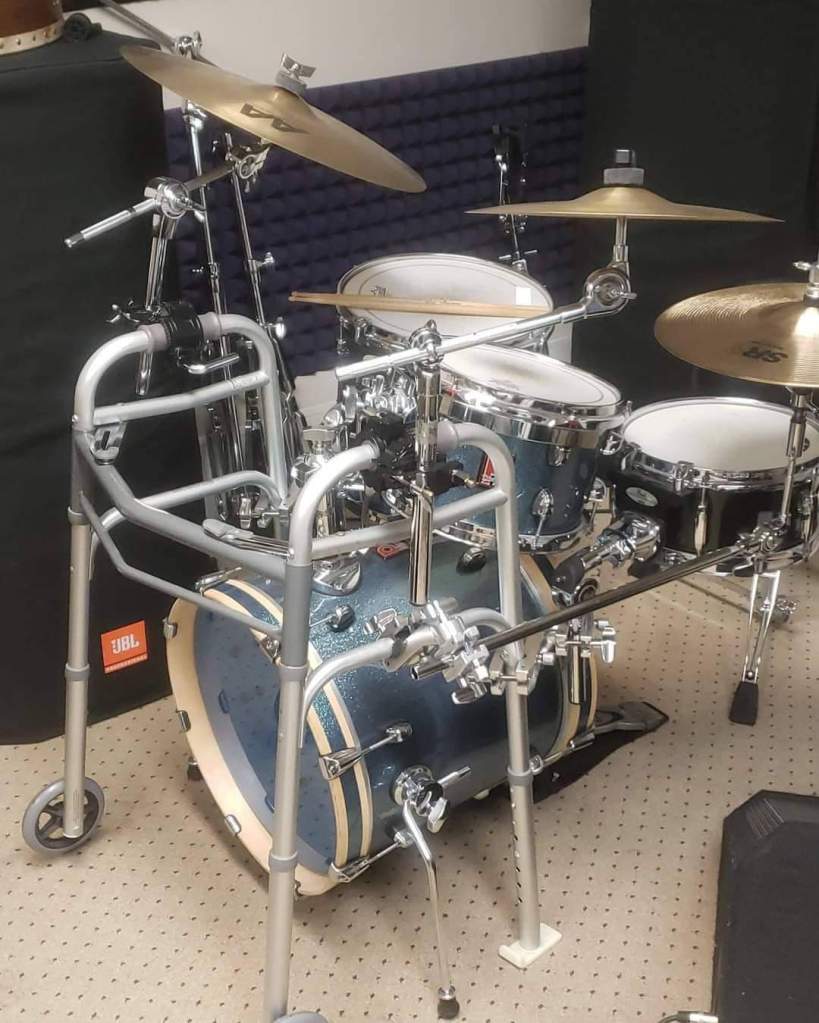
I’ve written about being a bass player several times, but my first love was the drums. A common trait amongst all old drummers we were all once young drummers. For my money, there was no better time to be a young drummer than the 1980s.
In the truest example of the yin and yang of the human experience, the 1980s are the decade whose music brought you wave upon wave of pop crap soaked in immortality brought to you by bands festooned with amounts of hair spray sufficient not only to poison the oceans, but to replace them entirely. But…and thank God for it… that same decade was also the golden age of the huge rock drum riff.
Every kid in America air-drummed to Phil Collins’ In The Air Tonight (go ahead, skip to 3:14 and get it over with…we’ll wait). The universal appeal of that riff is undeniable. but the young drummer in me was drawn more to the fill at 3:48. Either way, that’s really what this list is all about; great drum riffs that I did more than air-drum back in the day. Some you might recognize, and some might surprise you.
Just don’t blame me when you catch yourself air-drumming them.
Tom Sawyer (between 2:32 and 2:45): Neil Peart, Rush
The 8th grade might be the zenith of transformative years in any kids’ life. When it was my turn in 1981, three things happened in rapid succession that proved to be the shape of things to come.
- I bought my first set of drum sticks (Vic Firth 7A if you were wondering)
- I discovered MTV…
- …which brought me to Tom Sawyer.
Being a beginning drummer taking in the Neil Peart experience is like a brand-new altar boy being introduced to the Pope. But you didn’t need to be baptized in the church of percussion to love those massive Peart fills. 98% of teen-age boys in 1981 air-drummed them when they to tried to level-up from Phil Collins. The other 2% lie.
Like A Virgin (the groove): Tony Thompson, Madonna
I know…putting a Madonna track on this list would appear to create a serious Sesame Street “One of These Things Is Not Like The Other issue, but….
The exact opposite is true. What puts Like A Virgin here is the fact it is very much like some of the others. It’s the first…and certainly not the last…example of a funked-up timing exercise. In this case, add some serious precision and complete ownership of the groove, and that beat takes no time at all to get seriously infectious.
Not to mention, any garage-band drummer with even the most modest talent knows the recipe of precision and groove is how a drummer can be the glue holding together a band of even less-talented musicians. Look at how far Tommy Lee took Mötley Crüe with that very same formula. Don’t look now, but Dave Grohl admits exactly what I’m talking about.
Besides, Tony Thompson is one of those guys who never gets talked about because with the exception of his time with Chic, he popped up on so many 80’s tracks (like another guy he’s going to share the “Live Aid” stage with in 1985), including David Bowie’s Let’s Dance, Robert Palmer’s Addicted To Love, and The Power Station’s Get It On (Bang A Gong) and Some Like It Hot.
Changes (between 5:19 and 6:20): Alan White, Yes
This is another example which will speak to all you drummers out there regardless of age. Anybody’s who has ever had “formal” training on the “skins” knows times when a certain one of those “beat/timing” exercises (raise your sticks if you know which one I mean…) gets lodged in your head. One thing leads to another, and suddenly Alan White’s straight-forward “heart beat” kick drum features prominently in a song with more changes in time signature than Russia has time zones.
Opening of Sunday, Bloody Sunday: Larry Mullen, Jr., U2
U2 is the purest distillation of my postulate stating the best work from most bands comes within their first three albums. It’s certainly one of my more unpopular opinions that U2 lost me at their 4th, The Joshua Tree. That notwithstanding, there’s no denying this song is on any list of those immediately identifiable by their initial drum licks.
Flight Of Icarus (pretty much the whole track): Nicko McBrain, Iron Maiden
Because they are purveyors of heavy metal, Iron Maiden gets short shrift for the sheer musicianship featured on soooooo many of their tracks. Since I also play bass, we could spend all day on Steve Harris and his mastery of the “three-finger gallop” technique (which also figures prominently on this cut). The full discussion is for another day, although it matters for this conversation as well. This is all about the man on the cans because the “poo-pooing” of this track’s “heavy” nature hides Nicko McBrain’s mastery of his concerto for tom and snare and how he seamlessly weaves it around Harris’ thick-string thunder.
Born in the U.S.A. (Max Weinberg’s snare): Bruce Springsteen
While Bruce Springsteen was known as “The Boss,” from the initial measure Max Weinberg (later famed for leading the band on the Conan O’Brien show) made it clear that his left hand was going to be in charge for the next 4:43. From those initial solo quarter-notes to that amazing snare-forward solo at 4:07, and every one of his “big-band” fills in between, Weinberg lets his “jazz drummer” flag fly; the standard being his work on the snare.
In fact, Weinberg gets such a commanding sound out of that snare that drummers to this day speculate what it was…because he won’t tell. I’m in the camp believing it was a Ludwig Supra, or maybe a Black Beauty. If you have another theory…well, that’s why the blog gods created the Comments section…
Stranger (pretty much the whole track): Aynsley Dunbar. Jefferson Starship
Every experienced drummer feels this to his core, and one only need have been a drummer for about twelve measures just to understand it. Sometimes, you just want to count to four and hit something fuckin’ hard. You know that’s the theme from jump when Aynsley Dunbar’s right foot delivers a sonic kick in the belly; one redelivered time and again with each thump.
Jack and Diane (between 2:25 and 3:02): Kenny Aronoff, John Mellencamp
Richie Blackmore will live forever through the fingers of guitarists who will be replicating his iconic Smoke On The Water riff six months after the end of Armageddon. But in the room right next to them, there will be a drummer banging out Aronoff’s beat. Just like Blackmore’s riff, Aronoff’s snare-and-bass punch capped with a splash of hi-hat is for drummers just as iconic…and perfect for the beginner.
Separate Ways (at 2:27): Steve Smith, Journey
In 1983, every 15-year old drummer on earth had to stop whatever they were doing to learn this groundbreaking fill. Granted, Steve Smith probably wasn’t the first to showcase that 4-tom rolling riff. Louie Bellson came pretty damn close in 1955, and you be the judge on Ginger Baker’s solo in Toad in 1966. John Bonham had the sound at the end of Rock And Roll in 1971. We can even talk about Neil Peart from earlier in this very list. But when you nail it spotlighted on MTV (using traditional grip no less) in full view of every sophomore Stage Band “can man” in America, you’re Neil Fuckin’ Armstrong.
Opening of We’re Not Gonna Take It: A.J Pero, Twisted Sister
There’s three reasons why this riff isn’t as iconic as it should be. First, there’s the aforementioned discrimination against “heavy metal.” Second, the folks at Saturday Night Live decided to anoint another track in it’s pop-culture bellwether “Cowbell” skit. But it’s biggest problem presented by this riff for the neophyte drummer is just how hard it is to get just right. A lot of us “almost got it;” very few actually did.
Pretty Much Anything from Phil Collins
Forget the fact I’ve already mentioned the one Phil Collins’ drum riff everybody knows. Focusing on those few measures risks ignoring the fact Phil Collins’ must be included on any valid list of iconic rock drummers. Building a supporting resumé is to wander through discography much deeper than most might think.
The most familiar examples would be those fitting our 1980s theme. Just picking from the the Genesis catalog alone offers great choices like Paperlate, Another Record, and my own favorite Man Of Our Times. Then come the examples where Collins acts a a guest player, but his sound is still distinct. These include Robert Plant’s Worse Than Detroit and Other Arms, Frida Lynstad’s I Know There’s Something Going On, or a previous installment in this series, Band-Aid’s Do They Know It’s Christmas?
While they fall outside of the scope, the discussion of Collins’ drum work can’t be complete without the mention of his pre-lead singer days with Genesis and the jazz fusion/prog rock wonder known as Brand X.
And…we mustn’t forget how great he was (as was fellow list member Tony Thompson) spelling John Bonham with Led Zeppelin at Live Aid in 1985.
Opening of The Camera Eye: Neil Peart, Rush
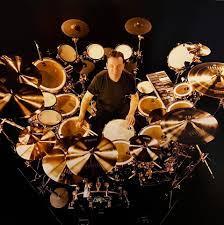
The same man who opens and closes this list is also the one who will remembered for his mastery of the complex. But it is his embrace of stripped-down simplicity which makes Neil Peart the bookends to this list. What Peart does in the first 1:30 of this track with a comparatively Spartan triad of snare and bass garnished by a twist of hi-hat is the purest essence of his greatness. This simple arrangement hides the technical complexity while still lending appreciation to the untrained ear. It also takes what started as a simple snare exercise building it layer-by-layer into the foundation of what I consider to be the “median” Rush cut.
For the Rush-o-philes like myself, one thing we know is the band discography ranges in sound from “old-school classic power trio” to the synth-heavy orchestrations of “prog rock.” The Camera Eye is smack-dab in the middle; half of Rush’s songs fall close to the “power trio” side and the others lean “proggy.” Neill Peart’s drumline puts the song there as it takes no time at all to transition from the neo-classic opening to a straight-up power-rock backbeat.
You can see all the Misty Water-Color Memories here.
Got a question, comment, or just want to yell at us? Hit us up at dubsism@yahoo.com, @Dubsism on Twitter, or on our Pinterest, Tumblr, or Instagram, or Facebook pages, and be sure to bookmark Dubsism.com so you don’t miss anything from the most interesting independent sports blog on the web.

 Dubsism
Man, I had never seen that Camera Eye video before. Thanks for sharing.
LikeLike