
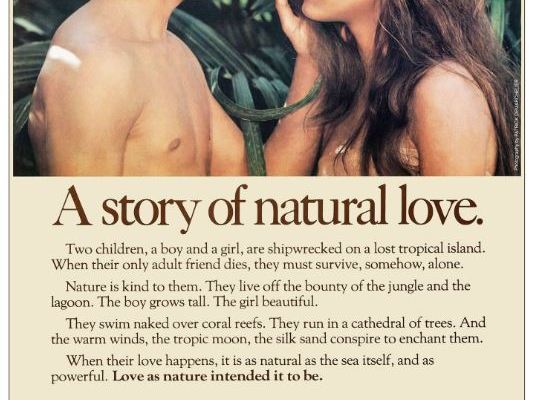
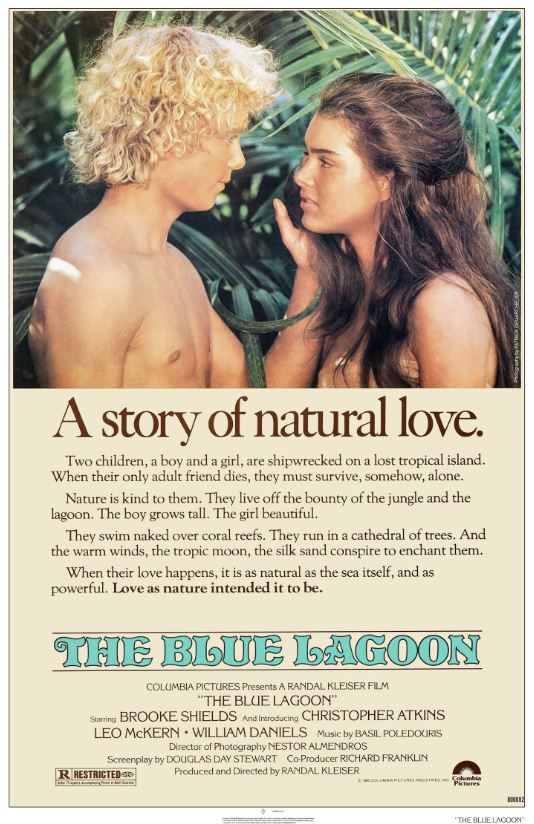
- Today’s Movie: The Blue Lagoon
- Year of Release: 1980
- Stars: Brooke Shields, Christopher Atkins, Leo McKern
- Director: Randal Klieser
This movie is not on my list of essential films,
Today’s installment of Sports Analogies Hidden In Classic Movies is just one of many contributions to a much larger exercise in adventure aptly named the Adventure-A-Thon. As one would expect, such a great topic was brought to us by co-hosts Cinematic Catharsis and RealWeegieMidget Reviews. Thanks to them, you can (after you leave my nonsense 🙂 ) see the insightful and talented contributors to this event:
The Story:
Set during Victorian England, the story of The Blue Lagoon finds nine-year-old Richard Lestrange (played by Glenn Kohan, later by Christopher Atkins) and his seven-year-old cousin Emmeline Lestrange (played by Elva Josephson, later by Brooke Shields) sailing across the South Pacific to San Francisco with Richard’s father Arthur Lestrange (played by William Daniels).
Disaster strikes when their ship is stricken by fire. In the scramble for survival, Arthur is separated from Richard and Emmeline, who escape in a lifeboat with the ship’s cook Paddy Button (played by Leo McKern). Paddy and the children wash up on the shore of a lush, tropical island. As the adult, Paddy assumes responsibility for the children and teaches them how to find food and build shelter.
One day Paddy discovers a stone altar covered in blood and the remains of what looks to have been a human sacrifice. Knowing there are dangerous natives on that side of the island, Paddy forbids Richard and Emmeline from the area, claiming it’s “the law” because the “Boogey-Man” lives there. In the same breath, Paddy warns against eating a certain scarlet berry that Emmeline finds, calling them “never-wake-up” berries.
Later, Paddy discovers a barrel of liquor which washed ashore from the sunken ship. The next morning, the children discover Paddy has died during his drunken binge. Distraught, Emmeline begs Richard to him to take her away from this place. In turn, they load all their belongings on a rowboat and take it to another beach on the island.
As they establish a new settlement for themselves, Richard and Emmeline are also maturing. While they spend their days diving for pearls, catching fish, and maintaining their tree house, puberty changes the relationship between the two. This first becomes apparent as the two are swimming naked in the ocean and Emmeline realizes her sexual attraction to Richard.
Uncomfortable with her “funny” thoughts toward Richard, she keeps them a secret. When Emmeline experiences her first menstrual period, she is frightened at first and calls out to Richard. But then her embarrassment takes over and she refuses to allow Richard to inspect her for what he thinks must be some sort of wound. Meanwhile, Richard is also developing a sexual attraction to Emmeline, however she is still reticent to admit her feelings.
However, Richard isn’t the only thing stoking Emmeline’s curiosity. Wandering to the “forbidden” side of the island, she discovers the blood-covered stone altar. But Emmeline associates the blood with the crucifixion of Christ believing the altar to be God. She attempts to persuade Richard to go with her to pray side of the island to pray with her, but he refuses to break “the law” resulting in their arguing.
Their surging teenage hormones only exacerbate the tension between the two. When Richard recognizes his attraction and tries to initiate sexual contact with Emmeline, she rejects his advance. As a result, Richard retreats to a secluded spot on the island to masturbate.
Despite the fact they have often discussed being rescued and being reunited with Richard’s father, when a ship appears on the horizon for the first time in years, Emmeline does not light the signal fire. The ship passes without noticing them. When Richard angrily confronts Emmeline, she states the island is now their home and they should remain there.
The fight between the two escalates when Emmeline reveals that she knows about Richard’s masturbation and threatens to tell Richard’s father if they are reunited. They continue to argue until throws a coconut at him, hitting him in the head. In anger, Richard slaps Emmeline and kicks her out of their tree house.
Emmeline goes to another beach and builds makeshift shelter for herself. But afterward, she steps on a venomous stonefish. Richard discovers Emmeline near death; she pleads with him to take her to “God.” More afraid of losing Emmeline than “the law,” Richard obliges by placing her on the stone altar and fumbles through what he remembers as prayers.
Emmeline recovers and regains her ability to walk. Later, the two swim together in the lagoon. Afterwards, as they are sitting naked on the beach, they share some fruit. This leads to their first kiss, and nature takes it course from there. As one would expect, as they continue to explore their passion for each other, Emmeline soon becomes pregnant. In a great bit of dramatic irony, the viewer is keenly aware what Emmeline’s hunger cravings and her ability to feel the baby move inside her mean. But Richard and Emmeline have no clue of childbirth; they just think Emmeline is getting fat.
One night Richard discovers Emmeline is missing and searches the jungle for her. He picks up the sound of drums and follows them to the stone altar known as “God.” Richard witnesses natives performing a human sacrifice. As he is fleeing the scene, he hears Emmeline’s cries as she is giving birth. They name the boy Paddy.
Upon bringing Paddy home to the tree house, they grow frustrated with their inability to feed him. Naturally it stands to reason since they knew nothing about childbirth, they had a similar level of knowledge about babies. Like everything else, they figure it out, and together they raise Paddy into a robust toddler.
A day comes when another ship appears on the horizon; this one led by Arthur Lestrange. Richard and Emmeline are visible from the ship, but as they are covered in mud, Arthur does not recognize them. Likewise, Richard and Emmeline see the ship and silently agree to forget any previous intentions of leaving the island as they retreat into the jungle with Paddy.
Resuming their everyday life, the family takes a rowboat to visit their original homesite to collect food and other supplies. While Richard searches for bananas and Emmeline is tending the boat, they don’t notice Paddy collecting the scarlet “never-wake-up” berries. While Emmeline and Paddy are in the boat waiting for Richard, she falls asleep.
The tide takes the boat out to sea; Emmeline is awakened by the sound of Paddy pushing one of the oars into the water. When she is unable to retrieve it, she calls out to Richard who starts to swim toward the the boat. But all the activity has drawn the interest of a shark that begins trailing Richard. Emmeline wards off the shark by throwing the other oar at it; giving Richard time to get into the boat. But now the boat drifts oarless out to sea.
After drifting for days, Richard and Emmeline awake from a nap to find Paddy eating the scarlet berries. As they frantically try to make him spit them out, they realize they’re too late…he’s already swallowed them. Eventually, they are unable to awaken Paddy. Distraught, Richard and Emmeline split the remaining berries and lie down to await death…only hours before they are discovered by Arthur Lestrange’s ship.
The Hidden Sports Analogy:
Some consider this film to be a very good, if not under-rated piece of cinema. Others believe it’s on a serious level of messed up. I’m in both camps, but largely because that combination forms the foundation of today’s hidden analogy. Together they allow us all to take a journey through something surging with an innocent and natural beauty, yet no matter how much masquerade it’s given, it’s still about cousin-on-cousin action.
Much like the connection between Emmeline and Richard, the merger of the American and National Football Leagues (AFL and NFL respectively) began as something wholesomely organic. But in the face of their respective growth, the relationships between both the cousins and the leagues become something much more complex…the difference being professional football is on the verge of discovering it’s own version of the “never-wake-up” berries.
To fully understand this analogy, one needs to realize it’s roots stretch back to the late 1950s…when the world of professional football changed forever.
The Catalyst: What Makes Everything Else Happen
If it weren’t for the shipwreck, nothing else in The Blue Lagoon ever comes about. If Emmeline and Richard complete their journey to San Francisco, this movie is reduced to mere travelogue. But the series of events leading to their being marooned is the catalyst for all that comes after.
For the world of professional football, the catalyst for change came on December 28th, 1958. The 26th NFL Championship Game was one of the first to be televised nationally…and the powers that be certainly picked the right one for the occasion. Universally regarded in football circles as “The Greatest Game Ever Played,” this was the first NFL playoff game to be decided in sudden death overtime.


As hard as it may be to imagine today with the modern NFL being the leviathan it is, but in those days professional football took a back seat in terms of popularity to baseball, college football, boxing, and horse racing. But when million of Americans watched Alan Ameche (cousin to classic film actors Jim and Don Ameche) plunge into the end zone to give the Baltimore Colts a 23–17 over the New York Giants, the clock began ticking toward the day professional football would become the king of the American sports mountain.
While that game served as the milestone marking the birth of professional football’s mega-popularity, it’s seeds were already growing organically. However, as the fan interest grew, so did the number of people who wanted to own a football team and cash in on the game’s bright future.
Lamar Hunt and Death: The Agents of Change
Even before “The Greatest Game Ever Played,” oil tycoon Lamar Hunt was interested in buying an NFL franchise. His first attempt came when he made an offer to buy the Chicago Cardinals; his idea being to move them to his hometown of Dallas. The problem was the Bidwill family (the Cardinals’ owner) refused to sell a controlling interest in the team and had no desire to move to a city that had already seen the failure of the NFL’s Dallas Texans in 1952…ironically the franchise that would become the aforementioned Baltimore Colts.
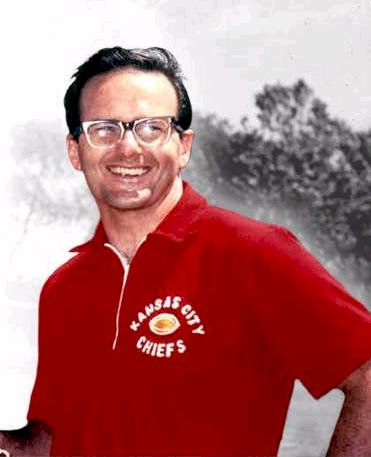
Hunt’s next attempt came when Hunt tried to convince NFL commissioner Bert Bell to grant him an expansion franchise, but several factors made this idea impractically complex. Left with no other option, Hunt organized several other prospective owners with the idea being the formation of a new league.
Contrary to what you might think, Hunt’s original intention was not to compete with the NFL. Instead, Hunt devised the idea of another professional football league only because he wanted to bring pro football to his hometown of Dallas, and purchasing an NFL team seemed not to be in the cards. Even though Hunt’s concept of the AFL came about before “The Greatest Game Ever Played,” and even though that game put a surge in the nation’s appetite for pro football, Hunt believed the market could support two pro leagues.
That’s why in the summer of 1959, Hunt sought the blessing of NFL Commissioner Bert Bell for his nascent league. While it was Hunt’s intention for the two leagues to co-exist peacefully; the hope being the avoidance of a costly rivalry… whatever the two men agreed upon went with Commissioner Bell to his grave in October of that year.
Here’s the key: The deaths of ship’s cook Paddy Button and NFL Commissioner Bert Bell changed the respective situations in identical ways. Alive, Paddy and Bell both represented a measure of control and stability. Once their deaths removed those constraints, both Emmaline and Richard as well as the AFL and NFL wound up in respective situations where they found themselves in a new reality nobody really understood. But now a common theme emerged for all: merge or perish.
The Merging and The Product
New NFL Commissioner Pete Rozelle came in the wake of Bell’s death. As he assumed control of the twelve-team league in 1960, Rozelle could see the NFL was operating on a business model at least three decades out of date. Games were frequently being played in half-empty stadiums, and the league’s presence on television hardly existed. There was no league-wide television deal like today, and only a few teams had local television contracts.
Rozelle saw the AFL’s very construction as an existential threat. Instead of each team making it’s own television deals and keeping it’s own gate receipts, Lamar Hunt built his consortium of owner’s on a foundation of revenue-sharing. In the AFL, teams shared in all the revenue from ticket sales and television, essentially making it a cartel that benefited all teams equally, as opposed to the NFL in which each franchise operated in a thinly-disguised laissez-faire economy.
Rozelle also saw the NFL’s future lie in adopting the revenue-sharing model. Growing the NFL nationally meant franchises in small markets had to be as economically viable as those in the large ones. Both leagues had teams in New York and Los Angeles, but Hunt and Rozelle knew expansion meant franchises in smaller cities without much competition in terms of professional sports. That’s why the AFL had charter franchises in Houston, Buffalo, and Boston.

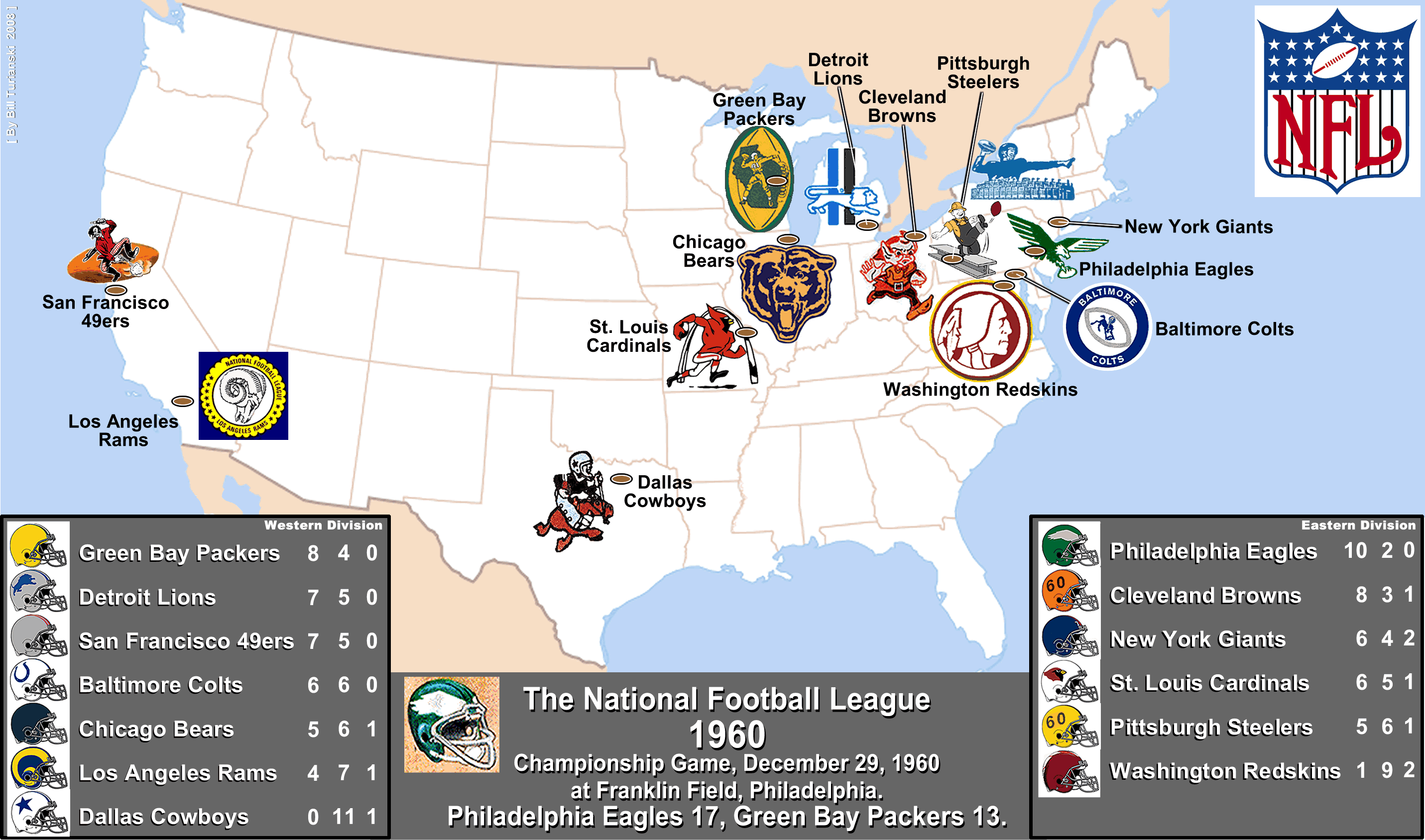
As the two leagues carved up America like a pro football Risk map, Rozelle did not share Hunt’s vision of co-existence and began making aggressive moves to limit the AFL’s growth.
It’s no accident the NFL expanded in the 1960s. Rozelle saw the AFL failing in the three markets where it went head-to-head with his league. The AFL couldn’t lure fans away from established teams like the Los Angeles Rams and New York Giants, but the real inspiration was the expansion Dallas Cowboys taking away the market from Lamar Hunt’s Dallas Texans, forcing the franchise’s move to Kansas City in 1963. Before the merger agreement between the two league was completed in 1966, the NFL continued adding franchises with the intention of denying the AFL access to those markets. By the time the merger was enacted in 1970, Rozelle had put teams in Dallas, Minnesota, Atlanta, and New Orleans, while the AFL countered by expanding to Cincinnati and Miami.
The other factor which drove the merger was the leagues’ bidding against each other for players. That meant the costly rivalry Lamar Hunt wanted to avoid was now a reality. On top of that, Hunt realized his notion of the league’s co-existing was never going to happen. Meanwhile, Pete Rozelle was taking a different road to reach the same conclusion.
In other words, Hunt and Rozelle had their “Richard and Emmaline” moment. Granted, the communion on the island was far more organic than a deliberate construct of multi-million dollar businesses, but they were both about mutual survival.
If you think about it, everything past that is really just so much window dressing. Whether it’s the love story between Richard and Emmaline or the merger of the two football leagues, nothing else matters in both cases since neither would have survived without the other.
The Super Bowl: Full of “Never Wake Up” Berries
For my money, The Blue Lagoon flirts with a lot “Adam and Eve” themes, which seems somewhat unavoidable given the premise. There’s many subtle/implied/disguised “forbidden” references here, but it’s one about the fruit that’s the key. There’s a “perfect storm” brewing which as the clouds thicken, the NFL edges ever closer to turning it’s crowning event into the “never-wake-up” berries.
Some sixty years later, the model foreseen by Pete Rozelle and Lamar Hunt has become a sports leviathan completely gorged on television revenue. However, the television landscape is changing tectonically. In 1960, there were only the broadcast networks. 1980 saw the infancy of cable, but it would be years before it became a major player. By 2000, cable was king, but this thing called in “internet” was posing possibilities for the future.
Today is yesterday’s future. Streaming changes the entire game, and in a way that puts the NFL at a distinct disadvantage. Networks and cable stop at the border, but the stream can be easily universal. That’s bad news for the NFL because it has limited international appeal, and it’s competing major leagues in North America already have crossed oceans and borders.
In other words, the American sports world is going global. Just tune into an NBA, NHL, or Major League Baseball game and count the number of foreign-born players. Countries which produce players can do so because they have hit “critical mass” in the number of people who have an interest in paying and/or watching the game. Around the world, “American” football is so called because that’s exactly what it is…100% by and for Americans.
Oddly enough, the NFL’s immense popularity offers a sort of economic “judo;” it’s own weight can work against it. Big revenue streams require big budgets to collect and maintain them, and as one grows, so does the other. Likewise, once one is capped, so is the other.
Paddy the child and the Super Bowl have a crucial commonality; they are the products of the analogous mergers. It’s obvious what having a child means to the union of a man and a woman, especially as it grows becoming a sum greater than the whole of it’s contributing parts.
The exact same thing happened to a football game which was originally intended to be little more than an exhibition between the respective league champions quickly overtook the Kentucky Derby and the Indianapolis 500 as the largest single-day sporting event in America. After the merger was completed and the Super Bowl became the new NFL’s championship game, it grew into one of the biggest days on the international sports calendar.
Every year, the Super Bowl draws billions of viewers globally. But now the NFL finds itself in a situation every year in continues to water down the quality of the actual football game in favor of making it more of an event with appeal beyond the world of sport.
That’s the “judo” part. The NFL is a massive operation with capped growth opportunities. As such, it is stripping away the sporting aspect of the Super Bowl in favor of growing it’s appeal as “global event.” That’s what every bloated commercial and over-produced halftime show is all about. But as it becomes more of an event than a game, the Super Bowl gets ever closer to being the tipping point chasing away the true fans.
As a result of the NFL’s need to maximize every revenue stream, the league is corrupting it’s crowning event. While the NFL sees the Super Bowl as a chance to grow it’s international appeal, it’s running the very real risk of alienating it’s core fan base. After all, Americans tend to like things that are by and for them.
The soul of temptation is risking what you have in favor of what you want. That’s what makes the Super Bowl a microcosm of the league’s thirst for maximum revenues even if it means losing the loyal fan. The NFL already understands it’s on-field product is loaded with “watch-ability” problems, but will never sacrifice a single dollar. That will not change as long as the NFL keeps eating the “fans will never leave” berries.
This is where the NFL is gambling with it’s very future. It’s faced with a world which is changing on all fronts; much like Richard and Emmaline when they see the rescue ship. But like the castaways, the league doesn’t realize what is really at risk.
So, NFL fans…I’m sorry you’re getting judo-tossed in favor of the almighty dollar. You’ll feel better after a handful of berries.
The Moral of the Story:
Deals having huge potential at the risk of catastrophe are called “deals with the devil” for a reason.
Got a question, comment, or just want to yell at us? Hit us up at dubsism@yahoo.com, @Dubsism on Twitter, or on our Pinterest, Tumblr, BlueSky, Truth Social, Instagram, or Facebook pages, and be sure to bookmark Dubsism.com so you don’t miss anything from the most interesting independent sports blog on the web.

 Dubsism
Thanks for bringing this film to the blogathon – you really came up trumps linking this with sport (although yes, there is a Dallas connection), loving your new look blog too. Added you to Day 3 and don’t forget to join the competition on Barry’s round up post and send him your link.
LikeLiked by 1 person
[…] at Dubsism takes us to The Blue Lagoon (1980) for adventures on a tropical […]
LikeLike
It was interesting to read about the first televised NFL Championship Game, and the role it played in turning the NFL into the juggernaut it is now. Also interesting to learn about the challenges the league faces today. I always learn so much when I come here. Thanks!
LikeLike
Great take on a nostalgic 1980’s film. Gotta say the cousin cousin thing is common in a lot of cultures (crazy I know) so I think people tend to overlook that. Isn’t wild-this movie could never get made today. Great review-really enjoyed it! 🙂
LikeLike
Fun take on a movie that shaped my consciousness when I saw it as a young teenager. Just the right age to totally get what it was all about!
LikeLike
wow! I was pretty sure I had seen the blue Lagoon, but there’s obviously a lot of the plot that I forgotten, especially the ending! Guess it’s time to revisit this classic!
LikeLike
Speaking of movies or sporting events crossing over into mega-“events,” although I never saw The Blue Lagoon I remember all the hype around it (for all the obvious reasons). Had to chuckle over the comparison of the union of the two movie leads with the NFL-AFL merger. Like the end of the world, people keep predicting the decline and fall of the NFL, but I think it’s going to be very slow and not immediately noticeable. P.S.: For some reason The Blue Lagoon’s ending reminds me of The Mist (the movie’s, not King’s original novella).
LikeLike