
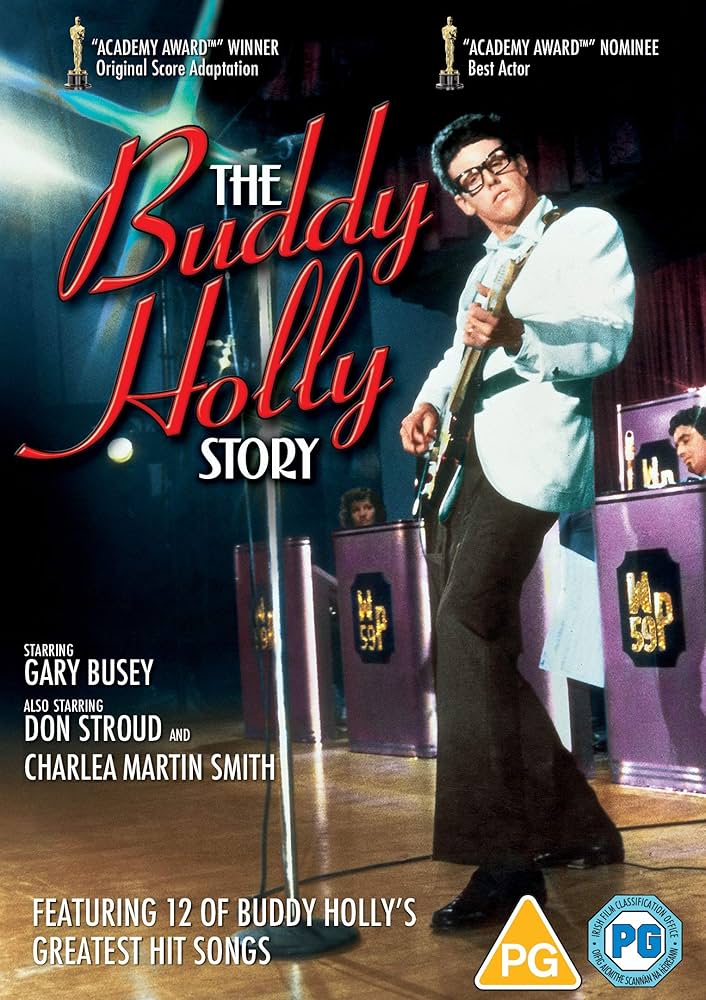
- Today’s Movie: The Buddy Holly Story
- Year of Release: 1978
- Stars: Gary Busey, Don Stroud, Charles Martin Smith
- Director: Steve Rash
This movie is not on my list of essential films.
NOTE: This installment of Sports Analaogies Hidden in Classic Movies is not being done as just part of a blog-a-thon. Instead, this is a monthly event hosted by MovieRob called Genre Grandeur. The way it works is every month MovieRob chooses a film blogger to pick a topic and a movie to write about, then also picks a movie for MovieRob to review. At the end of the month, MovieRob posts the reviews of all the participants.
For November of 2025, the honor of being the “guest picker” went to MovieRob himself, and and the topic is “Movies About Music or Musicians.”
The Story:

You’ve likely never heard the name Charles Hardin Holley, but there’s a statue of him in Lubbock, Texas. Granted, he became an icon under the name Buddy Holly…hence, the title of the film. The Buddy Holly Story begins with Buddy (played by Gary Busey), drummer Jesse Charles (played by Don Stroud) and bass player Ray Bob Simmons (played by Charles Martin Smith) setting up for a live show at a roller rink in Lubbock. The show is also being broadcast live on a local radio station.
During a commercial break, the younger members of the audience beg Buddy to play some “bop.” Buddy and his band mates accede to the crowd’s wishes. The older members cover their ears from the volume, and tone and one of the radio station’s sponsors threatens to pull his advertising if Buddy is not taken off the air. However, Riley Randolph (played by Bill Jordan) who happens to be the station’s owner and main disk jockey likes what he hears…and more importantly, he sees a market in the reaction of the kids.
The following Sunday Buddy, his girlfriend Cindy Lou (played by Amy Johnston), and his parents are in church. The minister’s sermon just so happens to be about the previous night’s show at the roller rink. As one would expect in rural Texas in the 1950s, he He declares that “jungle rhythm” music is both “un-Christian and un-American.”
Later during the family’s Sunday dinner, Buddy announces he has decided not to attend the seminary. Naturally, his parents are less than thrilled by this, and they want to know what Buddy’s plans for the future are. The band’s first break comes when Riley tells Buddy a vice president of World Records heard the roller rink show and wants the band to come to Nashville.
Once in the recording studio, the producers want to make several changes to Buddy’s work, to which he objects. The record company refuses to listen to Buddy, so the band heads back to Texas. Frustrated by this experience, Buddy is ready to quit music altogether. Buddy’s discouragement continues as Riley is getting more heat from his sponsors. After Riley tells Buddy he can only play country music on the air, Buddy becomes even more determined to play his music his way.
The twist comes as Riley also tells Buddy he recorded some songs from the show at the roller rink and sent a tape to a record company in New York City. Once he heard the tape, Coral Records executive, Ross Turner (played by Conrad Janis) considers signing Buddy and his band. But the decision gets made for him when another company assumed the demo of That’ll Be the Day was a master Turner had purchased from another label, and he already had it pressed and released…and it’s selling.
Meanwhile back in Lubbock, Buddy, Jesse, and Ray Bob are recording Everyday, but Buddy keeps picking up an unexplained noise they later discover to be a cricket. The recording session is interrupted by Buddy’s mother bringing news of an important long-distance phone call. A disc jockey in Buffalo, New York named Madman Mancuso (played by Fred Travalena) tells Buddy he has been playing That’ll Be the Day continuously with for the past fourteen hours with intention of breaking the world’s record. The name of the band is born when Mancuso asks about the instrumentation of the band and Buddy explains that it is only a guitar, bass, drums and the aforementioned cricket. As a result, Mancuso dubs them “Buddy Holly and the Crickets.”
When Buddy visits Coral Records, he is immediately taken with Turner’s secretary, Maria Elena Santiago (played by Maria Richwine). That’s not the only sign of things to come. Once the business discussions get underway, Jesse and Ray Bob want to sign a contract once Turner tells them they stand to gross about $25,000 from That’ll Be the Day. But Buddy balks when Turner assigning another producer for their recordings. Because of his previous experience in Nashville, Buddy demands to be the producer. Turner tells him that no artist is allowed to be his own producer, but changes his tune when Buddy, Jess, and Ray Bob all threaten to go to another record company.
In the film’s signature scene, Buddy and the Crickets are booked to do a show at the Apollo Theater in Harlem. The problem is the club’s owner Sol Gitler (played by Dick O’Neill) signed them sight-unseen assuming from their sound they were black. No white acts had ever played the Apollo, but Gitler wasn’t about to pay them for doing nothing. As Buddy and the Crickets open in their very country costumes, the audience gasps as the curtains reveal three white guys from Texas. By the end of their set, they’ve got the crowd dancing in the aisles.
Now well on the way to stardom, Buddy begins perfecting his sound in the studio while the distractions begin to mount. Buddy continues his courting of Maria, despite the fact her aunt Mrs. Santiago (and primary parental figure; played by Gloria Irricari) refuses to allow her date a musician or a non-Puerto Rican. Buddy pays her a visit where she is impressed by his asking for her permission to court Maria.
Buddy wastes no time proposing to Maria; he does it on their very first date…and she accepts. Buddy meteoric rise continues, but Jesse and Ray Bob are feeling increasingly left behind and want to go back to Lubbock. However, Buddy thinks they need to stay near the music business in New York City.
Tensions between Buddy and Jesse and Ray Bob come to a head backstage at The Ed Sullivan Show as both Jesse and Ray Bob have had too much to drink. This causes a fight during which Buddy loses a cap off of one of his teeth. After the show performance, Jesse and Ray Bob return to Lubbock.
Now, Bubby becomes a solo act, and Ross Turner tells him he needs to go on tour to promote his new identity and his new album. But Buddy doesn’t want to tour; he goes as far as admitting to Maria he is scared to go out on the road again without the Crickets. Despite his fears and the fact Maria is now six months pregnant, Buddy decides to go on the tour.
From a show in Clear Lake, Iowa, Buddy calls Maria to check on her. But right after she gets off the phone, Jesse and Ray Bob knock on her door. They want to rejoin Buddy, but they don’t know if he will have them back. Maria assures them they would be welcome; Jesse and Ray Bob decide to meet Buddy at the tour’s next stop.
But Buddy never makes it; he dies in a plane crash later that night which is still known to this day as “The Day The Music Died.”
The Hidden Sports Analogy:
Unlike Charles Hardin Holley, even casual You couldn’t really describe Buddy Holly. If he had been black, he would have been very Bo Diddley adjacent. There’s a clear homage to that in the video above. Slap a cowboy hat and a big belt buckle on this tall white boy from panhandle Texas and you’ve got a country music icon waiting to happen. But with his gangly awkward frame, his horn rim glasses and his signature bow tie, nothing really was comparable to Buddy Holly in 1955.
Likewise, you couldn’t really describe Larry Bird. If he had been black, today his name would come up in those “greatest of all time” discussions. Slap a Boston Celtics uniform and a set of Converse high-tops on this tall white boy from rural Indiana and he seemed like just another big man in the middle waiting to happen. But with his gangly awkward frame, his 6’10” height, and his ability to shoot the ball from anywhere on the floor, nothing really was comparable to Larry Bird in 1980.
Their shared inability to be categorized was the first clue both Buddy Holly and Larry Bird were “game changers.”
Start with Buddy Holly. As you can see in the movie, this is a guy determined to make his music his way; the main obstacle being it’s “black” nature. Likewise, Larry Bird wasn’t about to be just another big white guy in a game dominated by black players. Bird simply brought his game to the National Basketball Association (NBA), which just so happened to be good enough to make him the best player on the floor more often than not.
When you boil it all that down to the bare essence, you’re left with the fact both Buddy Holly and Larry Bird were straight-up bad-asses. What else is there to say about guys who were going to play their way and do it so well other players started to copy them. That’s the reason why Buddy Holly changed the sound so much he’s partially responsible for the rise of the very term “Rock N’ Roll.” Likewise, Larry Bird to this day is the prototype for the “big” who can score from anywhere…ergo Giannis Antetokounmpo, Victor Wembanyama, and the newly stream-lined Luca Doncic.
That’s also the the thread that ties the main bullet points of the mark Larry Bird left on basketball.
- Three-time NBA champion (Boston Celtics 1981, 1984, 1986).
- Three consecutive NBA MVP awards (1984 -1986).
- Two-time NBA Finals MVP (1984, 1986)
- Only person to win NBA MVP, NBA Coach of the Year, and NBA Executive of the Year (EoY and CoY Awards with the Indiana Pacers)
Not to mention, every kid with a basketball and a hoop tried to re-enact this commercial.
The Moral of the Story:
Labels are just comprehension tools for minds that can’t see true greatness.
P.S. FUN FACT: Twitter named its original bird logo after him “Larry the Bird.”
Got a question, comment, or just want to yell at us? Hit us up at dubsism@yahoo.com, @Dubsism on Twitter, or on our Pinterest, Tumblr, Instagram, or Facebook pages, and be sure to bookmark Dubsism.com so you don’t miss anything from the most interesting independent sports blog on the web.

 Dubsism
[…] recent post on this blog compared basketball icon Larry Bird to one of the biggest bad-asses in all of music history because […]
LikeLike