
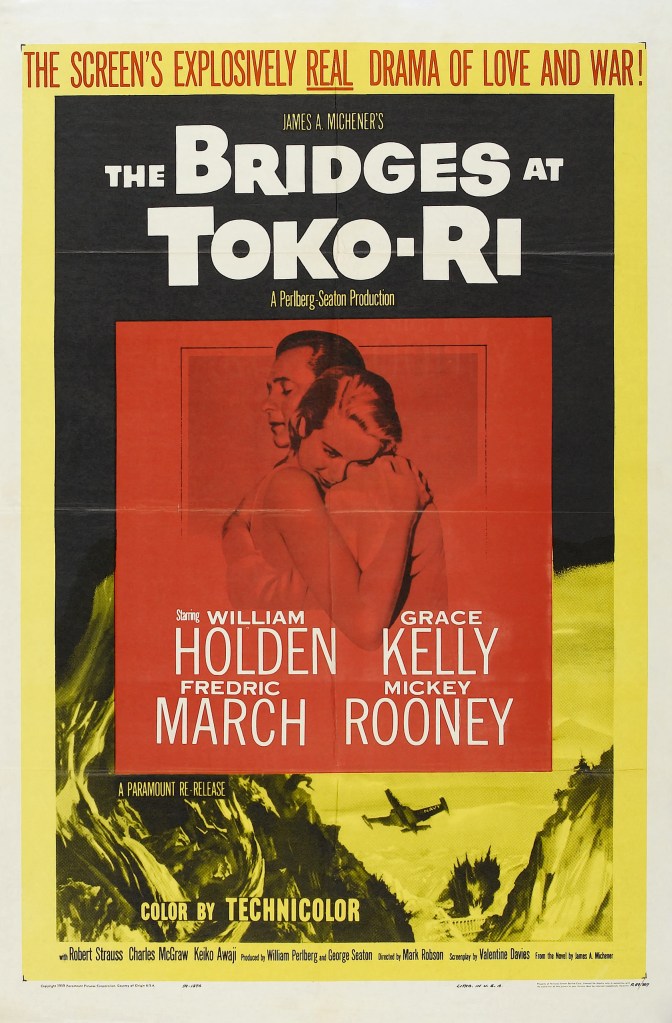
- Today’s Movie: The Bridges at Toko-Ri
- Year of Release: 1954
- Stars: William Holden, Grace Kelly, Fredric March
- Director: Mark Robson
This movie is not on my list of essential films.
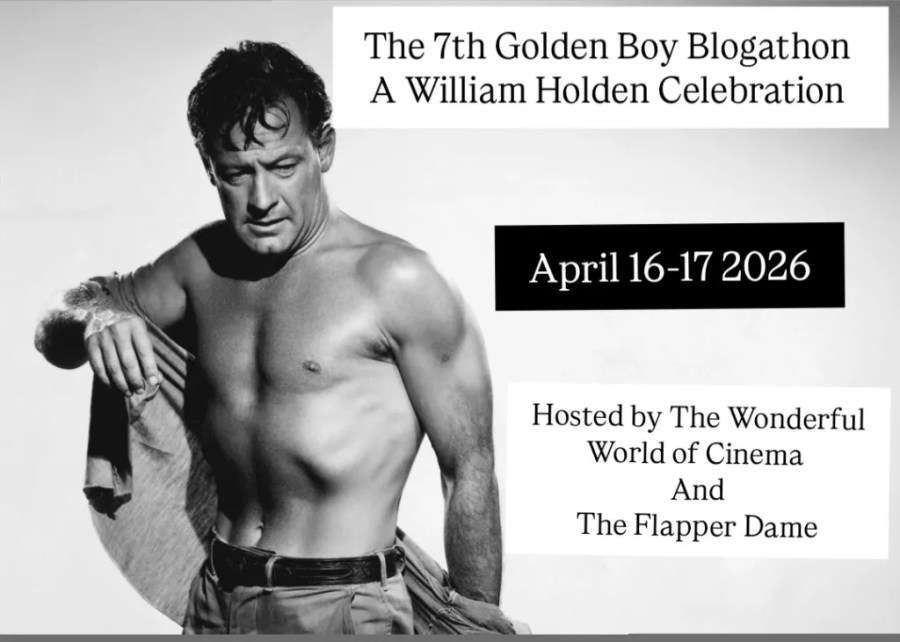
Today’s installment of Sports Analogies Hidden In Classic Movies is just one of many contributions to a event called The 7th Golden Boy Blog-A-Thon hosted by The Flapper Dame and The Wonderful World of Cinema. I’ve participated in so many events with them, I’ve literally lost count. Suffice it to say, it’s a lot. Numbers not withstanding, thanks to these two, I’ve shown several hidden sports analogies for “The Golden Boy:”
- “J.J. Sefton” was the model for the world’s first sports agent in Stalag 17.
- His role in Network as an executive making the fictional TV network UBS look just like today’s actual ESPN.
- To balance Stalag 17, Holden’s “Jim Dawkins” in Streets of Laredo was the essential “big-time free-agent” athlete “J.J. Sefton” was made to represent.
- Was “Pike Bishop” from The Wild Bunch the western equivalent of legendary football coach and commentator John Madden?
- “Lt. Col. Frederick” was ahead of his time in race relations in The Devil’s Brigade.
But going beyond the events I’ve mentioned, this is the first one I can recall with it’s own promotional video. But again, media drops into the same bucket as numbers. Their significance shouldn’t overshadow what always proves true here. These events always have great contributors; the variety of views is only outpaced by the passion of the participants.
The Story:
The Bridges At Toko-Ri is set during the Korean War, which is known among many American military historians as “The Forgotten War.” The fact it was sandwiched between two culturally and generationally defining conflicts such as the Second World War and Vietnam left it overshadowed.
But an important lesson was learned in Korea. The birth of the atomic age meant conventional wisdom skewed toward the obsolescence of large-scale land wars like the world had just seen. Following that thought, the United States dismantled much of it’s military might after Second World War. As a result, the U.S. found itself massively unprepared to react to North Korea’s surprise invasion of the South in 1950.
Another reason Korea faded in the American consciousness was the fact it was a war not largely dependent on the draft. The American reserves and National Guard were well-stocked with veterans of WWII, which made them the obvious solution for an immediate need for experienced troops.
This film’s protagonist is one of those veterans rousted from their civilian slumbers to face the nightmares of war yet again. Harry Brubaker (played by William Holden) served as a naval aviator during WWII, but had settled comfortably into a civilian life as an attorney. As a member of the U.S. Navy Reserve, Brubaker was recalled to active duty.
At this point, Brubaker becomes the embodiment of America’s state of unpreparedness. There really isn’t a better example than in the blink of an eye being forced to send somebody from a law office furnished with leather wingback chairs to the ejector seat of a Grumman F9F fighter-bomber being hurled from the heaving deck of an aircraft carrier. That’s how Harry the Lawyer goes from flying a desk to Lieutenant Brubaker, aviator in a naval fighter-attack squadron onboard the aircraft carrier USS Savo Island.
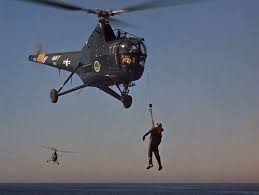
Just as quickly, Lieutenant Brubaker finds himself taking battle damage over North Korea and is forced to ditch his aircraft in the Sea of Japan. Bobbing helplessly in the bone-chilling water, Brubaker is moments from freezing to death when a Navy rescue helicopter appears. Brubaker is rescued by chopper pilot Chief Petty Officer Mike Forney (played by Mickey Rooney) and rescue diver Nestor Gamidge (played by Earl Holliman).
Once back aboard the USS Savo Island, Brubaker is called to the quarters of Rear Admiral Tarrant (played by Fredric March). Tarrant lost his own son at the Battle of Midway in 1942 and Brubaker reminds Tarrant of him.
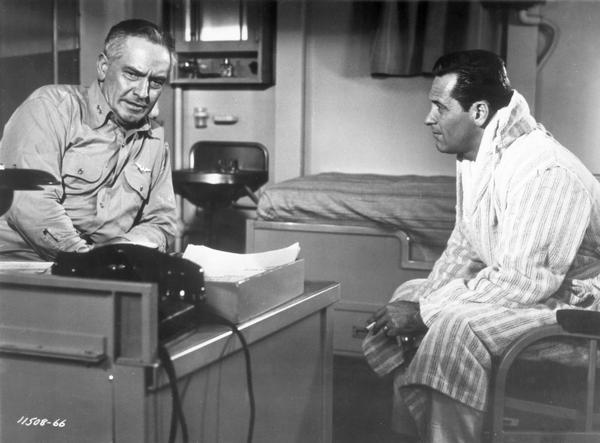
Given leave to speak freely, Brubaker complains about the unfairness of his recall when most active Navy Reserve pilots were not recalled, and he hadn’t even been flying. In response, Tarrant tells him “all through history, men have had to fight the wrong war in the wrong place, but that’s the one they’re stuck with.”
A new conflict is emerging as the group gets a new mission; a set of bridges vital to the North Korean supply lines. However, Tarrant is losing faith in his Carrier Air Group Commander Wayne Lee (played by Charles McGraw). Tarrant thinks Lee is too dedicated to his men; to the point of risking the success of the mission. This is the soul Tarrant’s belief Lee is too weak to be promoted.
Now…for the “how does Grace Kelly end up in this movie” part. The USS Savo Island has to return to it’s home port in Japan before it can carry out it’s next assignment. At the same time, Brubaker finds out that his wife Nancy (played by Grace Kelly) and their children have arrived in Tokyo on an unexpected visit. Tarrant gives him three days liberty in Tokyo, but the Brubaker family reunion gets raided by reality. Nestor Gamidge knocks on Brubaker’s hotel room door pleading for help rescuing Forney from the clutches of the shore patrol after the pugnacious pilot had another of his infamous brawls.
This pause gives Nancy leave of her own to ponder her fate. The joy of being reunited with her husband gets a hard tempering as she is greeted by a man showing all the signs of cracking from man ready to crack from combat fatigue. She contemplates the idea of her life as a widow. Tarrant tries to console her, but her is reminded of his own daughter-in-law’s struggle with sanity in the wake of losing her husband.
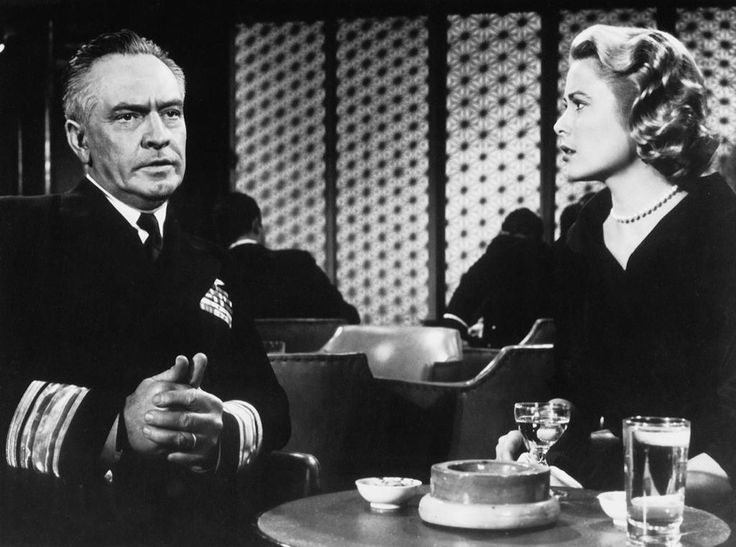
Once the Savo Island’s stocks are replenished, she sails for Korea. One of the first orders of business for the carrier air group is a dangerous reconnaissance mission to photograph the bridges at Toko-Ri. Commander Lee flies this mission with Brubaker as his wingman. Once the photos are shown to the other pilots, the danger of this mission becomes all too clear. Attacking the bridges will mean flying low along the banks of a river which is lined with anti-aircraft guns. Having seen it first-hand, Brubaker becomes ill during this briefing. Foreseeing his own death, he contemplates writing a letter to Nancy sharing his premonition.
Meanwhile, Forney’s latest escapades have landed him in hot water one too many times. As a result, he is re-assigned to another ship. But as he is leaving, he sees Brubaker in his moment of distress. Forney stops and shares his “cure for bad nerves;” facing the ocean head-on from the bow of the ship. Brubaker follows Forney’s advice, and Commander Lee tries to bolster Brubaker’s morale by asking him to stay behind if he feels he cannot accomplish his mission. But with renewed strength from Forney’s “cure,” Brubaker vows to do his duty.
Lee organizes two formations for the attack on the bridges. Lee leads the first one; while it does damage, the bridges are still intact. Brubaker leads the second wave on a low dash toward the target. Despite the intense anti-aircraft fire, Brubaker’s group completes the destruction of the bridges.
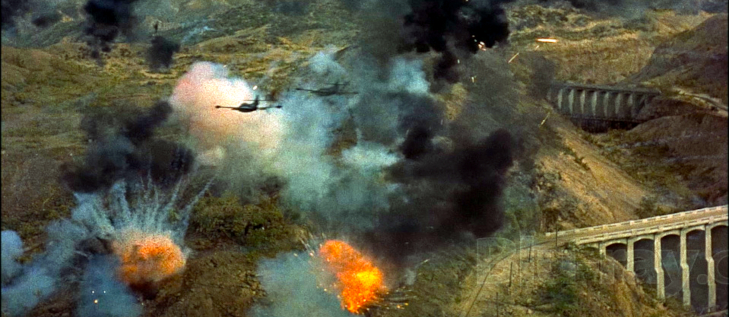
On top of that, the aircraft still have munitions after taking out their primary target. Lee then directs the formations to a secondary target, a North Korean ammunition dump. Brubaker complete his attack run on the target, but in the process takes enemy fire. The resulting fuel leak means Brubaker can’t get over the last hill between him and the sea, forcing him into a belly landing behind enemy lines.
Brubaker escapes his crippled F9F Panther to take cover in a ditch. Forney and Gamidge’s rescue helicopter soon appears on the horizon, but a North Korean patrol also enters the area. As Gamidge begins his rescue attempt, a burst of machine gun fire kills him instantly and disables the chopper. Forney is forced to join Brubaker in his defensive position, hoping they can hold off the North Koreans long enough for another rescue attempt. But armed only with pistols, two M1 carbines, and limited amount of ammunition, they are eventually cut down by the North Koreans.
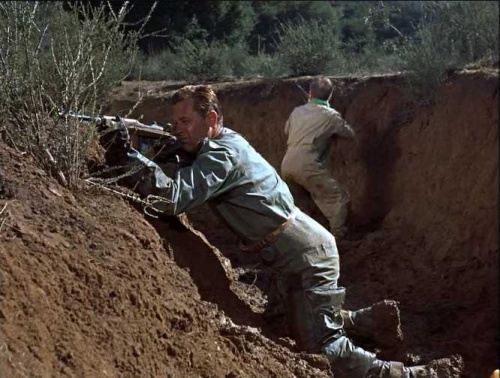
Shattered by the news that Forney, Gamidge, and Brubaker have been killed in action, Tarrant demands Commander Lee explain his decision to attack the secondary target. Lee defends his action, stating that despite the losses, the mission was a success. Tarrant can’t deny that as he also realizes Lee has “matured” as a leader and recommends him for promotion.
The Hidden Sports Analogy:
The irony isn’t lost on me that this film is set in “The Forgotten War,” because this really is a “forgotten” classic. Despite it’s two Academy Awards (Best Special Effects and Best Film Editing), even the hardcore Holden-ites don’t mention The Bridges at Toko-Ri if asked to name the “essential” William Holden films. You’ll get a lot of Sunset Boulevard, Network, or even Picnic before this movie comes from their mouths. I’m just as guilty despite the connections my background gives me to this movie, but even I’m prone to mention The Wild Bunch or Stalag 17 before it.
Just look at my earlier list of Holden flicks I’ve written about…
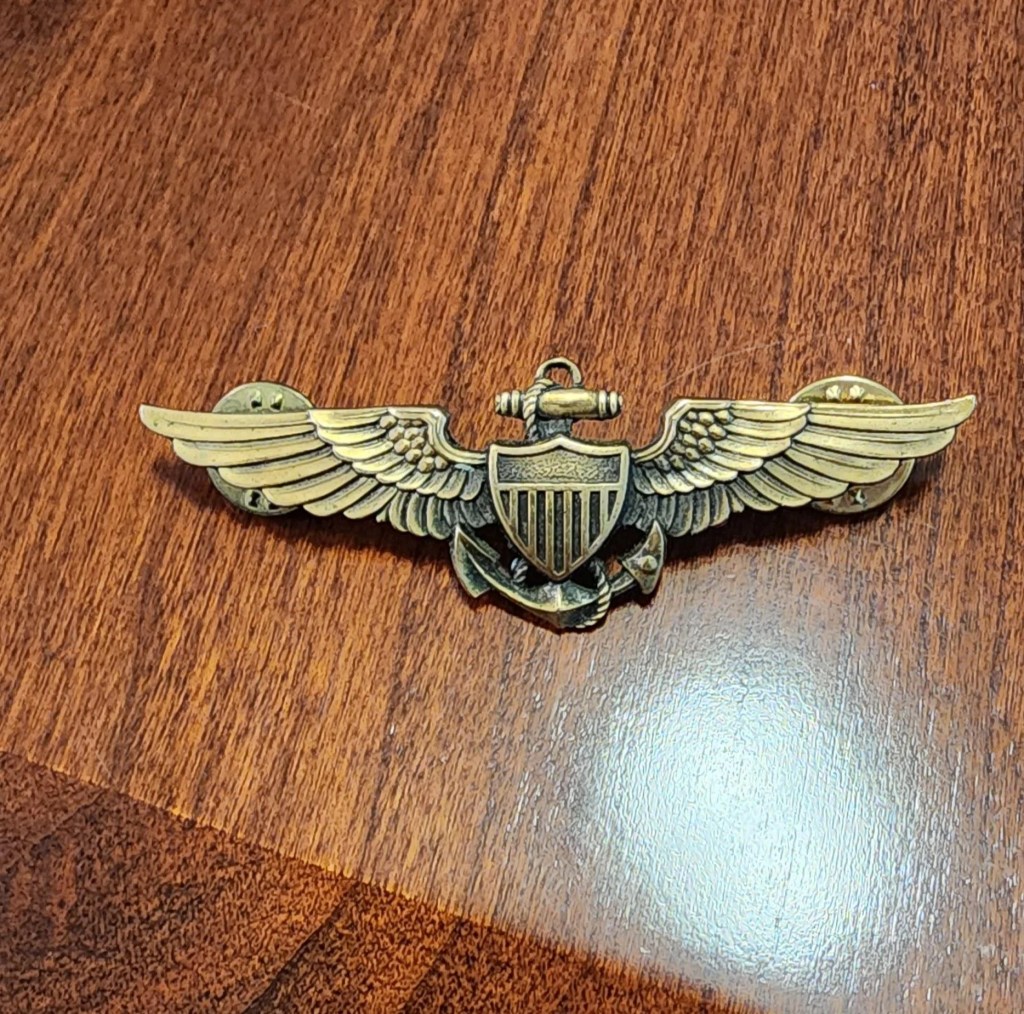
We humans tend to push the unpleasant or the uncomfortable to the fringes of our psyche. If you shift the conversation from William Holden flicks to movies about carrier pilots, The Bridges at Toko-Ri will rate far down that list. It doesn’t require the keen eyes of a pilot to see why. This movie is chock full of “unpleasant” and “uncomfortable.” Likewise, you need not have worn the gold wings of a Navy or Marine Corps Aviator to appreciate the realism of this film. It takes you right into the existence of a carrier pilot; a world all about skipping the frying pan by going straight from from fire to fire. Lt. Harry Brubaker exists to be the embodiment of such a journey.
To best illustrate this, allow me to begin with a clear and present danger that flies under the radar in this movie…being married to Grace Kelly.
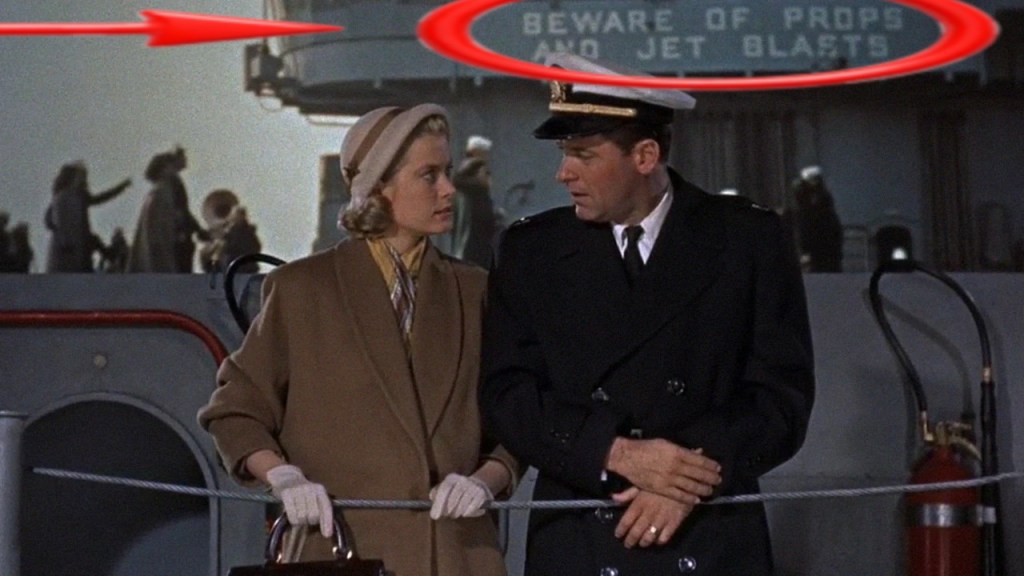
The part not shown is outlined by the old Dr. Hook song When You’re In Love With a Beautiful Woman. He has to know that while he’s away, one of his golf buddies is going to make a move. We all know they would be waiting like wolves looking for the first signs of Nancy’s loneliness and if she might be considering taking up some temporary company.
But the opposite is the real reason Grace Kelly exists in this film. She embodies the idyllic life left behind by Harry Brubaker. That makes the viewer empathize with him even more after his voicing the unfairness of his call to duty. It also draws the viewer into Harry and Nancy’s worries over his possible death.
This really comes to the forefront when Brubaker is puking over the rail, but this also overlooks the pantheon of ways to meet one’s maker inherent in naval flight operations. This started with a metaphor to the old saying about “going from the frying pan to the fire;” the modification needed is to imagine the flight deck of an aircraft carrier as a five-acre flat-top griddle; they are both hot, noisy, and extremely dangerous.
That was true at the dawn of carrier operations, and those dangers only grew as the planes got faster and the ships got bigger. An earlier image already warned of the perils of propellors and jet blasts, but the intake side of a jet engine can be problematic as well.
The movie itself paints a vivid picture for the part where people are getting shot at; we’ll just take that as understood. But anything that gets off the deck has to get back on. See below for some first-person perspective on what landing a 30-ton jet on a 100,000-ton floating steel city looks like.
Did you notice haw small that five acres is set against the vastness of the ocean…not to mention when you’re hurtling towards it at 150 miles per hour? If you really want to walk in Willie Holden’s shoes, a while back one of Dubsism’s contributors did a piece about how to simulate life aboard a Navy ship. Here’s how you can add pulling off a carrier landing to that experience:
- Stack all your furniture on one side of your living room.
- Place a dollar bill on the floor opposite the stacked furniture.
- Climb to the top of the furniture stack.
- With your arms stretched out to your sides and your tongue sticking out, jump off the stack toward the dollar bill.
- If your tongue lands on the dollar bill, you made it!
By now, you’re probably wondering where the sports analogy is. Well, just like how The Bridges At Toko-Ri is an “under-the-radar” Holden classic and how Grace Kelly has a hidden reason to exist in such a gritty war drama, today’s analogy doesn’t get much attention in the sports world.
The crown jewel of the American rodeo circuit is bull riding. Like it or not, there nothing which evokes such visceral responses from all of us, largely because it is simultaneously grotesque while being gruesomely entertaining. Having said that, this is not an exercise is debating its pros and cons. Rather, it’s all about the organized chaos seen on both the bull rider’s chute and a carrier flight deck.
First, there’s all the various handlers. Bulls don’t get into the chutes and aircraft don’t get loaded onto the catapult without an orchestrated effort. The same guys who prepare both for launch are the same who re-corral the bulls and put the planes back on the hangar deck.
Then there’s the rescue crews. In rodeo, this role falls to the bullfighters…or the artists formerly known as “rodeo clowns.” Back in the day, their clown-like costumes were believed to help draw the bull’s attention away from a downed rider, allowing him to escape. Sometimes, they have to rescue a rider who can’t escape.
There’s the common ground rodeo bullfighters share with Mike Forney and Nestor Gamidge. Those two are carrier-based bullfighters flying missions rescuing downed pilots…complete with Forney’s clownish green top hat and yellow scarf.
This brings us to the star of the show. While he may be getting into the cockpit of an F9F Panther rather than sitting on two angry tons of Big Macs on the hoof, Billy “Bull Rider” Holden is still strapping on a helmet to take a ride which could easily result in his death.
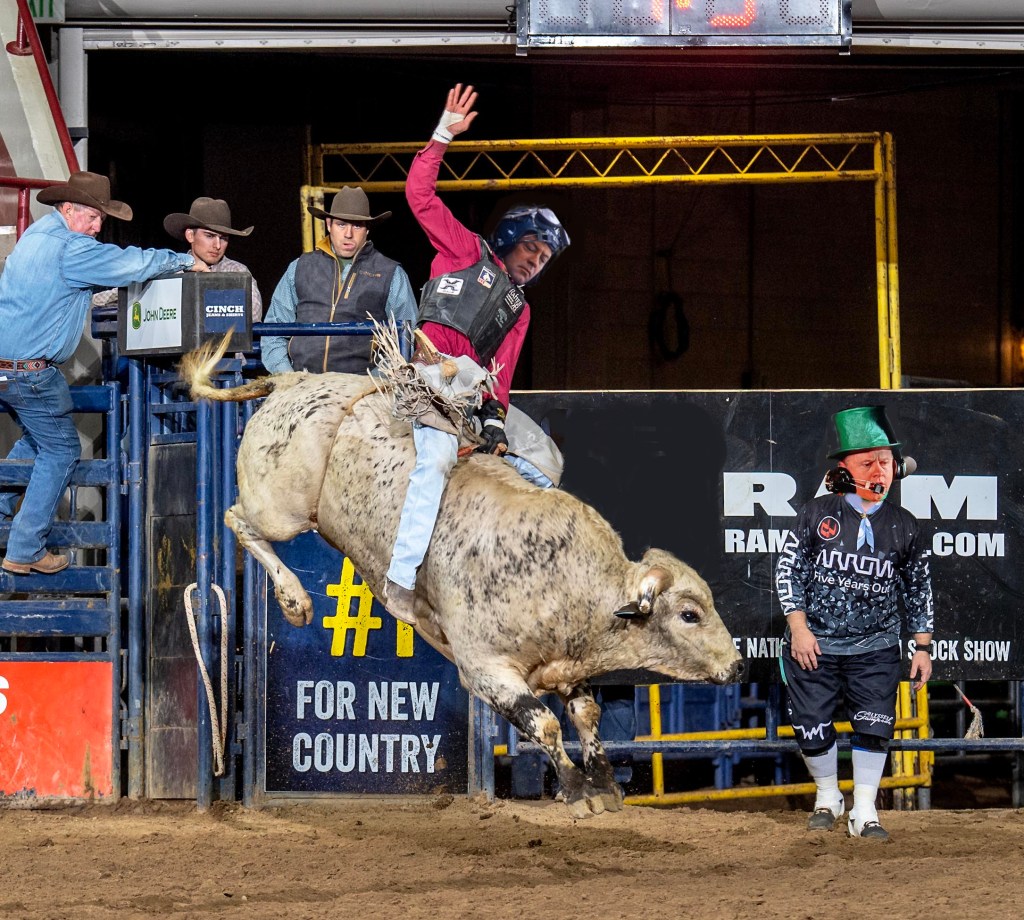
The only real difference between a bull rider and a carrier pilot is timescale. Bull riders are in and out of harm’s way in a matter of seconds; carrier pilots can meet death in every minute of an hours-long mission.
The Moral of the Story:
The unpleasant and uncomfortable fact is sometimes the bull wins.
Got a question, comment, or just want to yell at us? Hit us up at dubsism@yahoo.com, @Dubsism on Twitter, or on our Pinterest, Tumblr, BlueSky, Truth Social, Instagram, or Facebook pages, and be sure to bookmark Dubsism.com so you don’t miss anything from the most interesting independent sports blog on the web.


[…] Dubism, talks to us about the hidden sport analogies in one of my favorites, The Bridges at Toko-Ri (1954) (one of my favorites, with another one of my favorites, Grace Kelly!!… […]
LikeLike
OH MY GOD: this is certianly the most fascinating article I’ve ever read about Toko-RI. I really loved this movie because it’s such a different war movie than what is usually presented. Because you do see the military man interact with his family in the midst of being in active duty- similar to bull riding, when the family comes to the base, they get to kind of watch and be in the mix of things.
This was actually one of Mr Holden’s favorite movies and HE INSISTED the ending be the ending that it is, as producers wanted to change it. He used the ending to pay tribute to his own brother. His co stars Grace Kelly and Fredric March also made it a fantastic experience for him.
Its also one of my favorite “war movies” not just because of the cast, but because it is such a different type of war movie- the ending being realistic and not exactly hollywood, the fact you see the family involved with the man in active duty (not at home sending letters and supplies) and the psychology of what that does to a marriage.
A handful of Holden’s movies actually deal with inner psychology- and that to me is fascinating, this one in particular because its set in war. I do feel this is one of the first war movies to break the mold of just another action movie.
I’m so honored to have read this piece about Toko RI- THANK YOU SO MUCH! and thanks for writing!!
LikeLiked by 1 person
Great post Dubs and loved those pics- one question… are you going to join the throng on Blue Sky? Be good to see you there…
LikeLike
You called? @dubsism.bsky.social
LikeLiked by 1 person
My work is done ! Good to have you on board…
LikeLike
I didn’t know this sport analogy blog post would lead us to… bull riding! That was very interesting and a comparison that definitely makes sense. The Bridges at Toko-Ri is indeed not Holden’s best-known film, but it’s one that I love more and more on each viewing. Back in 2021, Earl Holliman sent me an autographed pictured of him in this film (answering my fan letter!). Lots of my favourites in that film! Anyway, thanks so much for your great contribution to our blogathon, you’re definitely one of our most faithful participants!
LikeLiked by 1 person
[…] – The Bridges at Toko-Ri (Mark Robson, […]
LikeLike
Thanks for reviving this overlooked film. With its cast, you can’t miss. My dad, who passed away last year, served stateside during the “Forgotten War.” He was drafted. As a kid in 1959, he took me to see Pork Chop Hill, another Korean War movie. It’s on Amazon Prime. Toko-Ri is on MGM Plus so I’ll definitely be watching. Thanks again.
LikeLike
Pork Chop Hill is a lot like The Bridges at Toko-Ri not just because it’s set in Korea, but that it gets overshadowed. When you think “Gregory Peck war movie” most people would go straight to Twelve O’Clock High.
.
LikeLike
Yeah, The Bridges at Toko-Ri isn’t very well known despite its cast, so when I watched it for the first time a few years ago, I was stunned to discover that it’s really, really good.
LikeLike