
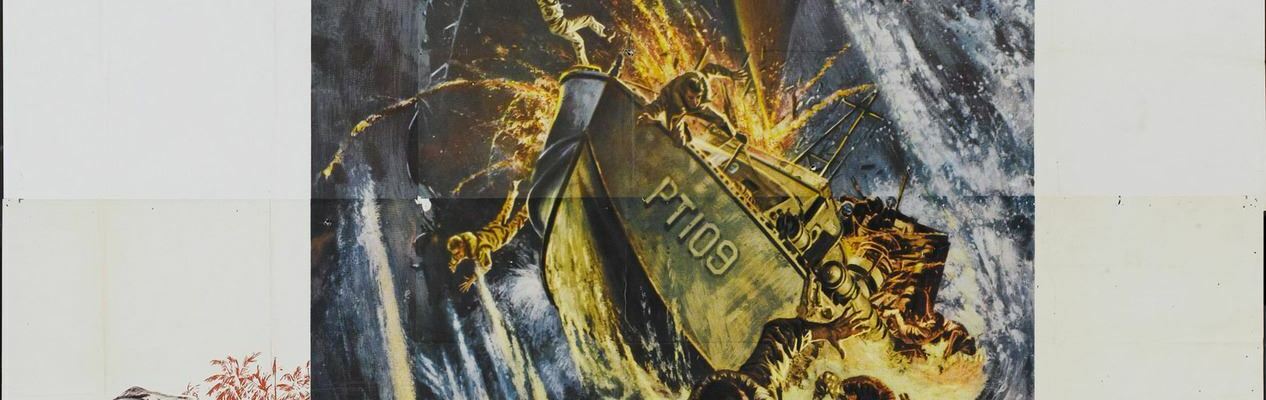
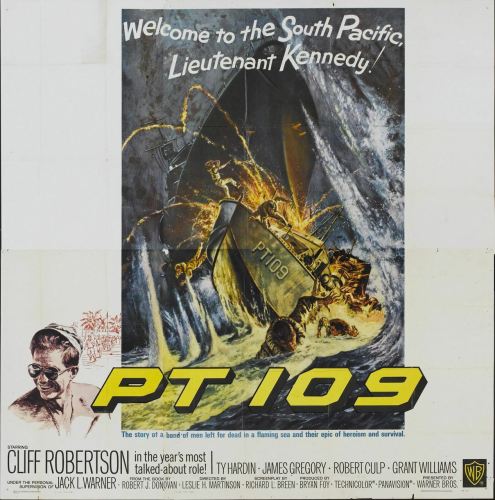
- Today’s Movie: PT-109
- Year of Release: 1963
- Stars: Cliff Robertson, Robert Culp, Ty Hardin
- Director: Leslie H. Martinson
This movie is not my list of essential films.

NOTE: This installment of Sports Analogies Hidden In Classic Movies is being done as part of something called the Two Jacks Blog-a-thon being hosted by Taking Up Room. This is an interesting topic as it marks the 60th anniversary of two men who died within hours of each other on November 23rd, 1963…C.S Lewis and President John F. Kennedy.
You can see all the contributors to this blog-a-thon here:
The Story:
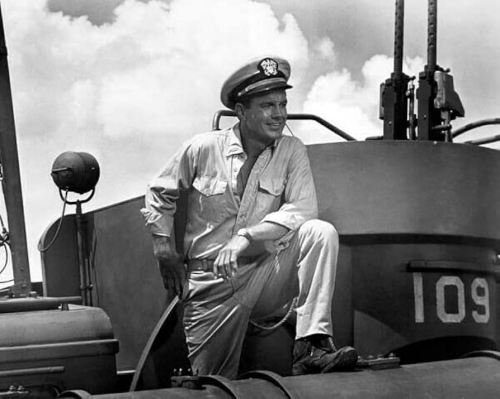
PT-109 opens in August 1942; the Second World War is in full swing. Lieutenant Junior Grade John F. Kennedy (played by Cliff Robertson) has just graduated from the U.S. Navy’s Patrol (PT) Boat Training School. Eager to get into the war, Kennedy exercises his family connections to get assigned to the Solomon Islands; the epicenter of the Pacific War at the time.
Upon arriving in the South Pacific, Kennedy is stationed at the PT Boat base on the island of Tulagi. He also wastes no time making it known he wants command of his own boat. As a result, Kennedy is given command of the barely-afloat PT-109.
To go along with his tired hulk of a boat, Kennedy is given a patch-work crew. Together with his new executive officer Ensign Leonard J. Thom (played by Ty Hardin) and sailors “Bucky” Harris (played by Robert Blake) and Edmund Drewitch (played by Norman Fell), Kennedy begins the arduous task of making his boat seaworthy again.
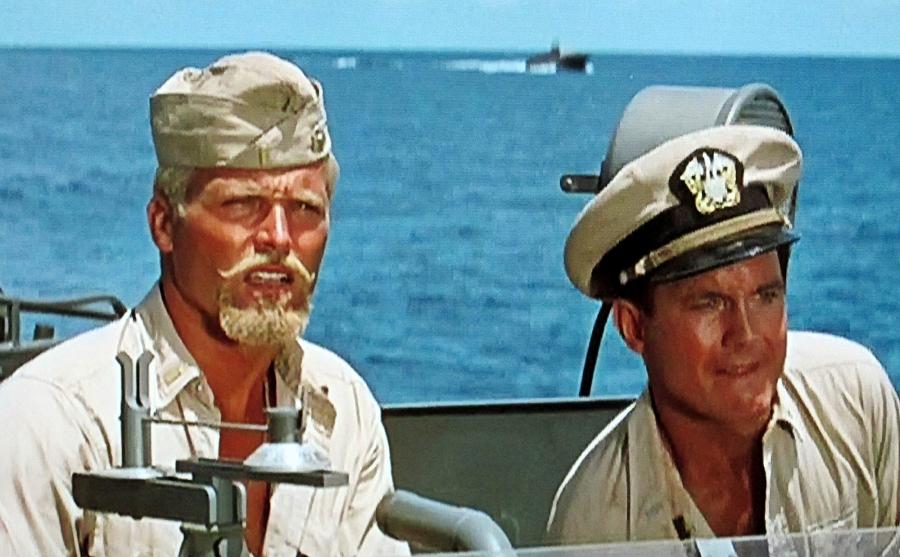
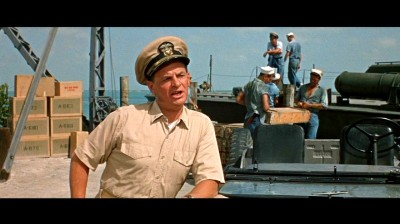
Originally, Tulagi’s crusty maintenance officer Commander C. R. Ritchie (played by James Gregory) is dismissive of Kennedy as just another young, inexperienced officer. However, after Kennedy gets the PT-109 ready for action, he and his crew get their chance.

Kennedy, Thom, and their crew are sent on a mission to rescue a group of U.S. Marines pinned down on the beach during a raid on the island of Choiseul. The catch is the PT-109 doesn’t have enough fuel to get back to Tulagi. Despite this, PT-109 successfully snags the Marines off the beach, and draws withering fire doing so. While making their escape, their engines fall silent starved for fuel. As the current is drifting the boat back into range of the Japanese guns, another boat arrives to tow the PT-109 to safety.
After this close call, PT-109 is re-assigned from Tulagi to Rendova. While on night patrol in August of 1943, Kennedy and his crew are searching for a Japanese supply convoy in a body of water colloquially called “The Slot.” Without warning, an enemy destroyer appears out of the darkness bearing down directly on the PT-109. Kennedy has no time to react; the PT-109 is rammed and cut in half; two of her crew are killed.
After the attack, Kennedy assembles the surviving members of the PT-109’s crew and leads them to refuge on Plum Pudding Island. When daylight comes, search planes are dispatched, but when the wreckage of the PT-109 is spotted with no signs of survivors, the boat is presumed lost with all hands. Knowing that their only hope for rescue is to draw the attention of passing ships, when night falls Kennedy swims out into the channel with a flotation device and a signal lantern. He stays in the channel all night in the hopes that he can flag down a passing ship…and gambling that ship isn’t Japanese. Having no success the next night, he sends Ensign George “Barney” Ross (played by Robert Culp) on the same mission.
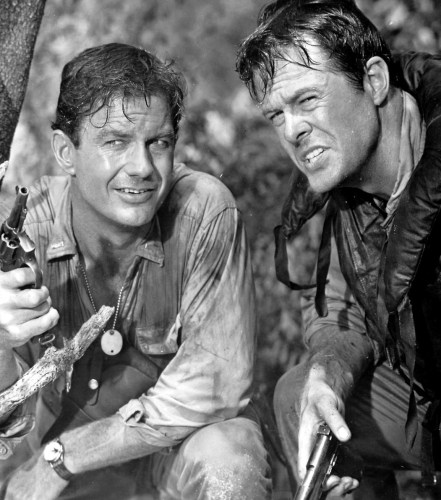
Several days go by with no success. As a result, the morale amongst Kennedy’s men plummets; so much so that Kennedy has to convince them not to surrender to the Japanese. Knowing he needs to enact another plan, he leads the crew on a three-mile swim to another island where Kennedy hopes there will be more food and water.
However, almost as soon as Kennedy and his crew hit the beach, they are greeted by two rifle-toting natives. They have no idea who these men washing up on their island are, and the language barrier only complicates matters. But the fact that Kennedy as his men look “not Japanese” seems to be enough for them to be willing to play messenger for Kennedy. As a result, he carves a message on a coconut and gives it to the two rifle-toters. In turn, they take Kennedy’s message to an Australian coastwatcher Lieutenant Reginald Evans (played by Michael Pate). Evans then notifies the U.S. Navy, after which Kennedy and his crew are rescued by another PT boat.
The Hidden Sports Analogy:
Today’s hidden sports analogy comes in the form of a question once posed Dubsism contributor the late Jason From Indiana (JFI). One day, we were talking about a blow-out football game when he asked me why does a team punt when it’s losing 53-0?
I said “because that’s how you play the game.” From the look on his face, he had the same level of comprehension if I had made that statement in Swahili. This moment would become the defining one for a running argument between us. I’ve always held the belief that the view of a sports differs between those who played it and those who didn’t.
For reasons he took with him to his own final score, he heard the word “different” as “better.” JFI always thought that meant somebody who never played football could never know as much about the sport than somebody who had.
Here’s the perfect example of What I really meant. I love watching hockey. I went to college at a school (the University of North Dakota) that is a historic power in college hockey, so I knew a lot of hockey players. Those guys could watch a hockey game and see things that would have never occurred to me. This phenomena is also why almost every sports broadcast team includes a “color guy” who played the game being covered.
In any event, my challenge was getting JFI to understand that the worst thing you can do as a player isn’t to lose…quitting is the unforgivable sin. Specifically to his question, regardless of the score. a team has to play the until the clock runs out.
For those of you who aren’t followers of American football, the point behind punting on 4th-down is to save one’s team from having bad field position. In World Football, the equivalent would be the losing goalkeeper just dropping the ball in front of his own net on a goal kick. He might as well pull out a folding chair and have a picnic lunch on the goal line while balls rocket past him into the back of the “onion bag.”.
We can all understand how bad that would look. What’s even more baffling is the “give up” mentality can rise far beyond trivial matters such as where a football rests on a field. That’s really what PT-109 is all about. From the moment his boat is sunk, Kennedy does everything he can to stay in the game of staying alive. He even has to quell a rebellion among his men who want to “give up.”
If you think about it, this film is the antithesis of Gilligan’s Island. The guy who swims out at night with a signal light into a shark-infested shipping lane isn’t about to put his faith in a professor who could build a radio out of a coconut but couldn’t fix a hole in a boat.
What it all boils down to is regardless of what you thought of JFK as a politician in the 1950s and 60s, the man was a sheer badass in the 1940s. The reason why is elementary. He simply did not know the meaning of the word “quit.” He did everything he could to get assigned to where the fighting was. He did everything he could to get his own PT boat. Then he did everything he could to keep himself and his crew alive and to get off that island.
We may never know how different history might have been had JFK taken the “Gilligan” approach… especially if Marilyn Monroe played “Ginger.”
The Moral of the Story:

Clichés earn that status because they are set in the concrete of truth. In this case, it’s a gem that came from the mouth of every coach I ever had…”Winners never quit, and quitters never win.”
Got a question, comment, or just want to yell at us? Hit us up at dubsism@yahoo.com, @Dubsism on Twitter, or on our Pinterest, Tumblr, BlueSky, Truth Social, Instagram, or Facebook pages, and be sure to bookmark Dubsism.com so you don’t miss anything from the most interesting independent sports blog on the web.

 Dubsism
[…] from Dubsism looks for the sports in the 1963 Kennedy biopic, PT-109, about JFK’s time as a second lieutenant on a PT […]
LikeLike
Thanks for this inspirational post, a reminder to Never Give Up.
Also, I loved your comparison of PT109 to Gilligan’s Island, and how that crazy professor could build a coconut radio but not repair a boat.
LikeLike
Yes! Love this–Kennedy wasn’t a quitter by any stretch of the imagination, and it’s cool that he got to see a movie of this caliber about himself. Thanks again for joining the blogathon with this great review!
LikeLike
Thanks for coming up with the great topic!
LikeLiked by 1 person
You’re very welcome, J-Dub!
LikeLike