


- Today’s Movie: The Legend of Bagger Vance
- Year of Release: 2000
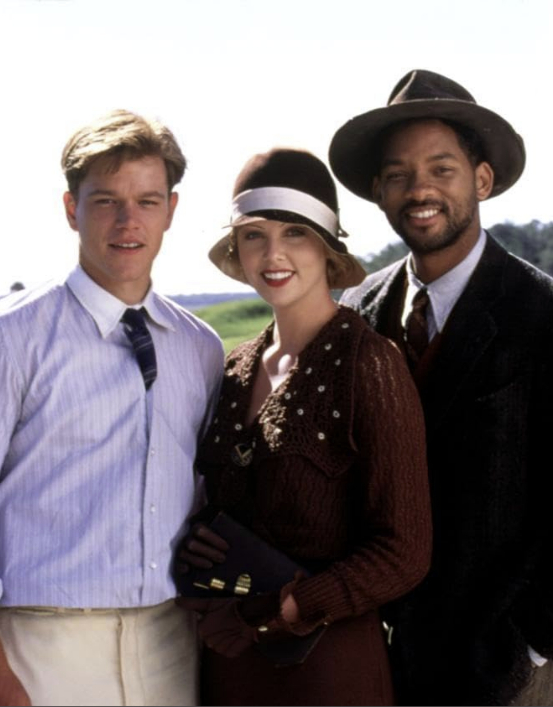
- Stars: Will Smith, Matt Damon, Charlize Theron
- Director: Robert Redford
This movie is not on my list of essential films.
Today’s installment of Sports Analogies Hidden In Classic Movies is just one of many contributions to a much larger exercise in flights of fancy called the Once Upon A Time Blog-A-Thon hosted by Hometown to Hollywood. Thanks to her bringing us this fully-loaded topic, you can (after you leave my nonsense 🙂 ) see the insightful and talented contributors to this event:
The Story:
Aficianados of sports films may find 2000’s The Legend of Bagger Vance somewhat reminiscent of The Natural from 1984. There’s three solid reasons for that.
First, they are both based on books. The Natural stems from a 1952 Bernard Malamud novel of the same name; where the film featured in today’s topic comes almost directly from Steven Pressfield’s 1995 work The Legend of Bagger Vance: A Novel of Golf and the Game of Life.
Second, both films are deeply rooted in mythology, albeit different flavors. The Natural borrows from Arthurian legend in the sense of Robert Redford’s “Roy Hobbs” being Perceval to Wilford Brimley’s “Pops Fisher” as The Fisher King. Similarly, in The Legend of Bagger Vance, Rannulph Junuh (played by Matt Damon) and Bagger Vance (played by Will Smith) represent the warrior-hero Arjuna being tutored by the god Krishna in the sacred Hindu text Bhagavad Gita. In fact there are so many comparisons between today’s movie an some form of mythology, one could have a contest to see how many such comparisons can be made.
There’s the one just mentioned. It’s not a stretch to convert Hindi to Jedi and the resultant comparison with Luke Skywalker and Obi-won Kenobi. If you can see that, it’s even easier to see Luke and Obi-Won as Arthur and Merlin the Magician of Camelot. For me personally, I see something strong between the original Krishnamurti theme here and Uncle Remus from Disney politically-expunged Song of the South.
At least The Legend of Bagger Vance has the balls to give us a black magus 🙂 But…I digress.
The third reason is really the raison d’être for the first two lie in the third; the presence of Robert Redford in both films. Having starred in the first one and directed the second is 100% why The Legend of Bagger Vance evokes themes from The Natural. That goes right down to the golden tones in the cinematography to the flight of balls set to classical music; in the case of “Vance” being In Paradisum from Faure’s Requiem.
As for the plot, the film is set in Savannah, Georgia. The story is told through the eye of Hardy Greaves (played as a child by J. Michael Moncrief, narrated as an adult by Jack Lemmon), who now is a senior citizen six heart-attacks past his golfing days. It all starts with Greaves contemplating how his late wife used to ask him why he kept playing “a game that seems destined to kill him.” His explanation for his love of the game begins with his legend of his boyhood hero: Rannulph Junuh.
In his day, Junuh was a golf wunderkind from a wealthy Savannah family. At first, it would seem that Junuh and his statuesque girlfriend Adele Invergordon (played by Charlize Theron), have the world as their proverbial oyster, but what supposedly was going to be a fairy-tale life was interrupted by the First World War.
Like millions of others, the war changed Junuh’s life. He went from being a golf prodigy with a “can’t miss” swing to a broken and somewhat embittered man; while serving as a captain in the U.S. Army, he saw his entire company cut down during a battle. Even though Junuh receives the Congressional Medal of Honor (the nation’s highest military honor), he goes into seclusion returning to Georgia well in the grips of alcoholism.
A decade later as the Great Depression is dawning, Junuh’s long-abandoned girlfriend Adele has inherited a country club from her father. As times are tough, she is desperate to save it from bankruptcy. To that end, she organizes an exhibition match between the two greatest golfers in the world, Bobby Jones (played by Joel Gretsch) and Walter Hagen (played Bruce McGill). The catch is in order to generate local interest, Adele needs a local participant. The young Hardy Greaves advocates for his hero. As a result, Adele asks her estranged lover Junuh to play.

Obviously, Junuh is nothing like the golfing golden boy he once was; a life of gambling and hard drinking having taken it’s toll. While somewhat futily attempting to regain his past form, Junuh is approached by a mysterious figure who introduces himself as Bagger Vance, part-time caddie and spiritual guru. Vance tells Junuh by being his caddy he can help Junuh regain his “authentic swing.” With Greaves in tow, the three begin the journey of Junuh’s redemption.
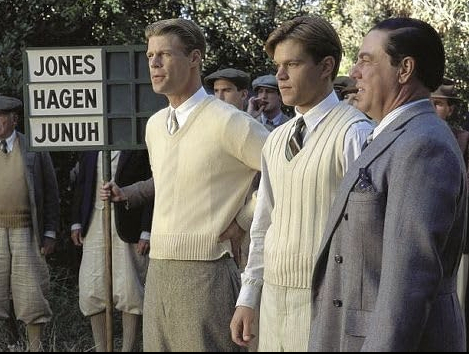
When they finally get to the match, Jones and Hagen each play well as expected; Junuh is the exact opposite. Sloppy and undisciplined, he falls well behind the golf legends by the end of the first round. But Bagger delivers on his promise; with some timely and sage advice, Junuh rediscovers his “authentic swing.” The second round is when Bagger’s advice begins paying off as Junuh begins gaining ground on Jones and Hagen. The third round brings more success for Junuh; he ends up right on the heels of the golf legends after hitting a hole in one in the process.
Meanwhile, Junuh and Adele predictably and formulaically rekindle their romance.
As we near the denouement on the final day of the tournament, in a fit of overconfidence, Junuh inexplicably stops heeding Bagger’s advice…and just as predictably begins playing poorly. He skulls a shot into the trees, which triggers a war flashback, but Bagger is able to bring him back into focus. As a result, Junuh scrapes his way to a tie with Jones and Hagen. With a chance to win on the final hole, Junuh calls a penalty on himself because his ball moved while he removing a loose impediment.
This moment convinces Bagger that Junuh has grown from his tutelage and decides that Junuh no longer needs him. Disappearing as mysteriously as he came, Vance turns over the caddy duties to Greaves. Despite the self-imposed penalty costing him a chance to win, Junuh drains an improbable putt which seals the match as a three-way tie.
The Hidden Sports Analogy:
When it comes to names, even those outside the golf world know Eldrick Woods. But there was another alongside Woods during that magic moment at the 1997 Masters when Eldrick became “Tiger.” That Sunday in Augusta also was the day the legend of “Fluff” Cowan was born.
Michael Thomas Cowan’s journey toward “Fluff” began with his birth February 7, 1948 in Winslow, Maine. He was a multiple sport athlete in high school, but his drive toward the links began in earnest with his making the golf team at Iowa’s William Penn College.
After college, he returned to Maine to work as a country club pro. But Cowan’s ascent to the Valhalla of golf would only come with his switch from the clubs to the bag. Once Cowan became a caddie, only time would control the growth of the legend.
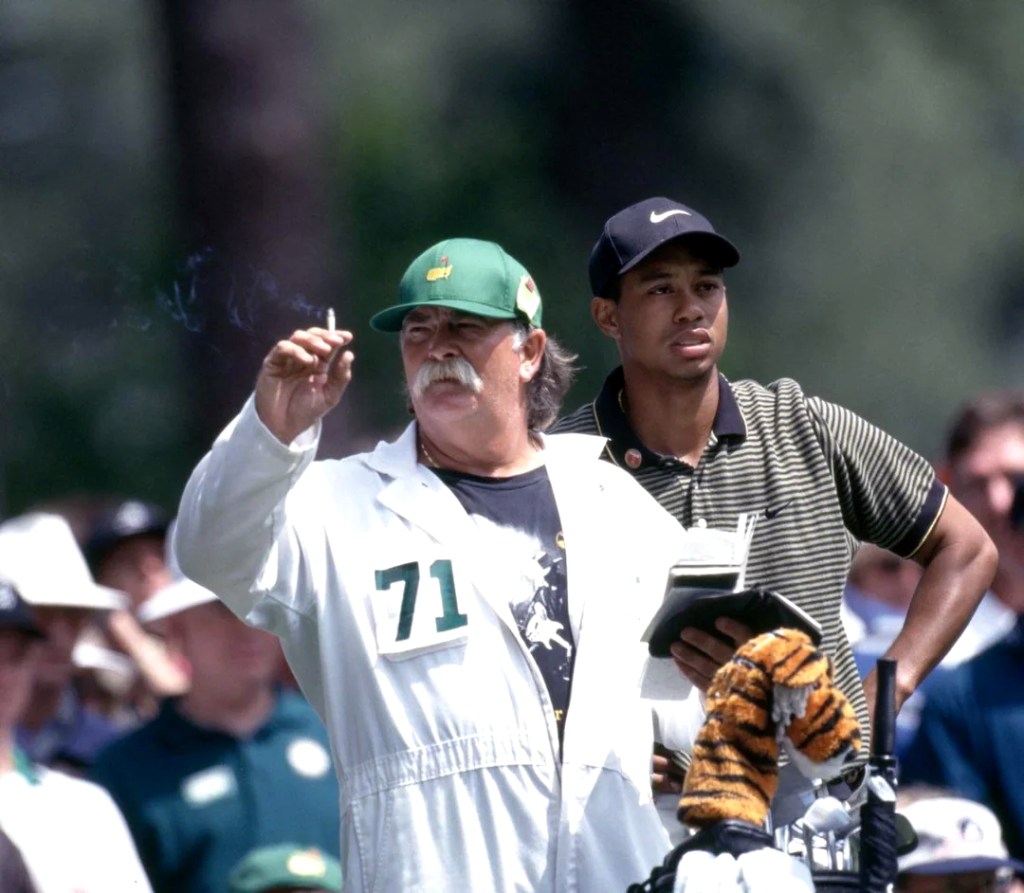
Cowan first caddied for Ed Sabo for two largely non-descript years from 1976 to 1978. Everything changed when Cowan began on the bag for Peter Jacobsen in 1978. In no time, Cowan became famous for more than his signature “walrus” mustache. Behind the lip-sweater was a genuine golf guru.
This became evident as once with Cowan, Jacobson rocketed to prominence on the Professional Golfers of America (PGA) Tour, including six tour victories, two Johnnie Walker cups, and nearly $8 million in career winnings…keeping in mind the purses in pro golf didn’t swell to their epic proportions until the tide of money brought by “Tiger.”
But in 1996, the tide hadn’t come in yet.
That’s the year Woods made his PGA debut at the Greater Milwaukee Open. That’s the year Cowan went with Woods, and the combination of young phenom and old guru was soon getting notice far beyond Milwaukee, the PGA, or the golf world in general.
The difference was easy to see; Woods’ ball coming off the club did things others didn’t, and the difference was measured in far more than the distance traveled. You could even hear the difference; his ball-strike didn’t sound like any others…and the comparison wasn’t even close.
All true golfers will attest to the game’s humbling mental aspects. That was the stuff even the duffiest weekend duffer couldn’t stop watching. Woods had a skill set unlike anybody before him, but Cowan was far more than an advisor on club selection and pin distance…he was teaching Woods how to win. It was now only a matter of time before the whole world also was watching.
The biggest stars shine their brightest on the biggest stages, and in golf there’s none bigger than Sunday at The Masters. But in 1997, Woods start on Thursday suggested there might not be a Sunday. Over his opening nine holes, Woods shot a near-disastrous 4-over-par 40. But that was when Cowan’s “Obi-Wan Kenobi” kicked in to mentor Woods’ “Luke Skywalker.”
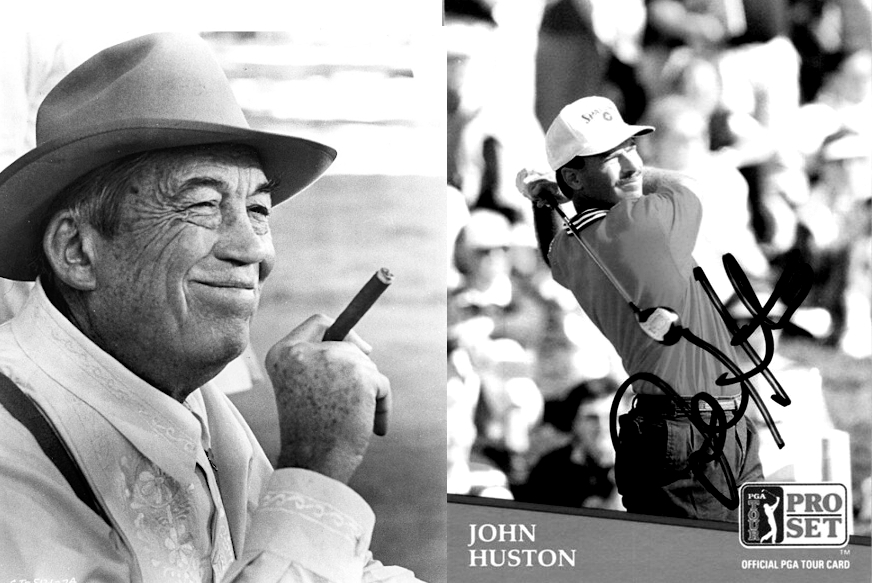
By teaching Woods the “Jedi Golf-Mind Trick,” Tiger turned it around on the back nine, draining four birdies and an eagle for a 6-under-par 30. That left Woods only three shots behind the first-round leader John Huston (not the movie John Huston).
From there, Woods pulled into the left lane and lapped the field; with Cowan’s guidance leading the way. On Friday, Woods shot a 6-under-par 66. Saturday, he bested that by a single stroke, signing the scorecard with a 65. Not only were those the best rounds of each day, but they sent our “phenom-guru” combination into “Big Stage Sunday” with a stranglehold on the tournament with a virtually insurmountable nine-shot gap between them and their closest competition.
If you hadn’t guessed, this would be the moment the whole world was watching.
On the biggest of stages, the game’s biggest star was born that Sunday at Augusta. Anticipating the coronation of golf’s next king, an estimated 44 million viewers across the United States shared their Sunday afternoon with the spectators on the course, all to witness Woods card a 3-under-par 69 for a then-tournament record score of 18-under pat 270. Woods also announced his presence with authority by winning with the largest margin in Masters’ history; twelve strokes ahead of Hall-of-Famer Tom Kite
By winning his first major championship, in such a dominating fashion, “Eldrick” became a golf immortal as “Tiger.” But everybody also saw the guru standing right next to him.
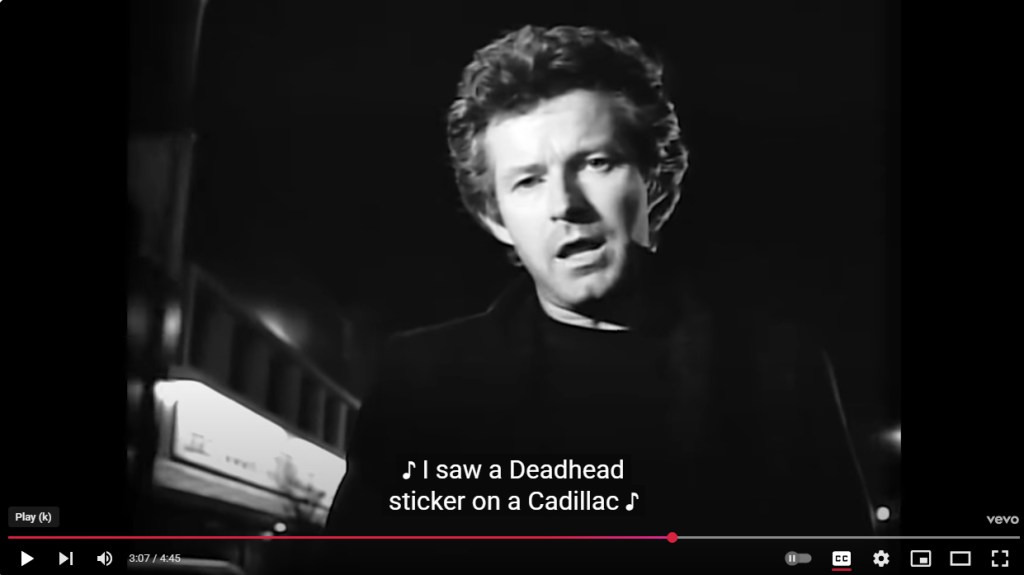
There’s a line in an old Don Henley song about seeing a “Deadhead” sticker on a Cadillac. That’s probably the best way to describe “Fluff Cowan.” He is a dedicated fan of The Grateful Dead, and his intersection of golf pragmatism and musical mysticism is what had him steering guys like Peter Jacobsen, Fred Couples, Jim Furyk, and “Tiger” toward fat-cat cars of their own.
The Moral of the Story:
The world is full of the unseen. Part of it includes legend, mysticism, and straight-up magic…and we all believe in it. If we didn’t, movies wouldn’t exist.
P.S. This was the final film featuring Jack Lemmon (#14 on my list of all-time favorite actors).
Got a question, comment, or just want to yell at us? Hit us up at dubsism@yahoo.com, @Dubsism on Twitter, or on our Pinterest, Tumblr, BlueSky, Truth Social, Instagram, or Facebook pages, and be sure to bookmark Dubsism.com so you don’t miss anything from the most interesting independent sports blog on the web.


I have yet to see this film but now I have to. And I love your moral of the story. You’re right. If we didn’t believe in magic, movies wouldn’t exist. I love that! 🙂
LikeLike
This looks like such a good film. Love the new look of the blog, by the way. 🙂
LikeLiked by 1 person