
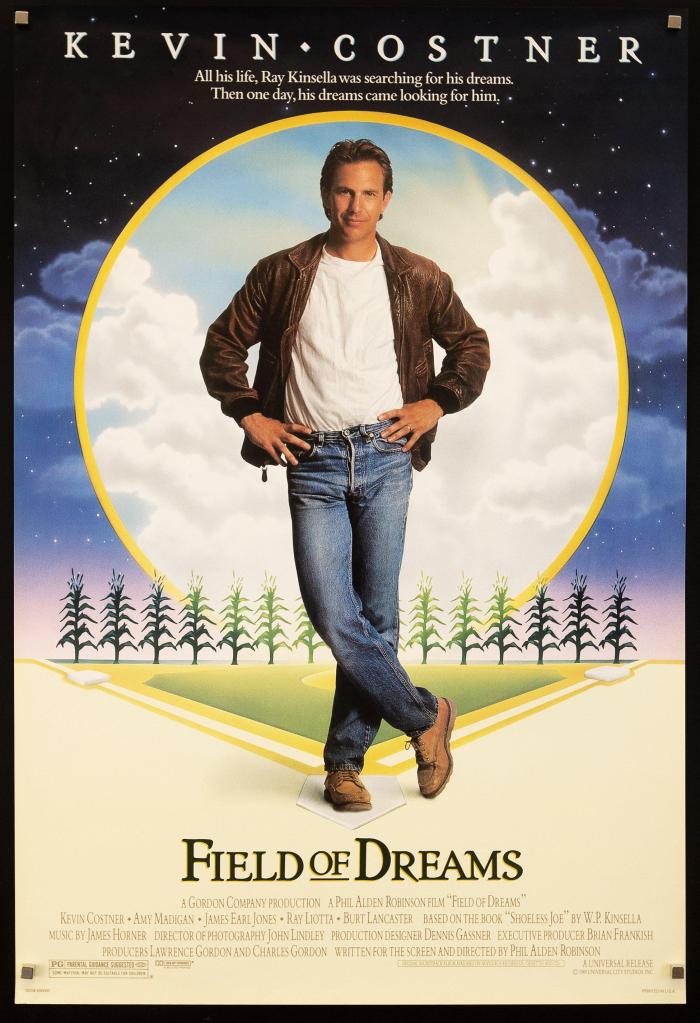
- Today’s Movie: Field of Dreams
- Year of Release: 1989
- Stars: Kevin Costner, James Earl Jones, Ray Liotta
- Director: Phil Alden Robinson
This movie is not on my list of essential films.
NOTE: This installment of Movies Everybody Loves That I Hate is being done as part of something called the Eighth So Bad Its Good Blog-a-Thon being hosted by Taking Up Room.
You can see all the contributors to this event here:
But it’s also squaring up a debt of one blog post owed by me since Taking Up Room also got even with me for a “Pick My Movie” tag.

That brings us to how Field of Dreams gets to be the subject of this double-header. I know about the legions of fans this movie has; it’s why they’ve turned the original field shown in the film into a tourist trap.
As the title of this post suggests, this movie makes Mrs. J-Dub’s brain bleed. For the record, I couldn’t agree more. That’s how we arrive at the assignment from Taking Up Room’s aforementioned tag. The challenge was to examine a sports movie that either never should have been made or is so flawed it offers endless opportunity for improvement.
In any event, there’s so many reasons why we both would rather gargle battery acid than sit through this movie again…although I suspect Mrs. J-Dub is curious about it’s “tourist trap.”
Reason #1) The Astonishing Lack of Attention to Detail
Mrs. J-Dub is far more forgiving about this sort of thing than I am, so when she starts grousing about “the little things” that can add up and ruin a movie, it’s safe to say it’s rife with flaws. Oddly enough, this isn’t about the usual nit-picking from baseball fans, but there is one such detail even she couldn’t overlook.
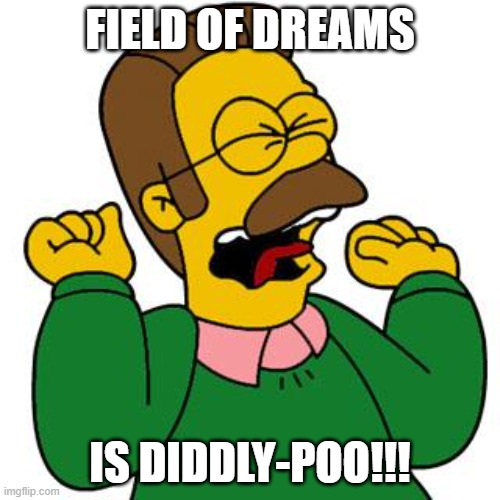
Mrs. J-Dub is militantly left-handed. She thinks Ned Flanders is an American hero for opening a specialty store for left-handed products. She also knows that “Shoeless” Joe Jackson was left-handed. She could overlook his being portrayed as an Italian with a New York accent rather than the barely-literate southerner he really was. What she couldn’t overlook was the fact they made “Shoeless” Joe a righty.
Once you whiff by that much, the other mistakes get magnified. A theme which runs throughout the film is Roy Kinsella’s (played by Kevin Costner) relationship with his father John. But once you notice John Kinsella is supposed to be in his 50s when Roy was born, but in the family photo, he’s not a day over 25.
From there, it’s not a big stretch to notice the sun both rises and sets and rises over left field in Roy’s ballpark. What is hard to believe is the idea that sacrificing 3 acres of crops can somehow bankrupt even a small family farm. Let’s be honest…if Roy’ farm is that close to the edge, he really shouldn’t be screwing around with a baseball diamond.
There is a boatload of that kind of nonsense in “Field of Dreams,” but I can let that stuff go in any movie if the story is good one and if it tells it well. The problem here is that “Field of Dreams” does a horrible job of telling the story…and to be honest, the story it wants to tell is terrible.
Reason #2) It Aged Like Milk

The first time I first saw Field of Dreams came on it’s original release in the spring of 1989. I hated it. Mrs. J-Dub’s introduction came a bit later, but we ended up in the same place.
Despite the difference in timing, we both agreed that our original screening of this movie happened before either of us graduated from college. That meant neither of us had life experiences yet to make us appreciate Roy’s struggles. Flash the clock forward to now…we’re both in our 50’s and have a completely changed perspective of what Roy’s really dealing with. The assumption is that because we’ve now experienced the themes intricately wound throughout this film; loss, grieving, and it’s power forcing reflection on regrets and the inherent wish of turning back the clock.
Not even fucking close.
Sorry, but this movie only connects with the sloppily sentimental and the emotionally wanting. Those are pretty good chords to hit since they obviously resonate with so many people. But neither Mrs. J-Dub or I fit that bill. The bottom line is in the nearly four decades since this film was foisted upon us, it’s managed to worm it’s way into the pantheon of American culture beyond being just a “baseball movie.”
But we still hated it.
We weren’t being myopic then, and we’re not wrong now. Other movies striking similar feels for soul-searching trips down memory lane (Stand By Me springs to mind) age like fine wine given the growth of age. But Field of Dreams went for cheese, and ended up just so much curdled milk.
Reason #3) It’s Really Just a Bunch of Nihilistic Crap

It’s not hard to find lists of “best baseball movies” ranking Field of Dreams at or near the top. Naturally, mine didn’t. Critics loved it, and so many fans share that sentiment, so I shudder at the thought of what this piece is going to do to our Inbox. Even mildly suggesting Field of Dreams is anything less than a time-honored national treasure will get crayons sharpened across the interwebz to berate us. I learned that lesson with another cinematic sacred cow called It’s A Wonderful Life, but that’s because they are both exercises in pure, uncut nihilism.
This is Mrs. J-Dub will proudly fly her colors as an English Lit major. She would point out emphatically this movie is built on a sell-job left undelivered. It’s all in it’s iconic signature line.
“”If you build it, he will come.”
~Field of Dreams
It shouldn’t take anybody perusing this blog long to figure out I’m a diseased-level sports fan. I’m a huge lover of baseball; of all people I understand the power of the schmaltz sold by the likes of Ken Burns, George Will, and Bob Costas. They peddle the days-gone-by when baseball was more than a sport, the “national pastime,” a leisurely-paced exercise in Americana played out on patches of earth made sacred by 90-foot lines of chalk.
Through sheer proximity, Mrs. J-Dub became a convert to the church of baseball, and that only intensified her disdain of this film.
“What total bullshit!”
~Mrs. J-Dub
The most powerful part of nostalgia is it’s “feel-good” nature powered by it’s oversight of the negative. There’s nothing wrong with the occasional backward glance, but trying to turn yesterday into today can only end in futility. Riding a crest of just such schmaltz, Field of Dreams plays on the power of yesteryear doing exactly that, twisting the commentary of old baseball writers pining for some “Golden Age” where nostalgia awash in sentiment and emotion overpowers reason by obfuscating the realities of today. This is where the splitting of the philosophical atom releases the power of evil. Man has an existential need to escape nihilism; which is why offering false hope is so sinister.
That’s Field of Dreams in a nutshell. It pulls at your heartstrings offering a meaningless illusion from the past as a useless solution to a problem today.
Reason #4) It Can’t Even Explain It’s Own Plot
It’s time to reveal the biggest fake-job in this movie; it isn’t about baseball at all. The real title should have been Ray’s Fucked Up Father Situation.
This might actually be the most universally appreciable aspect of Field of Dreams. If you had a problematic relationship with your father, you will immediately realize Ray Kinsella’s (played by Kevin Costner) true plight. If you were lucky enough to have had a healthy relationship with your father, you also will immediately realize Ray’s true plight.
He’s saddled with a script written by someone with no understanding of story-telling.
It should be fairly straight-forward. Ray Kinsella owns a struggling Iowa farm who one evening hears an ominous voice command…”If you build it, he will come.” Eventually we find out this is all about Ray’s relationship with his father which suffered a fatal blow when Roy bad-mouthed “Shoeless” Joe Jackson; a player his father idolized despite his being implicated in the “Black Sox” scandal. Now we all get stuffed into the cattle cars taking on all us Ray’s uninspiring emotional arc. Being a “Baby Boomer” who came of age in the 1960s, Ray has the sneering disrespect of all things authoritative endemic to that generation, particularly those who went off to college to be indoctrinated by dipshit professors as to what assholes their parents were.
That’s the foundation of Ray’s problem. He’s a typical teen-age kid who doesn’t get along with his baseball-loving father, John. The story-teller’s intention is to use baseball as an all-encompassing metaphor illustrating the disconnect between the two. As this just-shy-of-predictable “prodigal son” arc originates at Ray’s rejecting John’s beloved baseball, the true “slap in the face” was Ray’s calling “Shoeless” Joe Jackson a “criminal.” They never speak again, and John’s death seals them in silence.
Now the cattle cars roll with Ray on his self-induced “guilt-meets-regret” mind-warp as he starts having the delusions about voices commanding to build a baseball diamond. Here’s where you expect to be taken on a journey where Ray meanders through his own inner torments while they are resolved through the idea that building the baseball diamond will provide the magic needed for Ray to put closure on his failings with his father.
Instead, we watch while he razes part of his crop to build the field. But along the way, there’s so prattling on about how this will be financially catastrophic, it distracts from the very question it raises. Nobody ever asks how the hell can using such a small patch of land be so detrimental to a farm shown to be at least hundreds of acres?
Welcome to the problem. This movie spends so much time raising questions it doesn’t answer the main plot suffers because of it…not the least of which is you’re so close to bankruptcy, WHY ARE YOU FUCKING AROUND WITH A BASEBALL FIELD?!?!?
At this point, I should be right there with Ray in his moment of triumph as “Shoeless” Joe and the others emerge from the corn along with a young John Kinsella. But instead of being in the moment of rapprochement between father and son, I’m wondering how the hell we got here?
Mrs. J-Dub said the same thing. When you really think about it, you can’t help but realize the story-tellers here have done almost nothing to give any substance to Ray and John’s relationship despite the fact it literally drives the entire movie.
Not only that, the father-son-dynamic between Ray and John is the keystone for why anybody loves this movie. If somebody is ardently defending this film, start a stop watch. It won’t run longer that 30 seconds before they refer to their relationship with their father. Given enough latitude, they will make comparisons to that of Ray and John despite the fact the movie never nails down what the issue between them really is.
We’re supposed to buy this was all about something somebody said about a dead baseball player? Really?
Reason #5) What’s Really The Problem?
Short of the usual generational friction, the viewer really gets nothing on which to construct a theory as to why the relationship between Ray and John is strained.
Field of Dreams starts with a solid clue. John’s wife is killed in the opening montage, leaving him to raise baby Ray alone. That sure feels like that could be worth exploring; the loss of a wife and mother might loom a bit larger than baseball. But no…instead we are left holding the leaky bag believing this is all about baseball.
Let’s take a big leap and say baseball is just the vector through which the son’s rejection of the father’s values was discovered. If that’s true, then this movie is reduced to a pedantic exercise in Cool Hand Luke-style “failure to communicate.” Worse yet, that really leaves Field of Dreams as little more than the elevation of an old man’s dreams over those of the young.
If you think about it for more than half a second, you realize accepting that means understanding “it takes two to tango.” But we never really get to see John’s perspective as the movie only paves the road for Ray’s disrespect of his father’s values. Anybody whose had a bad relationship with their father knows that’s almost always a two-way street. The problem is we never get to see the things which were important to Ray that John rejected?
That expands on the failure in Reason #4. Without that perspective, Ray becomes the protagonist nobody roots for. He drops into that same aforementioned bucket for college-educated “Baby Boomers” who became entitled pains-in-the-ass. At no point do we ever get the idea that John ever rained on Ray’s values, yet there’s a clear one-sided lack of respect shown by Ray toward his father.
To me, that’s emblematic of Ray’s 1960s idealism…everything is about him. That’s why despite the fact at the rime he hears the voices, despite all the caterwauling about how this will destroy his family’s life, he still plows his farm under, repudiates everything he stood for, and risks his family’s financial security all for his own sense of satisfaction.
But the most damning example is when Ray mocks his own idealism when it’s shown by his wife Annie (played by Amy Madigan). Her big moment in the film comes when she stands up to some wanna-be censors at a local school board meeting. In general, the scene treats Annie as a low-IQ and unhinged caricature.
But even Ray dismisses Annie in her own moment of triumph. While she’s sharing her excitement…this may have been the first time in years that her youthful, activist fire had been lit…he cuts her off changing the subject to the voices he heard. On top of all that, Ray wants us all to believe that complex and unresolved issues with your late father can all be resolved solely through baseball and a game of catch.
The real problem: Ray is a dick.
Reason #6) The Sloppily Constructed Political Statement
In his defense, Ray Kinsella is the typical 1960s liberal dipshit; meaning that he loves himself a politically-charged black writer. Enter the reclusive author Terence Mann (played by James Earl Jones). This guy is a well-spring of the cheap platitudes guys like Ray swallow wholeheartedly.
First off, Mann is the toilet paper roll the baseball hacks who love this movie wrap themselves in. The genesis of that idolatry comes from his mini-monologue in another signature scene.
“The one constant through all the years, Ray, has been baseball. America has rolled by like an army of steamrollers. It’s been erased like a blackboard, rebuilt, and erased again. But baseball has marked the time. This field, this game, it’s a part of our past, Ray. It reminds us of all that once was good, and it could be again.”
~Terrance Mann
That’s the perfect sort of pablum that empty souls like Ray Kinsella fill themselves with because they think it means something. Frankly, I have no idea what the hell he’s talking about.
Considering the “Terence Mann” character is purported to be a Dick Gregory-ish 1960s activist whose push for social change was so radical that an Iowa school wants to ban his books, I don’t get where his waxing nostalgic for Major League Baseball’s segregated era comes from. Moreover, he shares Ray’s warped vision of a baseball cornfield from beyond the grave. But the most confusing thing about Mann is in that last sentence; one that could have come straight from a Donald Trump “Make America Great Again” speech.
It’s no surprise Terrence Mann is jumble of mixed messages. In the original novel which served as the basis of this film, the “reclusive author” was supposed to be J.D. Salinger. The producers wanted nothing to do with even the mention of Salinger as the keepers of his estate are notoriously litigious. As a replacement, the character of Terrance Mann was created.
But this created another problem. The more racially-tinged the movie became, the more that would overshadow the main plot. The solution was to make the originally “Black Panther-adjacent” Mann’s platitudes a hybrid of quasi-progressive slop disguised with pseudo-religious overtones. That’s why after Ray tells Terrance about the “Shoeless Joe” fight with his father, Terrance calls Ray’s endeavor with the baseball field his “penance.”
I understand side-stepping the landmines of racism, but if you’re going to do that, maybe don’t introduce Terrance Mann with a soliloquy about Jackie Robinson being his hero. In other words, don’t pump up the tires if you’re not going to ride the bike.
But Terrance Mann’s wishy-washiness represents much more than just another of this movie’s failing to deliver on expectations. His “hybrid” nature re-enforces the nihilism in this film by pulling the rug out from under Ray’s idealism…as misguided as it may be. Being portrayed as a writer at the vanguard of 1960s progressivism set the expectation that Mann has insightful observations on the human condition. But by the end of the film, all he really delivers is more nihilism; it’s almost like a dark prediction. When Mann stars his rant about selling nostalgia and it’s “restorative power” at $20 a pop to Americans looking for a respite from reality. Not only is he describing exactly what this movie was doing, it foreshadows that damn tourist trap town.
Reason #7) The Type-Casting of James Earl Jones
In the initial installment in this series, I introduced you to a phenomenon I call “reverse typecasting.” This happens when when you see an actor who played a role in something which became part of this country’s cultural fabric, and even when you see them in something made before their face became associated with an iconic character, that’s all you can see.
In this case, it’s more like all you can hear. Those of us of a certain age immediately associate James Earl Jones’ voice with that of Darth Vader. But if you look at his IMDB page, he’s in a ton of stuff. He’s in just about as many good things as bad…if you stick to the most recognizable titles.
| Good James Earl Jones Movies | Bad James Earl Jones Movies |
| Dr. Strangelove | The Bingo Long Traveling All-Stars & Motor Kings |
| The Great White Hope | Claudine |
| Most of the “Darth Vader” Voice stuff | The Last Remake of Beau Geste |
| Coming To America | Conan the Barbarian |
| The Hunt for Red October | Soul Man |
| Matewan | Field of Dreams |
| The Sandlot | Patriot Games |
| Naked Gun 33 1/3: The Final Insult | |
| Clear and Present Danger |
Having said that…now is as good a time as any to address this. James Earl Jones is one of the most over-rated actors ever. Don’t get we wrong, I always liked his work, but when he passed away in 2024, there were people who wanted to put him in the same class as Sir Laurence Olivier.
That’s a reach…
To be fair, Sir Larry made a lot of crap at the end of career, but what tips the scale is JEJ’s IMDB page again. When you scroll it, you will see a gargantuan number of “made for TV” movies. Let’s be honest, that phrase almost automatically means “terrible.”
That also makes the comparison invalid. Sir Larry was winning Academy Awards for playing Hamlet; JEJ was winning a Daytime Emmy for a children’s special.
8 ) Burt Lancaster went out on this?!?
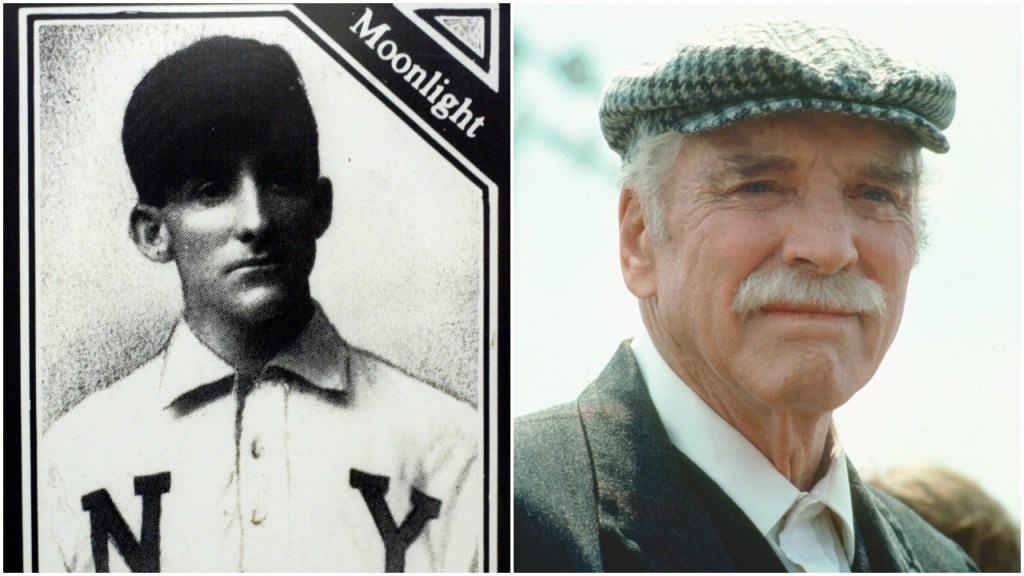
Speaking of actors better than James Earl Jones, this film marks the swan song for Burt Lancaster. It’s just a goddamn shame the career of a man who brought us Oscar-worthy performances in classics like Elmer Gantry, From Here To Eternity, and Gunfight at the O.K. Corral made his final big-screen appearance in this cinematic strike-out.
A great actor going out in an awful movie is one thing, but what makes it worse is his character has no reason to exist. Moonlight Graham is ham-handedly shoved into the plot only to provide validation for Ray’s vision which has already been provided by Terrance Mann. Moreover, we all know by now that validation gets cemented when the ballplayers appear. Can you imagine how much more nihilistic this film gets if Ray builds the diamond and they don’t come?
Script scuttlebutt has it Graham is based on a real person who played one game in the major leagues, didn’t get a chance to hit, and left the game to become a doctor. He also tells Ray about his own falling-out with his father over the Black Sox, after which they all head back to Iowa.
Guess what happens? Graham finally gets a chance to bat against the big leaguers on Ray’s field. And for more nihilism, Graham gets his chance at the plate, but he hits a sacrifice fly, which still doesn’t count as an official at-bat…even on a Field of Dreams.
9) The Overpowering Hypocrisy
After all that, you might think there can’t be a bigger eye-roll left in this movie. You’d be wrong. also find out from Just wait until you get to the part where “Shoeless Joe” tells us the Black Sox won’t let the ghost of Ty Cobb play because he was “a bad guy.”
Forget that Ty Cobb wasn’t a member of the Black Sox and really wouldn’t have a reason to be there. Instead, you’ll want to duct-tape your eyeballs in place so they don’t roll right of your head at the idea of a bunch of guys convicted of several federal crimes, committed God-only-knows how many more, and nearly destroyed the entire sport of baseball passing judgement on anybody.
Conclusion:
As I’ve said, I love baseball and I won Mrs. J-Dub over to being a convert to the National Pastime. As such, we’ve both been through that narrative convincing us that baseball is an ethereal escape which somehow pierces our individual souls to connect us all in a collective zeitgeist driven by an enlightenment shining on a deeper view of the mysteries life.
That is the foundation upon which Field of Dreams rests. But it fails to build from there because it gets lost in it’s own over-romanticization. That’s exactly why this movie only connects with the sloppily sentimental and the emotionally wanting. Those are the same people with a pathological need to live in the past, and the only thing that can be accomplished by such misguided nostalgia is to screw up the present.
Welcome to the real message behind this nihilistic crap-fest.
The Gene Rayburn Memorial Poll
You can see all the movies we hate here.
Got a question, comment, or just want to yell at us? Hit us up at dubsism@yahoo.com, @Dubsism on Twitter, or on our Pinterest, Tumblr, Instagram, or Facebook pages, and be sure to bookmark Dubsism.com so you don’t miss anything from the most interesting independent sports blog on the web.

 Dubsism
[…] J-Dub of Dubsism combines So Bad It’s Good and the Pick My Movie Tag with a look at Field of Dreams. […]
LikeLike
Some of that rings true. But I have to be honest, most of my dislike for Field of Dreams is that I just can’t stand Kevin Costner, and then there’s that hippie can’t we all just get along vibe from Amy Madigan’s character. Where is Loretta Castorini when you need her?
LikeLiked by 1 person
A-freakin’-men, brother…
LikeLike
Glad I am not the only one who doesn’t love this movie. The one time I saw it, I thought, what is all the fuss all about.
LikeLiked by 1 person
Poor Burt Lancaster as you say, even signing up for The Love Boat would have been a better swan song. Possibly… And good to see the word foisted in so many of these so bad it’s good entries this year. Beginning to think this word should be used a blogathon topic all on its own..
LikeLike
At least on the Love Boat, he might have got to score (wink, nudge)
LikeLiked by 1 person
Well played, Dubs!
LikeLike
I have never seen Field of Dreams because I assumed it would make me puke. After your hysterical review, I think my assumption was correct.
LikeLike
Great stomachs think alike.
LikeLike
Nice. Samuel L. Jackson’s career may also be falling into the James Earl Jones category.
LikeLiked by 1 person
That’s a really good call…
LikeLike
I wanted to love Field of Dreams when I saw it, but I found it deeply dissatisfying. As you pointed out, it raises a lot of unanswered questions. I loved the idea of the baseball players emerging from the cornfield, but the movie overall didn’t do justice to that concept. It should have done better.
I agree 100% with your review.
LikeLike
You could easily do an entire post on ways this movie could have been improved…
LikeLiked by 1 person
Interesting choice for the blogathon. Like most people, I fell in love with Field of Dreams when it first came out. I even bought the DVD as soon as it was released, but never actually watched it. Two years ago, during an ’80s movie marathon, I finally decided to revisit it, and to my shock, I ended up disliking it so much. Beyond being corny and cheesy, the film just doesn’t work: it’s badly written, poorly paced, and full of clichés. I couldn’t believe I once loved this movie.
LikeLike
HI J Dub
This post made my night! Hilarious laugh out loud moments!
I ma never want to see Field of Dreams now- I’m not super big on kevin costner, never got the hype. But Ive never had the desire to watch this movie.
Poor Burt Lancaster- and I say this as not a big fan of Burt Lancaster! Sometimes you can’t choose your final role!
LikeLike
I hope my comment went though!
If not
Poor Burt Lancaster. I feel sorry for Burt and I’m not even a super fan!
I may never want to see this film, so far I’ve never wanted to, I don’t see it changing
This post made my night! SERIOUSLY LOL passages
LikeLike
PS LOVE how you and the MRS BOTH hate this movie!!
LikeLike
Dude. This is a blogging masterstroke, and I am tipping my hat to both you and Mrs. J-Dub. Field of Dreams rubbed me the wrong way when I saw it in middle school, but I couldn’t explain why and didn’t want to see it again. Now I think i know why. It’s crappy writing pretending to be brain-y. Thanks again for this post and for joining the blogathon! 🙂
LikeLiked by 1 person