

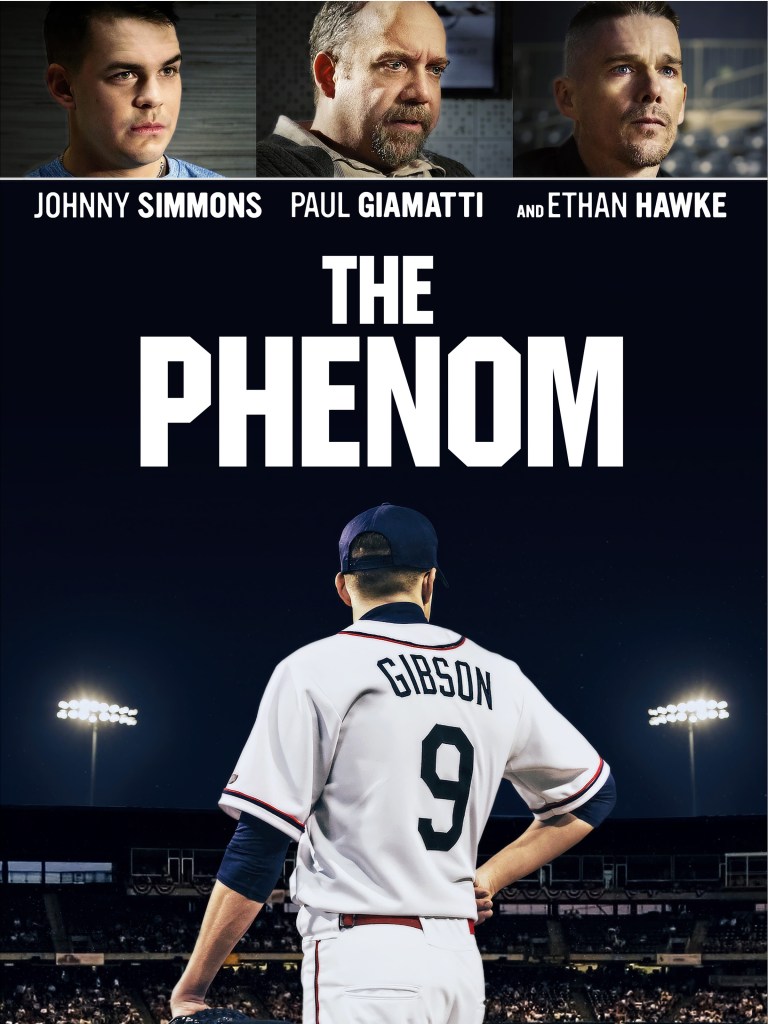
- Today’s Movie: The Phenom
- Year of Release: 2016
- Stars: Johnny Simmons, Paul Giamatti, Ethan Hawke
- Director: Noah Buschel
This movie is not on my list of essential films.
NOTE: This installment of Sports Analaogies Hidden in Classic Movies is not being done as just part of a blog-a-thon. Instead, this is a monthly event hosted by MovieRob called Genre Grandeur. The way it works is every month MovieRob chooses a film blogger to pick a topic and a movie to write about, then also picks a movie for himself to review. At the end of the month, MovieRob posts the reviews of all the participants.
For July of 2026, the honor of being the “guest picker” went to yours truly, and the topic I picked was “Movies About Baseball.”
The Story:
Baseball is all about streaks. Joe DiMaggio’s 56-game hitting streak, Orel Hershiser’s 59 scoreless innings streak, or the feat of hitting home runs in eight straight games as done by Dale Long, Don Mattingly, and Ken Griffey, Jr. are all the stuff of legend. But not all streaks are a good thing as this film explores.
The Phenom is a serious departure from the traditional “baseball” movie. In fact, there’s very little baseball in it. It’s the photo-negative of A League of Their Own‘s signature line “There’s no crying in baseball!” in it’s exploration of sports psychology. Take Robert Redford’s Ordinary People and make it about Roy Hobbs from The Natural and you’re getting close.
The film opens with young pitching phenom Hopper Gibson (played by Johnny Simmons) talking about having thrown five wild pitches in a row in his last game. In no time it all, the viewer is in the guts of this film; a series of in-depth therapy sessions between Hopper and sports psychologist Dr. Mobley (played by Paul Giamatti). As Mobley probes into Hopper’s life, the impact of certain relationships on his psyche become evident.
There’s a great deal of juxtaposition between the therapist’s couch and Hopper’s baseball exploits; at one point he was the #3 high school pitching prospect in the nation. That “back and forth” forms the saw which cuts the deeper view into Hopper’s head.
Once inside, those impacts are viewed through a series of conversations between Hooper and those doing the impacting. There’s his supportive coach Scott Borwitz (played by Paul Adelstein), his long-suffering mother Susan (played now Alison Elliott), and his intellectual girlfriend Dorothy (played by Sophie Kennedy Clark). However, none of these play as large a role in the mind of the faltering player as does the incredibly dysfunctional relationship with his abusive father, Hopper Sr. (played by Ethan Hawke).
Hopper Sr. is the textbook case of his son’s success colliding with his own failure as a ballplayer; creating the father’s warped idea he can recognize greatness because he understands failure. That distorted view leads to his enforcing of inviolate “rules” in his attempt to keep his son from making his own journey from ballplayer to petty criminal.
This is dramatized in the initial scene between father and son. One of the “rules” is to never show emotion during a game. When the son does exactly that, the father angrily throws a beer can at his head and makes him run “suicides” in the driveway. This type of abuse lingers throughout the film; ultimately becoming the main vector showing the source of Hopper Jr.’s emotional numbness, it’s dampening effects on his personal relationships, and how the life of a sought-after sports star can still be one of trauma and loneliness.
Because this film is more Ordinary People theatric than legend-disguised-as-baseball The Natural, there’s no rousing, big-game finale one would expect from a sports movie. Instead, there’s just the sense of all our everyday struggles.
The Hidden Sports Analogy:
Throwing the ball is an essential skill for every baseball player, not just the pitchers. Obviously, anybody who makes it to the major leagues has mastered the physical act of throwing. So, when that ability suddenly leaves, there has to be another reason. It’s actually common enough the have it’s own name: The Yips.
Baseball history is so full of famous cases, there has to be more reasons for it than simply having an asshole for a father. Here’s some of the more memorable cases…
Rick Ankiel
Rick Ankiel is the case which most closely resembles Hopper Gibson, Jr. Ankiel was a star pitching prospect for the St. Louis Cardinals who had a dramatic flame-out on live television during the 2000 play-offs. Just like Gibson, Ankiel air-mailed five wild pitches in that game. Eventually, his wildness ended his career as a pitcher, but he made a comeback as an outfielder.
Steve Blass
Steve Blass’ case was so profound he’s the namesake; The Yips are widely known as “Steve Blass Disease.” Blass notched two seasons with 18-plus wins, won his two starts (including Game 7) in the Pirates’ 1971 World Series triumph, and was selected to the 1972 All-Star Game. But in 1973, the wheels came off. Blass lost his control to the tune of walking 84 batters across 88 2/3 innings with a bloated 9.85 Earned Run Average. Eventually, the Pirates had no choice but to send Blass back to the minors.
Jon Lester
Jon Lester was a top-level major league pitcher. He had impeccable command of the strike zone, but he had a complete inability to make routine throws to first base. He avoided pick-off attempts at all costs, eventually having to alter his time between pitches to confuse baserunners.
Matt Garza
Garza and Lester shared the same strain of The Yips. Garza was solid big-league pitcher i the 2010s, but opposing hitter routinely bunted against shim knowing he was likely to throw the ball right past first base.
Chuck Knoblauch
Chuck Knoblauch is the classic case of karma. The 1991 Rookie of the Year and World Series winner was a perennial All-Star second baseman with the Minnesota Twins. When he he was traded to the New York Yankees, he burned bridges by bad-mouthing both the Twins and their fans.
Coincidentally, his ability to throw the ball to first base didn’t follow him. After a stretch of such errant throws, including one that hit ESPN SportsCenter anchor Keith Olbermann’s mother in the head, the Yankees were forced to move Knoblauch to left field.
Also coincidentally, this move came before the Yanks went on the road to Minnesota. Putting “Knobby” in the outfield meant he was well with in range of Twins fans who did not share his affliction…who pelted him with everything from coins, half-eaten hot dogs, and various beverage containers.
Steve Sax
Like Knoblauch, Sax won the Rookie of the Year award and World Series winner early in his career, then suddenly forgot how to throw the ball to first base. He inexplicably committed 30 such errors in 1983, prompting the coining of the term “Steve Sax Syndrome” as “Steve Blass Disease” for infielders.
Mark Wohlers
Mark Wohlers was easily one of them most dominant closers of the mid-1990; a virtually unhittable fastball being the primary weapon in his arsenal. But in 1998, those fastball tarted sailing wider and wider from the strike zone to the tune of an astronomical 33 walks and 7 wild pitches in only 20 1/3 innings pitched. Naturally, this got him sent back to the minors where recovered to a point, but never recovered his dominating form.
Jarrod Saltalamacchia
Pitchers are the only group who throw the ball mor than do catchers. That means catchers get The Yips almost as much as pitchers do. Not only was Jarrod Saltalamacchia saddled with the longest name in the bigs, he developed a complete block for throwing the ball back to the pitcher. After a trip to Triple-A and some couch time with a sports psychologist, “Salty” got back to the major leagues as important part of the 2013 World Series champion Boston Red Sox.
Mackey Sasser
Before “Salty,” there was Sasser. Mackey Sasser was catcher for the New York Mets who 1989 was plagued with the same issue. Every throw to the mound was an adventure. The problem was clearly visible. Sasser had a “stutter” in his arm; pump-faking several times before he could actually release the ball.
Dave Engel
In 1985, Engle was a part-time designated and bench catcher for the Minnesota Twins. He was sinking down the depth chart because he too couldn’t get the ball back to the pitcher. He could only lollipop-lob the ball back or run in back to the mound, a habit opposing base runners loved. Engle claimed to have an issue with his shoulder, but several exams found nothing. At the time Twins’ manager Billy Gardner said “Hopefully, it’s just muscles in his shoulder and not a problem with his head.”
The Moral of the Story:
Don’t be a dick to your kids.
Got a question, comment, or just want to yell at us? Hit us up at dubsism@yahoo.com, @Dubsism on Twitter, or on our Pinterest, Tumblr, BlueSky, Truth Social, Instagram, or Facebook pages, and be sure to bookmark Dubsism.com so you don’t miss anything from the most interesting independent sports blog on the web.


The Rick Ankiel comparison really puts the movie in perspective. It’s crazy how something so physical can suddenly become completely mental.
LikeLike